Transaction Advisory, Oil & Gas

March 17, 2020

Energy Valuations: Freefall Into Bankruptcy Or Is This Time Different?

This post originally appeared on Forbes.com on Monday, March 9, 2020. Energy valuations are taking an epic pummeling. Considering declining demand amid COVID-19 concerns, the initial fallout to the Saudi-Russia feud was predictable. Within hours, prices had dropped like an anchor (to $33 a barrel as of this morning). Several companies have already announced cutbacks, including Diamondback Energy, as they dropped two additional drilling crews. Parsley Energy made a similar announcement and more are sure to follow. Perhaps even more draconian, SM Energy’s unsecured bonds fell to $0.42 on the dollar and pushed the yield up to around 25%. These bonds traded above $0.90 as recently as February 24th. Trading has been halted this morning amid the panic. Whether the market fallout has hit rock bottom remains to be seen. Regardless of what Russia may have been thinking, the geopolitical climate has put more pressure on U.S. producers and bankers. Operators who were contemplating hedging production at $50 per barrel but waiting to act are kicking themselves today. Energy and related bankruptcies that were estimated to rise in 2020 will likely accelerate a few notches. According to Haynes and Boone’s Oilfield Services Bankruptcy Tracker, there were six (6) new bankruptcies in the oilfield services area in the fourth quarter of 2019. Up until this point in 2020, Pioneer Energy Services is the only major oilfield services company to enter Chapter 11 bankruptcy. That’s almost undoubtedly going to change soon. As upstream companies have vowed to spend within their cash flow, oilfield services will take the biggest brunt of this at first. However, producers with high leverage capital structures could quickly follow. Gas prices have held their ground but they’re so low anyway, it’s hard to know how much lower they could go.

Can Banks Hold On?

The looming factor for companies is how banks will go about determining borrowing bases this year. It’s a tough position to be in at this point. Bankers at the Hart Energy Capital Conference in Dallas last week did their best to portray patience towards the upstream sector, but were also clear about expectations. Those expectations were that borrowers can meet their obligations, and that borrowing bases will shrink with valuations. One of the speakers, Tom Petrie, expressed concern about $110 billion in debt coming due in the next decade for the energy market.

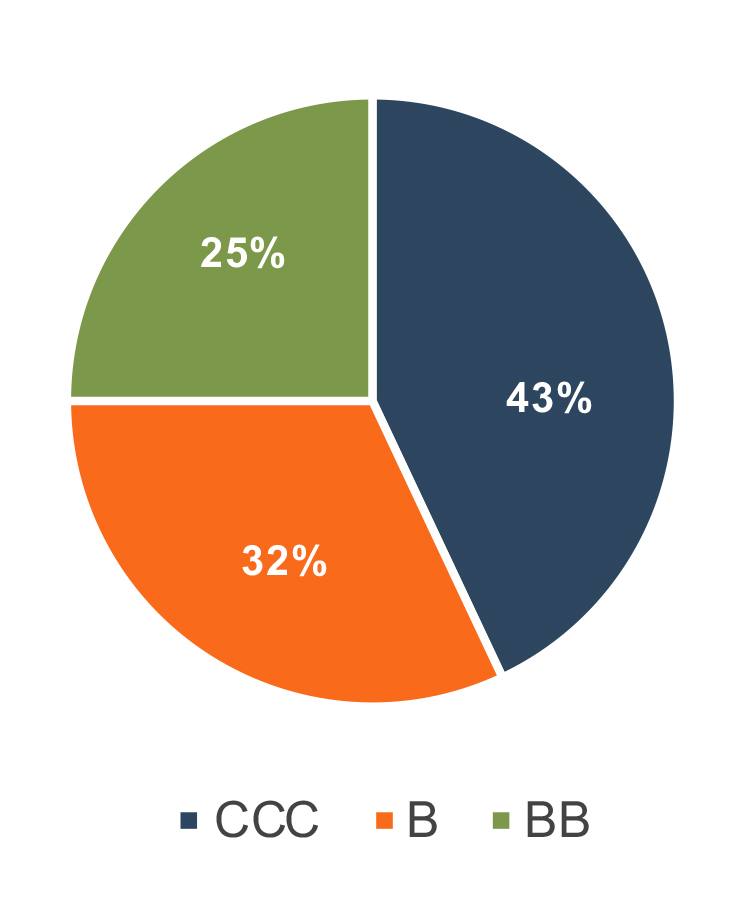
As working interest values for producing interests dive, the expected returns have changed from PV10 to closer to PV20. This has degraded credit quality. The mix of below-investment grade debt has worsened in the past year. In high yield markets, CCC or below is the most common rating according to some recent data.

High Yield Debt Rating Mix
SOURCE: JP MORGAN CORPORATE ENERGY & POWER PRESENTATION


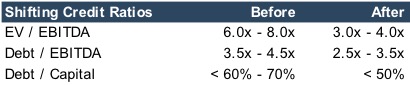
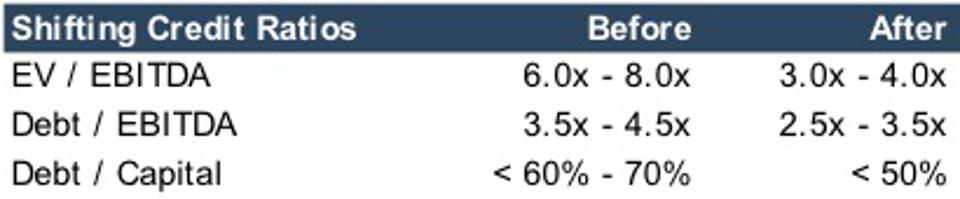
Even if bankers lending on reserves maintain their lending ratios, the borrowing bases will shrink accordingly. However, based on recent indications, lending ratios have and will continue to shrink alongside values. Debt-to-EBITDA ratios which used to often float in the 3.5x to 4.5x range are now, not surprisingly, in the 2.5x to 3.5x range. Enterprise values for upstream producers were often between 6.0x to 8.0x EBITDA too. That is in the past.

Shifting Credit Ratios
SOURCE: OCC GUIDELINES AND AMEGY BANK PRESENTATION


Impacts appear bad and immediate. However, this plunge could, ironically, buy the market a little more time. The founder of OnyxPoint Global Management, L.P., Shaia Hosseinzadeh, told Bloomberg just last week that “Things are so bad now, that the banks can kick the can down the road and say ‘there’s no point of rushing everybody into bankruptcy, we’ll wait until October.’ But if it’s business as usual, it’s going to be a horror show.” That may be a prescient thought. Another consideration is that fewer banks are even lending to energy companies anymore. The rise of the environmental, social, and governance (“ESG”) movement, alongside weak returns, have pushed many bankers and other investors out of the space. There isn’t as much capital to go around, not that it’s cheaply available right now anyway.

Due to valuations being so low, the recovery for bankers coming out of Chapter 7 situations may be less attractive, especially on the oilfield service side. The market value of intangible assets is so depressed compared to other times in the commodity cycle, that it may not make economic sense to rush into the process for some.

Can Values Recover?

This prognostication about delayed bank behavior may be a moot point if liquids values can’t recoup over time. This is an undercurrent that has been a factor in keeping values down recently. Electrification trends and the idea that liquids demand will wane have proffered the notion that demand for liquids will be flat to even shrinking in the future, all while supply becomes bountiful. Some project the electrical passenger car trends to reach around 20% by the end of this decade. However, while the short-term appears bleak, many projections about the medium- and longer-term remain more optimistic for upstream producers and servicers. J.P. Morgan Cazenove recently suggested that the oil industry may be under-equipped to meet demand recovery in 2021 and beyond. Another way of putting that is downward pressure on prices could be its own cure in the medium term. Capex budgets have been slashed and continue to be. Over 200 oil drilling rigs (and counting) have been shut down in the past six months. Production will suffer, even with drilling and production efficiencies achieved in recent years. Especially in the U.S. shale markets, declines on existing wells drop off so fast, that their effect on supply will show up sooner rather than later.

Producers are hopeful for this. Regardless of the market’s relentless pounding down on reserve values, producers know that, particularly proven reserves are next year’s production. They do not want to sell or unload them for the pennies on the dollar (or less) that implied valuation multiples suggest right now. Intrinsically, they have much more value than inferred by market capitalizations. Management teams believe that enterprise values shouldn’t be trading at a fraction of PV10 values over a long period of time. At a minimum, many producers believe there is an optionality to their future drilling inventory.

The question remains, could that happen fast enough to save a bankruptcy slog this year? Only time will tell.


Continue Reading

Mineral Aggregator Valuation Multiples Study Released-Data as of 03-10-2026
Mineral Aggregator Valuation Multiples Study Released

With Market Data as of March 10, 2026

Mercer Capital has thoughtfully analyzed the corporate and capital structures of the publicly traded mineral aggregators to derive meaningful indications of enterprise value. We have also calculated valuation multiples based on a variety of metrics, including distributions and reserves, as well as earnings and production on both a historical and forward-looking basis.
Themes from the Q4 2025 Energy Earnings Calls
Fourth quarter 2025 earnings calls suggest an industry preparing for a transitional 2026, emphasizing organic inventory expansion, structural natural gas demand growth, and tightening service market fundamentals. Management teams appear focused less on short-term volatility and more on positioning for the next upcycle.
NAPE Summit 2026: Dealmaking at the Crossroads of Molecules, Electrons, and Minerals
Mercer Capital joined industry leaders at the 2026 NAPE Summit (NAPE Expo), held February 18th to 20th, at the George R. Brown Convention Center in Houston, Texas. As with prior Expos, NAPE delivered a focused marketplace where conversations move quickly from “nice to meet you” to “what would it take to get this done?” This year, Bryce Erickson and David Smith represented Mercer Capital on the expo floor and across the conference programming, meeting with operators, minerals groups, capital providers, and advisors.If there was one defining characteristic of NAPE 2026, it was convergence. The industry’s traditional center of gravity, upstream oil and gas dealmaking, was still very much present. But the surrounding ecosystem is widening, as programming incorporated adjacent (and increasingly intertwined) sectors. The hubs for 2026, included Offshore, Data Centers, and Critical Minerals, as part of an event lineup designed to broaden the deal flow and participant mix. Below are our key takeaways from the conference, with a tour through the hub sessions and the themes that were emphasized.The Hub Sessions Told a Clear Story: Energy Is Becoming a Multi-Asset PortfolioThe 2026 NAPE hubs provided a useful lens into where capital is flowing and how industry priorities are evolving. This year’s programming demonstrated a market that still values traditional upstream opportunities, while increasingly integrating adjacent and emerging sectors into the broader deal landscape.Prospect Preview Hub: Showcasing OpportunitiesNAPE’s Prospect Preview Hub once again served as a platform for exhibitors to showcase available prospects on the expo floor, providing concise overviews of their technical merits and commercial potential. Presenters framed their investment thesis in a narrative that reflects how assets are marketed in a competitive transaction environment.Minerals & NonOp Hub: Strategies and TrendsThe Minerals & NonOp Hub discussions focused on market trends, financing strategies, and technology-driven approaches to sourcing and managing acquisition opportunities. Presentations in this hub addressed strategies, recent trends, technologies, and related developments.Offshore Hub: Long-Cycle Capital with Global ImplicationThe Offshore Hub highlighted exploration frontiers, development innovation, and the broader geopolitical context influencing offshore investment. Particular emphasis was placed on high-potential offshore regions, navigating environmental and regulatory frameworks, supply-demand trends, and the role of offshore energy in the global energy mix. Offshore projects require significant upfront investment and longer development timelines, which heighten sensitivity to regulatory stability, cost control, and commodity price outlook assumptions. In this sense, offshore dealmaking underscores how long-cycle assets must be evaluated differently from shorter-cycle onshore plays.Renewable Energy Hub: An Integrated FrameworkThe Renewable Energy Hub reflected an industry increasingly focused on integration rather than segmentation. Presentations centered on integrating renewables with traditional energy sources, hybrid project models, sustainability pathways with a focus on technology, and strategies for navigating evolving energy markets. Rather than viewing renewables as a standalone vertical, participants frequently discussed how renewable assets fit within broader portfolios that include natural gas, storage, and transmission infrastructure.Critical Minerals Hub: Supply Chain Strategy Comes to the ForefrontThe Critical Minerals Hub emphasized the strategic importance of minerals such as lithium, cobalt, rare earth elements, and graphite within evolving energy supply chains. The three sessions - Exploration/Development, Market Dynamics, and Sustainability/Innovation - featured presentations focused on resource development pathways, supply chain positioning, sourcing practices, and recycling technologies. Unlike traditional upstream projects, critical mineral investments often face unique permitting, processing, and geopolitical risks. As capital flows into the space, differentiation increasingly depends on technical credibility and downstream integration potential.Data Center Hub: Power Demand Is Now a First-Order VariableThe Data Center Hub positioned data centers as a critical component of the global economy, emphasizing the sector’s immense and growing energy needs and the resulting opportunities for collaboration between energy and technology stakeholders. Sessions addressed (i) structuring power supply, interconnection, and grid compliance, (ii) managing data center development risk, and (iii) how rising energy demands impact data center development.In practical terms, this emerged in two ways. First, site selection and power availability are increasingly central to “deal conversations.” Co-location strategies, generation capacity, transmission access, and long-term power contracting are becoming key underwriting considerations. Second, infrastructure constraints are entering valuation frameworks. Power availability, interconnection queues, permitting timelines, and fuel optionality are no longer secondary factors; they directly influence project timing, risk, and expected returns.Our Takeaways: What We Heard Repeatedly on the FloorAcross hub sessions and meetings, three themes came up again and again:Infrastructure constraints are turning into valuation drivers. Power, pipelines, processing, and permitting are not background details—they’re often the gating items that shape cash flow timing, risk, and ultimate marketability.The market is hungry for clarity. Whether the topic is policy, commodity outlook, or capital availability, counterparties are placing a premium on deals with understandable risks and executable paths.Energy dealmaking is becoming “multi-asset” by default. Even when the transaction is traditional upstream, the conversation increasingly touches power, infrastructure, data, or minerals adjacency.Final ThoughtsMercer Capital has long valued NAPE as an event where real deal conversations happen and where shifting industry priorities can be identified early on. As the lines between upstream, infrastructure, power, and emerging energy/minerals continue to blur, independent valuation and transaction advisory services become even more important, since the hardest part isn’t building a model, it’s choosing the right assumptions.We have assisted many clients with various valuation needs in the upstream oil and gas space for both conventional and unconventional plays in North America and around the world. Contact a Mercer Capital professional to discuss your needs in confidence and learn more about how we can help you succeed.

Cart

Your cart is empty