
Key Takeaways
Sales volumes stabilized, but growth remains constrained
December showed modest sequential improvement, pushing full-year 2025 industry sales above 16 million units for the first time since 2019. However, year-over-year declines persisted through Q4, reflecting affordability pressure, tariff-driven pricing, and the post-EV-credit demand hangover—suggesting volume stability, not a strong growth cycle, heading into 2026.Inventory discipline is becoming a key separator of franchise value
Days’ supply trends underscore that brand-level inventory management matters more than industry averages. OEMs with tighter control (e.g., Toyota and Lexus) continue to support dealer margins and working capital, while brands carrying elevated inventory face margin compression and increased incentive reliance—an important consideration in dealership valuation and performance analysis.Profitability continues to normalize despite higher prices
Transaction prices rose modestly year over year, but increased incentive spending and competitive pressure are driving per-unit profits lower. While dealer profitability remains above historical norms, the downward trend exiting 2025 reinforces the need for disciplined operations, brand selection, and cost control as the industry adjusts to a lower-margin environment in 2026.
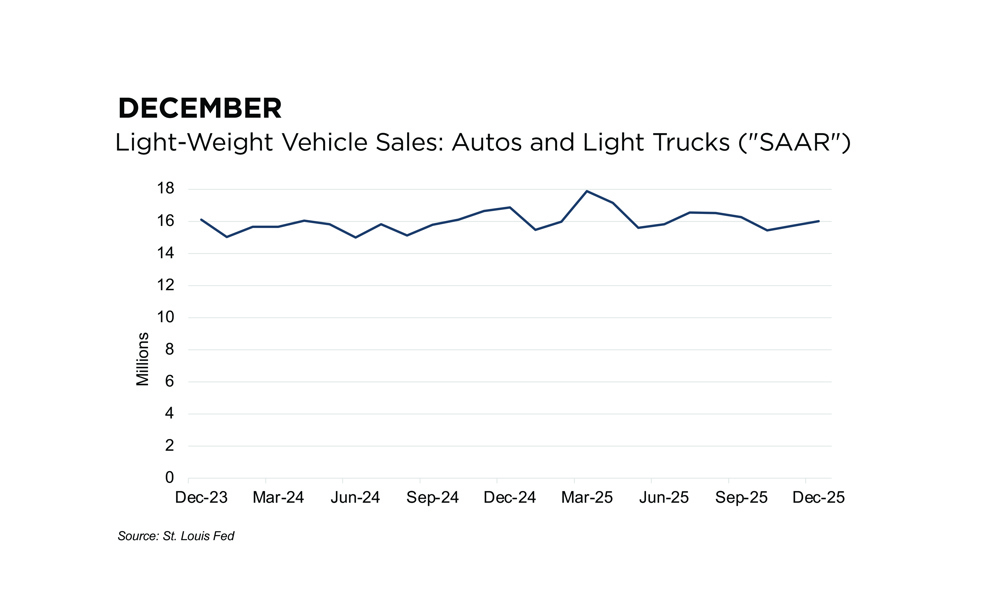
In December 2025, the U.S. auto industry finished the year modestly stronger on a sequential basis, with the SAAR increasing to 16.0 million units, up from 15.7 million in November. While this marked continued recovery from the beginning of Q4, December represented a third consecutive month of year-over-year declines, with volumes down approximately 5% from December 2024.
As we discussed last month, reasons for the Q4 slowdown include tariff-related price increases on 2026 model-year vehicles and the expiration of EV tax credits in September 2025. The pull-forward effect from expiring credits drove an all-time high BEV market share in September, followed by a sharp retrenchment through December.
Unadjusted Sales Data
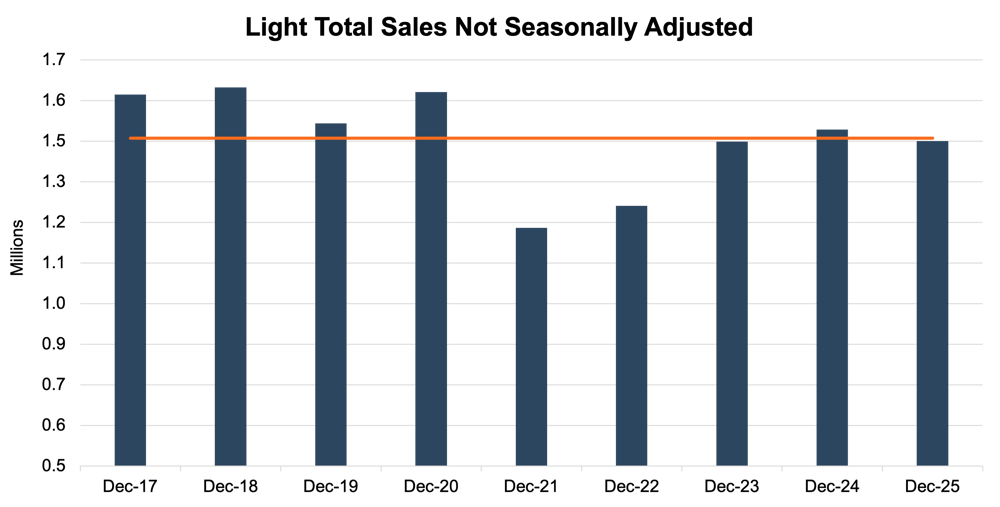
On an unadjusted basis, December 2025 industry sales finished at approximately 1.46 million units, reflecting typical year-end seasonality but still a slight decline versus December 2024. For the first time since the onset of the microchip shortage in 2021, December was not the highest unadjusted volume month of the year, as sales were greater in March, April, and May surrounding the tariff uncertainty.
Combined with October and November’s respective 1.28 million units, fourth-quarter unadjusted volumes were adequate to push the industry above the 16-million-unit threshold for the year for the first time since 2019. See the chart below for a look at unadjusted sales over the last nine Decembers.
Days’ Supply
Brand-level days’ supply data from Cox Automotive provides a granular view of OEM inventory strategies, emphasizing that a dealer’s inventory position is increasingly driven by brand-specific discipline rather than industry averages.
See the chart below for a look at days’ supply by brand in November 2025.
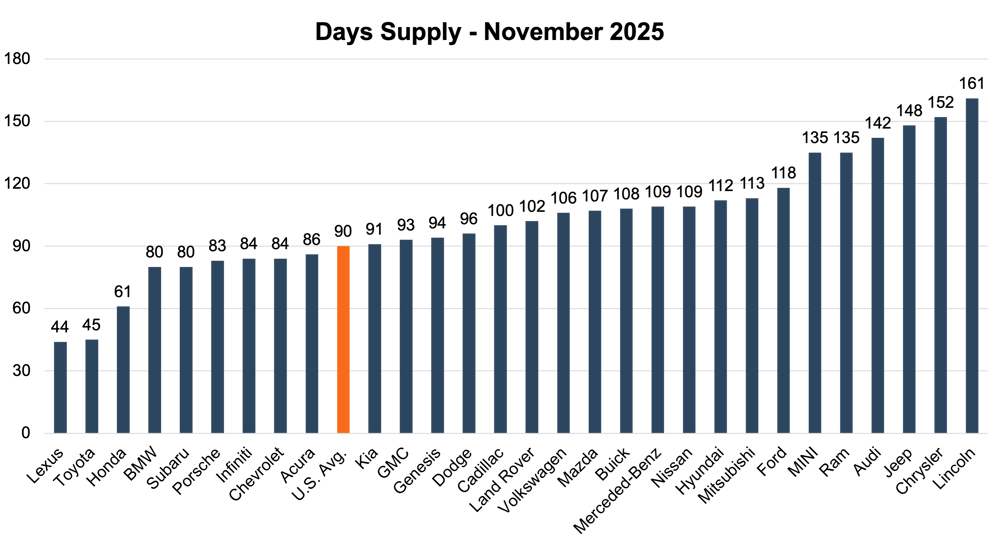
Inventory management remains a key differentiator among OEMs. Evaluating franchise value now requires a closer examination of how effectively a brand maintains operational steadiness. From October 2025, there was not a material change in days’ supply with the U.S. average edging up 2 days. Days’ supply increased the most for brands on the opposite ends of the spectrum. Lexus and Toyota’s increases can be seen as normalization though they are still well below peer figures. On the other end, brands with elevated inventory levels (VW, CDJR, Mini and Lincoln) also saw their days’ supply increase, which is putting pressure on margins and working capital. No other brands saw their days’ supply change by more than a few days up or down.
Transaction Prices
According to J.D. Power, the average new-vehicle retail transaction price in December 2025 is projected to be approximately $47,104, representing a year-over-year increase of roughly 1.5%. The increase for non-EVs was 1.4% over the same period, as EVs are selling for modestly more on average but the relatively small volume of EV sales causes the impact to be minimal. Post-EV tax credit, it will be interesting to see how these pricing dynamics continue to evolve.
Incentive Spending and Profitability
Thomas King, the president of OEM solutions at J.D. Power, discussed the factors impacting incentive spending in December:
“The average manufacturer’s incentive spend per vehicle is on track to reach $3,433, which is $140 higher than November and $77 higher than a year ago. Expressed as a percentage of MSRP, incentive spending is currently at 6.5%, up 0.1 percentage points from last year. Discounts on EVs are expected to average $11,414 in December, down $57 compared with December 2024, and down $472 from November 2025. Discounts on non-EVs are projected at $3,219, an increase of $425 from last year.”
Total retailer profit per unit, including vehicle gross and finance & insurance income, is projected to decline modestly year over year in December, reflecting continued normalization from post-pandemic highs and increased competitive pressure. While profits remain above long-term historical averages, the trend exiting 2025 is clearly downward.
January 2026 Outlook
After two months of depressed sales, December delivered modest sequential improvement on a SAAR basis and full-year 2025 volumes successfully surpassed the 16 million threshold, marking an important milestone for the industry.
That said, declining per-unit profitability and elevated inventory of certain brands may result in weaker total dealer performance, even with stable volumes. The industry has yet to reach the 17-million-unit threshold since the pandemic, and based on current demand, affordability, and inventory conditions, we do not expect a return to that level in 2026.
Mercer Capital provides business valuation and financial advisory services, and our auto team helps dealers, their partners, and family members understand the value of their business. Contact a member of the Mercer Capital auto dealership team today to learn more about the value of your dealership.