
Key Takeaways
Published blue sky multiples from firms such as Haig Partners and Kerrigan Advisors provide an important snapshot of current dealership valuations, but they may predict where blue sky values are headed.
Industry research from Murphy Automotive Partners and The Presidio Group suggests that product cadence, dealer sentiment, acquisition appetite, and manufacturer momentum can provide early indicators of future valuation trends before they are reflected in completed transactions.
Dealership valuation depends not only on current earnings and market multiples but also on expectations for future performance, making it important to evaluate franchise-specific prospects alongside historical transaction data.
Every quarter, dealership owners eagerly await the latest blue sky multiple reports from Haig Partners and Kerrigan Advisors. These reports have become an important benchmark for buyers, sellers, lenders, and valuation professionals because they summarize recent buy-sell activity and provide valuable context regarding the current dealership market.
But published blue sky multiples only answer part of the valuation question. The Haig and Kerrigan multiples summarize prices observed in recent transactions and discussions with other industry participants. They do not necessarily explain why buyers favor one franchise over another or how those preferences may evolve. To answer that question, it helps to supplement these reports with additional industry research that examines product pipelines, dealer sentiment, acquisition appetite, and brand momentum.
This week, two such industry research reports dropped. I attended a webinar put on by the Automotive Press Association featuring the inaugural Murphy Automotive Product Pipeline (MAPP) from Murphy Automotive Partners. The Presidio Group also released their Midyear 2026 Dealer Direction Survey providing additional context regarding factors that market participants may consider when evaluating dealership franchises. While neither report directly attempts to estimate dealership values, both offer perspectives that may help explain differences in buyer demand across brands.
Today's Favorite Brand Isn't Necessarily Tomorrow's Best Investment
Few would dispute that Toyota dealerships occupy an enviable position today. Strong earnings, disciplined inventory management, customer loyalty, and high buyer demand have helped Toyota franchises command some of the strongest blue sky multiples in recent transactions despite not being a luxury brand. If someone offered most dealer groups the opportunity to purchase a quality Toyota store, the line of interested buyers would likely be long. Murphy’s Brand Survival Index places Toyota in its highest category, while the brand also ranks first in Presidio’s dealer desirability survey.
However, if everyone already agrees Toyota is among the industry's most desirable franchises, how much of those expectations are already reflected in today’s purchase price?
As one of my colleagues likes to say, one of the most important inputs to investment return is entry price. Investment returns depend on more than owning a great asset. Buyers who acquired Toyota dealerships years ago benefited from both rising earnings and expanding multiples. Buyers entering today may be paying for a greater portion of those expectations upfront.
The “next Toyota" may not be the brand that sits at the top of today's blue sky multiple range. It may be a franchise that is beginning to improve while much of the market is still focused elsewhere.
Looking for Early Signals
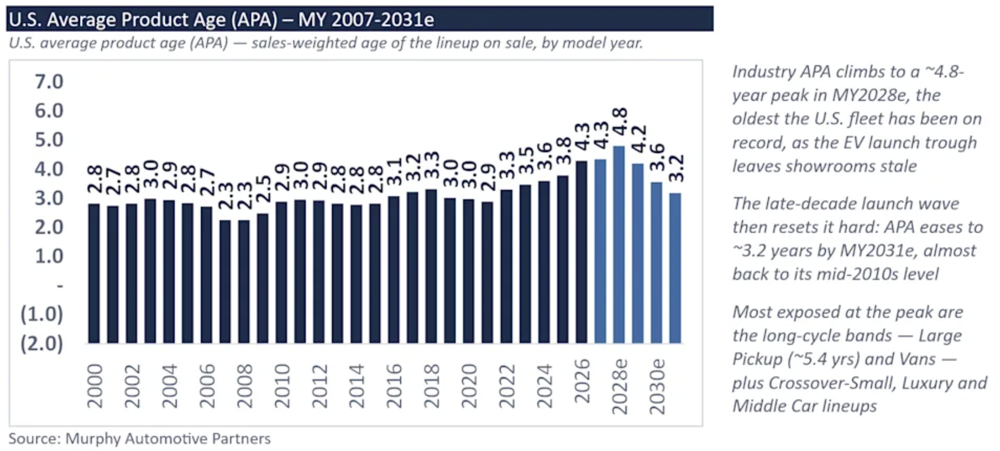
Murphy Automotive Partners approaches the industry through product planning. Murphy’s research suggests that product cadence, hybrid strategy, and fresh model launches will play an important role in determining market share and long-term competitiveness over the next several years. According to Murphy, brands with aging lineups or delayed product introductions may face increasing pressure, while manufacturers launching attractive trucks, SUVs, and hybrid models could gain momentum. Below is one of Murphy’s key metrics: Average Product Age. He expects APA to peak in 2028 due to recent reversals in EV strategy from many OEMs.
The Presidio Group approaches the market from another direction. Its survey asks dealers where they want to invest capital and how they view profitability, valuations, and franchise desirability. The survey found that 64% of respondents remain interested in acquiring dealerships even as many expect profits to soften over the next year. At the same time, the survey suggests buyers are becoming increasingly selective about brands, markets, and store quality.
Considered together, these reports encourage readers to think beyond current transaction multiples. Which brands appear to be gaining momentum? Which manufacturers seem positioned for stronger product cycles? Where is dealer sentiment improving? Those questions cannot be answered solely by reviewing completed transactions.
A Few Interesting Examples
Nissan may be one of the more intriguing stories to watch. Historically, Nissan franchises have occupied the lower end of published blue sky multiple ranges. Yet Presidio's latest survey shows Nissan climbing five positions in dealer desirability, the largest improvement among the surveyed brands, citing leadership changes and improving product direction.
Haig Partners has recently observed that Nissan and CDJR franchises may represent opportunistic buys at current valuations. Presidio’s improving dealer sentiment for Nissan may provide additional support for this thesis.
Neither report suggests Nissan should suddenly command Toyota multiples. Together, the reports suggest that buyer perceptions can change before those changes are fully reflected in published transaction multiples. This is part of the reason Kerrigan Advisors specifically includes “Buyer Demand” and “Multiple Outlook” alongside its published multiples. For buyers with a longer investment horizon, those changing perceptions deserve attention.
Porsche presents an interesting contrast. It has a strong reputation as a premium franchise. After years occupying the top spot, it is currently only second to Lexus. However, Presidio's survey shows Porsche falling to tenth in dealer desirability, which Presidio attributed to product challenges, margin pressure, and increasingly demanding facility requirements.
Of note, Porsche is just behind both Chevrolet and Ford, whose blue sky multiples are approximately half the price for a “similar” earnings stream. Murphy’s research suggests that manufacturers with fresh truck portfolios and healthy product cadence may be better positioned over the next several years. If that proves accurate, it could help explain why Chevrolet and Ford rank relatively well in dealer desirability despite trading at materially lower blue sky multiples.
The desirability index may also reflect a bit of this entry price phenomenon. Brands like Porsche and Audi are much lower on the desirability index than their current blue sky multiple ranking. Lower desirability rankings could indicate that prospective buyers are less willing to pay premium prices for brands currently facing operating or product-related headwinds.
None of this proves where future blue sky multiples will settle. It simply illustrates why valuation professionals monitor information beyond completed transactions.
Multiples Are a Snapshot. Expectations Matter.
Valuation has always been forward looking. Although valuation begins with historical financial performance, valuation professionals routinely make appropriate adjustments and develop expectations regarding future earnings capacity. Recent blue sky reports from Haig Partners similarly emphasize the importance of expected future profitability. And Kerrigan Advisors notes its multiples are applied to the latest earnings, with less consideration of prior periods.
Two dealerships generating identical earnings today may deserve different valuations, all else being equal, if market participants expect one franchise to produce stronger future performance than the other. Product cadence, factory investment, market position, dealer sentiment, acquisition demand, and expected profitability may influence those expectations. Accordingly, blue sky multiples should rarely be viewed in isolation.
Conclusion
Haig Partners and Kerrigan Advisors provide an indispensable view of current market pricing. Research from Murphy Automotive Partners and The Presidio Group provides complementary perspectives on product planning, dealer sentiment, and franchise desirability. No single publication tells the entire story, but together they can provide a broader context for understanding the factors that market participants may consider when buying, selling, or valuing auto dealerships. Published blue sky multiples remain the benchmark, but looking beyond them may help explain why those benchmarks change over time.
Industry research can provide valuable context, but every dealership valuation ultimately depends on its own facts and circumstances. If you would like to discuss how current market conditions or franchise-specific factors may affect the value of your dealership, contact a member of Mercer Capital's Auto Dealer Valuation team.