
Key Takeaways
February rebound masks continued year-over-year softness. February SAAR improved sequentially to 15.8 million units following January’s weather-driven slowdown, but volumes remained 1.5% below February 2025 levels. While winter distortions faded, February was the fifth consecutive month of year-over-year declines with demand still constrained by affordability pressures.
Elevated days’ supply reflects slower sales velocity, not excess production. January’s national days’ supply increased sharply to 98 days from 76 in December, largely due to reduced sales activity rather than a surge in inventory. Brand dispersion remains wide, with disciplined OEMs maintaining sub-65-day levels while others exceed 100 days. The divergence reinforces the importance of inventory management as a driver of pricing power and dealership performance.
Affordability pressures are reshaping mix, incentives, and financing behavior. Internal combustion engine vehicles and hybrids are gaining share while EV penetration declines, influencing incentive averages and margin dynamics. Retailer profit per unit is projected to soften as discounting rises on non-EVs and more buyers extend loan terms to 84 months. Although easing interest rates and stable trade-in values provide partial relief, transaction prices above $46,000 continue to limit demand elasticity heading into the spring selling season.
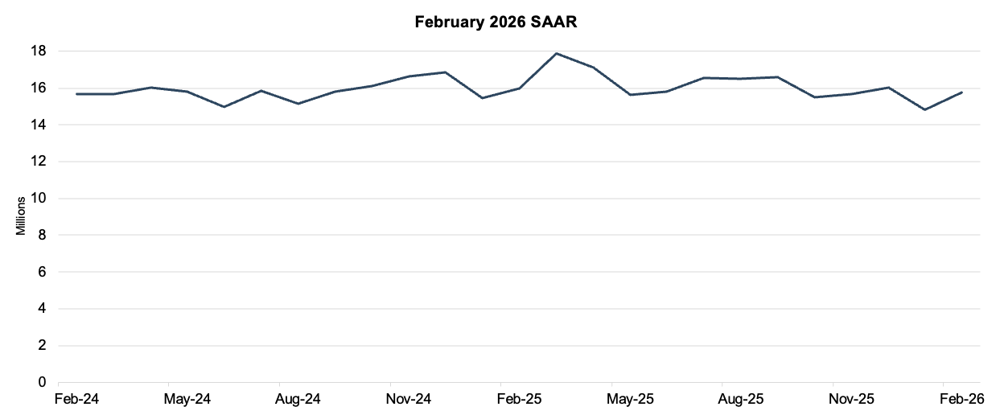
In February 2026, the U.S. auto industry regained its footing after experiencing a 7.4% decline in the SAAR in January. From January to February, the SAAR increased by 6.3%, reflecting a notable increase from 14.8 million light total units sold in January to 15.8 million units sold in February. However, on a year-over-year basis, the SAAR fell 1.5% from February 2025, the fifth consecutive month of year-over-year decreases.
As we discussed last month, SAAR numbers in January were impacted by the typical winter seasonality issues and the severe winter storms that affected much of the country in the last week of the month. Moving into February, seasonality continues to be present as cold weather and shorter days impact consumer behavior, which is expected to improve in March as we’ve already turned our clocks forward.
Unadjusted Sales Data
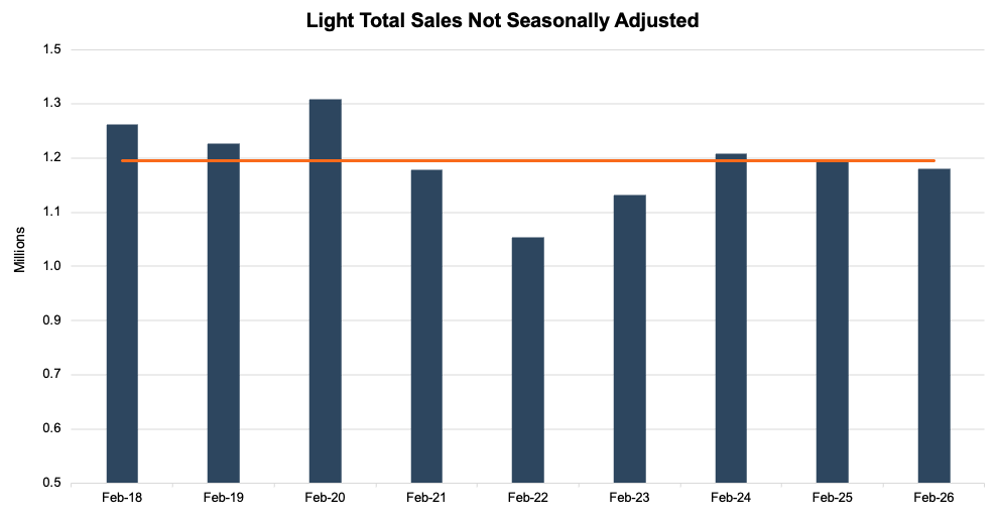
On an unadjusted basis, February 2026 industry sales finished at approximately 1.2 million units, reflecting typical early-year seasonality and representing a 2.0% decline from February 2025. While sales increased month-over-month from January, the unadjusted SAAR data reveals that the month’s sales grew at a more muted rate than in the same period last year.
Compared to previous years, February 2026 represents a setback in the climb back from pre-2022 sales volume lows, with the promising gains seen in 2024 and 2025 experiencing a slight downward trend in February 2026. As displayed on the chart below, over the past nine Februarys, unadjusted volumes experienced a marginal decline from 2018 to 2019, before experiencing substantial increase in 2020. Positive performance in 2020 was followed by relative troughs in 2021, 2022, and 2023, while recent years display a modest recovery.
Days’ Supply
Brand-level days’ supply data from Cox Automotive provides a granular view of OEM inventory strategies, illustrating that days’ supply is typically brand specific . As we’ve discussed for a while, Toyota, Lexus, and Honda continue to dominate the low end of the spectrum, all remaining below 65 average days’ supply in January. Comparatively, Land Rover, BMW, and Mercedes-Benz saw their days’ supply tick above the national average with days’ supply greater than 100. Compared to December, January’s national days’ supply is much larger, up from 76 to 98. While this trend is partially due to seasonality with limited inventory turnover happening in January compared to December, severe winter weather in many parts of the country also hindered purchasing activity, contributing to the increase in average days’ supply. The number of vehicles on the lots didn’t materially increase; it’s the denominator (sales volumes) that led to the increase in days’ supply.
See the chart below for a look at days’ supply by brand in January 2026.
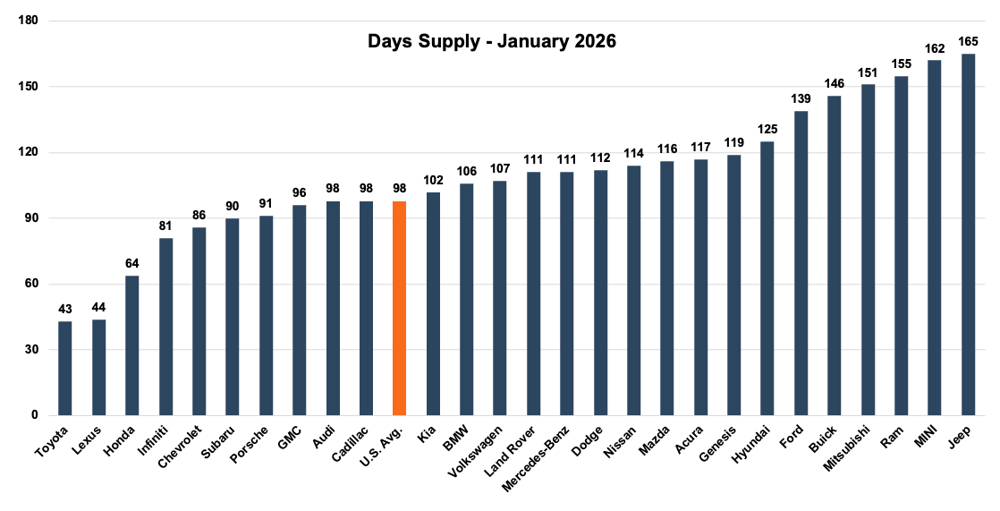
As described by Cox Automotive, another contributing factor to increased days’ supply is stable inventory. Many brands are holding inventory steady while shifting demand and seasonal factors slow showroom traffic. For example, Nissan’s January sales slowed by 12% from the prior month, increasing days’ supply from the 90s to above 110. A similar phenomenon impacted Honda, Hyundai, Kia, Chevrolet, and Ford. As noted by Cox Automotive, the takeaway is that “January was just a slow month”, a sentiment echoed at NADA 2026 by sellers commenting on quiet showrooms.
Even brands’ most popular models including the Toyota Camry, Honda Accord, Nissan Altima, and Ford’s F-Series struggled to attract demand. Among well-selling sedans and SUVs like the Accord and Toyota Highlander, days’ supply moved from under 60 to the 80-day range illustrating a pattern of softening demand.
Transaction Prices
According to JD Power, total new vehicle retail sales for February 2026 are expected to decrease 4.6% year-over-year despite February 2026 having 24 selling days, the same as February 2025. Except for leap years, Februarys are the steadiest from a selling days perspective due to the symmetry of the calendar having exactly four of each day of the week.
Internal combustion engine vehicles are projected to total 78.8% of new-vehicle retail sales, representing an increase of 2.6 percentage points from last year. Hybrid vehicles are also expected to increase as a percentage of total new vehicle sales, while EV sales are expected to decrease by 1.8 percentage points compared to February 2025. In aggregate, the average new vehicle retail transaction price in February is expected to reach $46,303, up $1,225 from last year.
Thomas King, the president of OEM solutions at J.D. Power, discussed the factors impacting incentive spending in February:
“The average manufacturer's incentive spend per vehicle is on track to reach $3,293, which is $63 higher than a year ago. However, the changes in average discounts are heavily influenced by the decline in EV sales. Discounts on EVs are expected to average $10,356 in February, down $1,664 compared with February 2025. Meanwhile, discounts on non-EVs are projected at $3,085, an increase of $346 from last year. As a percentage of MSRP, discounts on non-EVs are at 6.0% in February, up 0.6ppts from a year ago. Total retailer profit per unit is projected to decline 2.6% from last year, reflecting a mix of affordability pressure and changes in monthly financing, with more customers turning to 84-month loan terms. Additionally, easing interest rates (down 48 basis points from a year ago) and strong used-vehicle values provide some relief for buyers facing elevated monthly payments.”
In light of macroeconomic conditions, the full-year outlook remains cautious. With the year-over-year performance in February contracting from 2025 and automakers stating they are preparing to increase sales volume in 2026, analysts expect that competitive intensity will rise. However, expected interest rate cuts and continued refinements in supply chain efficiency offer tailwinds for sellers. Additionally, the spring months typically result in higher sales volumes, offering a better glimpse into the year’s performance than January and February.
March 2026 Outlook
In March 2026, U.S. new-vehicle sales are expected to improve modestly with the onset of the spring selling season and SAAR projected to hold in the mid-15 million range. While this represents sequential strengthening from the winter months, volumes are likely to remain slightly below year-ago levels as affordability pressures continue to weigh on retail demand. Elevated transaction prices and financing costs are expected to keep price-sensitive buyers on the sidelines, though easing rates and stable trade-in values may provide some offset. Fleet deliveries should remain supportive but not disproportionately large. Inventory levels are projected to stay stable overall, though days’ supply may remain elevated relative to last year due to slower sales velocity earlier in the quarter. Pricing discipline is expected to hold among leaner OEMs, while brands with higher inventory positions may rely more on targeted incentives to sustain momentum. As competitive intensity builds into the spring season, performance will increasingly depend on disciplined inventory management and a balanced product mix that preserves margins while maintaining accessibility for more value-oriented buyers.
Mercer Capital provides business valuation and financial advisory services, and our auto team helps dealers, their partners, and family members understand the value of their business. Contact a member of the Mercer Capital auto dealership team today to learn more about the value of your dealership.