
Key Takeaways
Framework agreements establish the conditions under which large dealer groups can operate and expand, including franchise ownership limits, performance requirements, and financial standards. These restrictions can influence acquisition opportunities and competitive dynamics for smaller dealers.
When evaluating potential buyers, selling dealers should consider whether a buyer’s framework agreement permits the proposed acquisition and whether other OEM approval conditions can be satisfied. An established agreement may make the approval process more predictable, but it does not guarantee approval.
Large dealer groups may divest profitable dealerships to comply with manufacturer ownership limits or concentrate operations in selected markets. These divestitures can create opportunities for smaller operators whose geographic presence and operating strategies make a store a stronger fit.
Dealership acquisitions are typically discussed in terms of blue sky multiples, profitability, franchise desirability, and the availability of capital. However, another factor can influence whether a transaction gets done: the agreements between large dealership groups and the manufacturers whose vehicles they sell.
These agreements, commonly referred to as framework agreements, establish parameters for how large dealer groups operate and expand their portfolios of dealerships. While smaller dealer groups may not be parties to these agreements themselves, understanding their implications can provide useful perspective when evaluating potential buyers, acquisition opportunities, and competitive dynamics in their local markets.
For dealer principals considering a sale, framework agreements can influence which buyers are most likely to close. For dealers looking to expand, they can help explain why larger groups occasionally sell stores that might otherwise appear to be attractive investments.
What Is a Framework Agreement?
Each franchised dealership operates under a dealer agreement with its respective manufacturer. These agreements govern the relationship between the OEM and the individual dealership, including operating standards, sales performance, facilities, and other franchise requirements.
Framework agreements operate at a higher level. Rather than governing a single rooftop, they establish the terms of the relationship between an OEM and a larger dealership organization.
Among other provisions, framework agreements may establish:
Limits on the number of franchises a dealer group can own, including geographic concentration restrictions
Performance requirements that must be satisfied before acquiring additional dealerships
Minimum capitalization and other financial requirements
Restrictions involving changes in ownership, management, or control of the dealer group
The specific provisions vary by manufacturer and auto group. Importantly, these agreements supplement individual franchise agreements rather than replace them. State franchise laws can also affect how their provisions are enforced.
For OEMs, framework agreements help manage concentration risk and maintain oversight of dealer groups that represent an increasingly significant portion of their distribution networks. For dealer groups, they impose restrictions on expansions but can also clarify the conditions for approval of future acquisitions.
Why Framework Agreements Matter When Selling a Dealership
For a dealer principal evaluating competing offers, the highest purchase price is not necessarily the only consideration. The ability of a prospective buyer to secure financing, obtain OEM approval, and close within the anticipated timeframe also matters.
A framework agreement can be thought of like being prequalified for a mortgage.
A prospective homebuyer who has been prequalified by a lender has already established certain parameters under which financing may be available. That does not guarantee approval for a particular home, but it can provide the seller with greater confidence in the buyer's ability to complete the purchase.
Similarly, a large dealer group with an existing framework agreement may have greater visibility into whether a proposed acquisition would satisfy the manufacturer's requirements.
This distinction could become relevant when a selling dealer principal receives two offers with similar pricing and other transaction terms. If one buyer operates under an established framework agreement with available capacity to acquire another franchise, that buyer may have a more predictable approval process than a competing buyer with no established relationship or acquisition history with the OEM.
Of course, the existence of a framework agreement does not guarantee approval. A buyer could already be approaching its franchise ownership limits, or an underperforming store elsewhere in its portfolio could affect its ability to acquire additional dealerships.
For selling dealers and their advisors, the relevant question is not simply whether a prospective buyer has a framework agreement, but whether that agreement permits the contemplated acquisition and whether other approval conditions can be satisfied.
Why Larger Groups Sometimes Sell Attractive Dealerships
Framework agreements can also help explain a transaction that might otherwise seem counterintuitive: a large public dealer group selling a profitable dealership while simultaneously acquiring others.
Large dealer groups regularly reassess the composition of their portfolios. A dealership may be profitable on a standalone basis but contribute relatively little to a group's broader geographic or operational strategy. An isolated store may also have fewer opportunities to share management resources, advertising, personnel, and other costs with nearby dealerships.
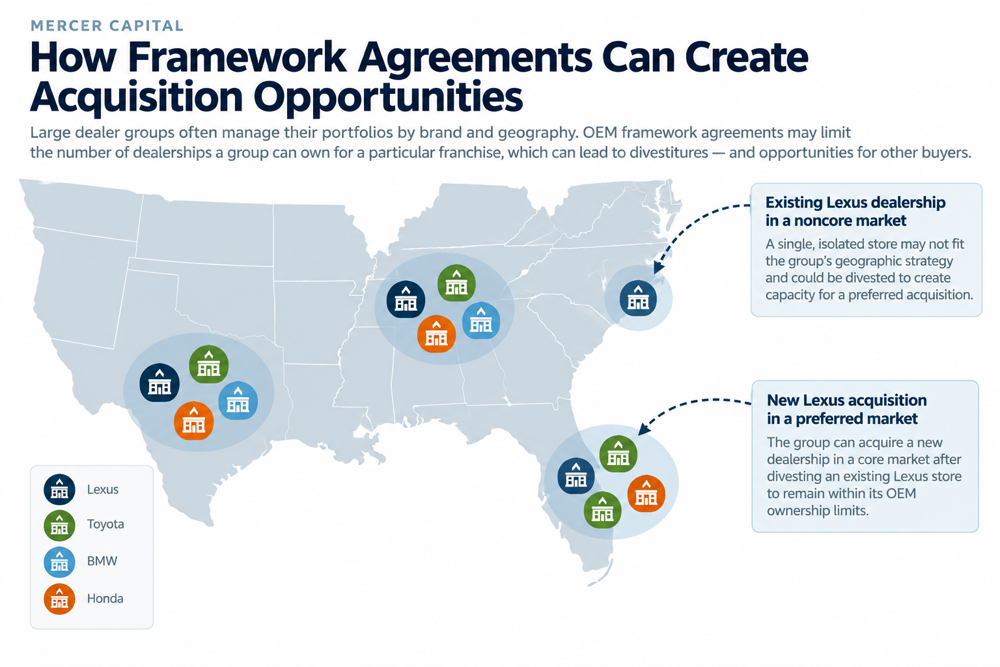
Manufacturer ownership restrictions add another consideration. A group approaching its permitted number of franchises for a particular brand may need to sell an existing dealership before pursuing a more attractive acquisition.
As we've discussed previously, large dealer groups manage their portfolios with an eye toward franchise mix and geographic concentration. Framework agreements add another consideration to these decisions by limiting ownership of particular franchises.
A recent example involves Penske Automotive Group. According to the Q2 2026 Haig Report, Penske's acquisition of two Lexus dealerships in Orlando contributed to it divesting a smaller Lexus dealership in Rhode Island to remain within its OEM framework agreement. The transaction illustrates how a dealership can become available for reasons that have relatively little to do with the underlying attractiveness of the franchise.
Group 1 Automotive has also emphasized its strategy of building clusters of dealerships in selected markets. Its Hennessy acquisition highlighted its focus on expanding existing geographic concentrations to improve operational efficiencies and returns. This recent activity from the publics demonstrates that larger groups are not necessarily pursuing growth through the accumulation of as many rooftops as possible and in some situations may already be at capacity in certain brands. Portfolio composition, geographic concentration, and OEM restrictions can be equally important considerations.
What This Means for Smaller Dealer Groups
For an independent dealer principal, an enterprising general manager pursuing a first dealership, or a smaller group considering expansion, these dynamics can create opportunities.
Consider a public dealer group that owns a single dealership in a market where it otherwise has little presence. That store might be a reasonable business on its own, but it may not benefit from the same economies of scale as the group's dealerships in more concentrated markets.
A smaller regional operator with existing dealerships nearby could potentially realize greater operational benefits from the acquisition. Alternatively, an experienced general manager may view an underperforming store as an opportunity to improve sales effectiveness, expense management, or fixed operations profitability. A dealership that fails to meet a large group's investment criteria is not necessarily a poor investment for every potential buyer.
This does not mean that every dealership divested by a public group represents an attractive acquisition opportunity. Prospective buyers still need to evaluate the franchise, historical profitability, facility requirements, capital investment needs, and competitive position of the dealership.
Smaller dealer groups should be aware of which public and large private dealer groups operate in their markets, particularly those with only one or two dealerships in the area. These stores may be divestiture candidates if the larger group decides to focus its investments elsewhere or needs to create capacity for acquisitions under an existing framework agreement. A store that is peripheral to one group’s strategy could be central to yours.
Considerations for Dealer Principals and Their Advisors
For dealers contemplating a sale, understanding a buyer's OEM relationships should be part of evaluating the likelihood of closing, alongside purchase price, financing, timing, and other transaction terms. Attorneys advising dealership buyers and sellers should pay particular attention to applicable manufacturer consent requirements and how they could affect the contemplated transaction.
For buyers, an understanding of the larger groups operating in their region can help identify potential acquisition opportunities. Watching which markets public groups are expanding into, and which dealerships they are exiting, may provide a useful indication of where additional transactions could occur.
Although framework agreements are negotiated between manufacturers and larger dealer organizations, their implications extend to smaller dealers as well. Understanding how these agreements influence acquisition approvals and divestiture decisions can help dealer principals evaluate both potential buyers and opportunities for expansion.
At Mercer Capital, we regularly analyze dealership transaction activity and the operating performance of auto groups as part of our valuation and advisory services. Understanding how OEM restrictions and consolidation strategies influence the buy-sell market is another consideration when evaluating dealership investments and ownership transitions. If you have questions about how these developments may affect the value of your business, please contact a member of our Auto Dealer team.