
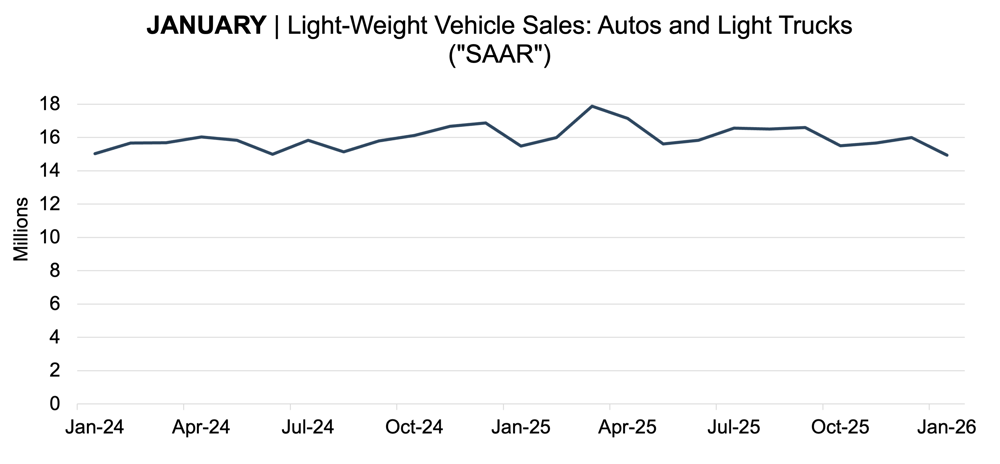
In January 2026, the U.S. auto industry started the year weaker on a sequential basis, with the SAAR decreasing 6.7% to 14.9 million units, down from 16.0 million in December. On an adjusted basis, January represents a 3.5% decrease in volumes from January 2025, the fourth consecutive month of year-over-year decreases.
As we discussed last month, Q4 was marked by a slowdown due to tariff-related price increases on 2026 model-year vehicles and the expiration of EV tax credits in September 2025. The pull-forward effect from expiring credits drove an all-time high BEV market share in September, and a sharp retrenchment in December. As we begin Q1 2026, Q4 conditions are still present, coupled with lower sales in January 2026 due to typical seasonality in the demand cycle and severe winter storms that impacted much of the country in the last week of the month.
Unadjusted Sales Data
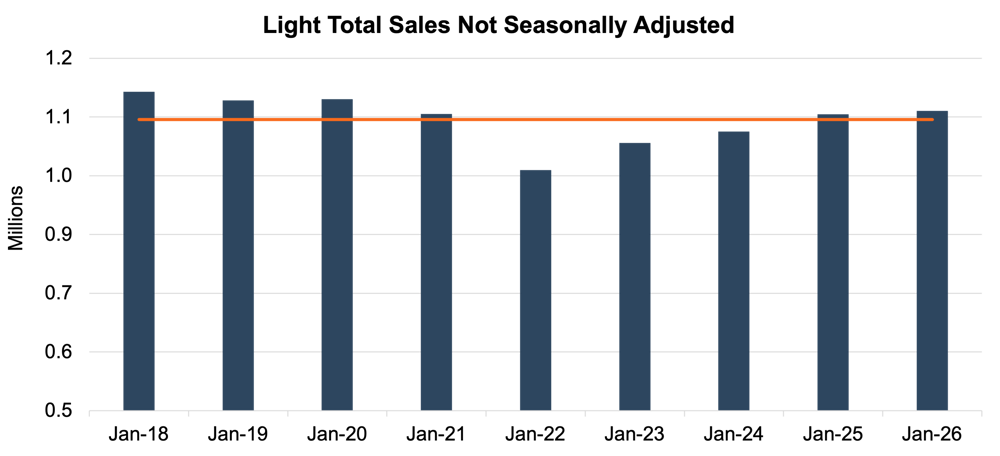
On an unadjusted basis, January 2026 industry sales finished at approximately 1.11 million units, reflecting typical early year seasonality, but actually represented a 0.6% increase from January 2025. This is a prime example of how the seasonal adjustment in auto sales is not just related to the month of the year, but other factors including selling days, etc. With actual unit count up January over January but the sales pace down, SAAR is indicating that other factors caused January 2026’s performance to be below that of January 2025, despite both being the same calendar month. Specifically, January 2026 had five Saturdays while January 2025 only had four; however, the relative underperformance is because that fifth Saturday was snowed in for a significant amount of the country. As is typical, January marked the lowest monthly unadjusted volume of the past year.
Compared to previous years, January 2026 represents a continued return to pre-2022 unadjusted sales volumes, with the last four year-over-year periods seeing an increase to unadjusted volumes. As displayed on the chart below, over the past nine Januarys, unadjusted volumes experienced a marginal decline from 2018 to 2021, followed by a steep trough in 2022 and subsequent recovery although not nearly to pre-COVID levels.
Days’ Supply
Brand-level days’ supply data from Cox Automotive provides a granular view of OEM inventory strategies, illustrating that the spectrum of days’ supply is increasingly brand specific, with Lexus and Toyota dominating the low end of the spectrum, and brands like Stellantis and Volkswagen struggling to move closer to the national average.
See the chart below for a look at days’ supply by brand in December 2025.
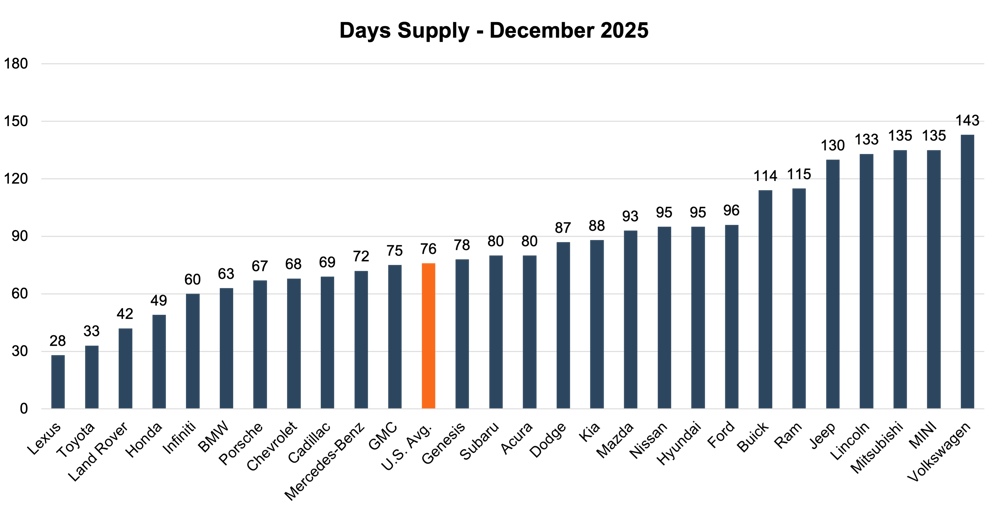
Brand divergence and pricing pressure continue to be the key challenges facing OEMs. Days’ supply is increasingly brand dependent, with Lexus, Toyota, Honda, and Land Rover reporting days’ supply under 50, representing brand strength and reflecting disciplined production and sustained pricing power.
Affordability has been a key issue in the market for a while, and one might wonder whether a lack of affordable options was causing days’ supply to accumulate as the wrong mix of vehicles is on dealers’ lots. Interestingly, Cox Automotive noted that while there are ten brands that have an average list price under $40,000, only two of those (Subaru and Honda) have days’ supply below the national average. Cox suggests this trend may indicate that price-sensitive customers are leaving the new vehicle market altogether.
Compared to vehicles with prices under $40,000, which tend to remain on lots longer, luxury vehicles above the $75,000 price point average approximately 63 days’ supply. Affluent buyers appear to be less sensitive to price and remain in premium segments, while mainstream customers either move into higher segments or defer participation in the new vehicle market whether trading down to used vehicles or holding onto their current vehicles longer. While affordability pressure mounts, automakers also face challenges with passing the tariff burden absorbed in 2025 along to consumers in 2026. Although prices will likely rise, automakers hold out some optimism for the USMCA Trade Agreement set to be up for renegotiation in July.
Transaction Prices
According to JD Power, the average new-vehicle retail transaction price in January 2026 is projected to be approximately $45,880, up 1.1% from January 2025. The increase for non-EVs was 0.9%, while EV prices rose 18.1% over the same period. Higher transaction prices in January offset lower sales, with consumers projected to spend nearly $39.7 billion on new vehicles over the month, a 1.4% increase from January 2025.
Incentive Spending and Profitability
Thomas King, the president of OEM solutions at J.D. Power, discussed the factors impacting incentive spending in January:
“The average manufacturer's incentive spend per vehicle is on track to reach $3,192, which is $25 higher than a year ago. However, the changes in average discounts are heavily influenced by the decline in EV sales. Discounts on EVs are expected to average $11,212 in January, down $1,820 compared with January 2025, and down $353 from December 2025. Discounts on non-EVs are projected at $3,004, an increase of $403 from last year. As a share of MSRP, discounts on non-EVs averaged 5.9% in January, up 0.8 percentage points from a year ago.”
Total retailer profit per unit is projected to decline 2.6% from last year, reflecting a mix of affordability pressure and changes in monthly financing, with more customers turning to 84-month loan terms. Additionally, easing interest rates (down 48 basis points from a year ago) and strong used-vehicle values provide some relief for buyers facing elevated monthly payments.
Despite seasonal and macroeconomic conditions affecting January sales, the full-year outlook remains positive. With rising lease-return volumes and the expectation of lower interest rates, the industry is experiencing tailwinds. Additionally, continued improvements in EV cost structures and supply chain efficiencies may provide operational benefits across broader vehicle production.
February 2026 Outlook
SAAR is expected to remain in the mid-15 million range as demand stabilizes and seasonal volatility fades. Affordability will continue to shape purchasing behavior, with elevated transaction prices offset partially by easing interest rates and stable trade-in values.
Per-unit margins are likely to face mild pressure as incentive spending trends modestly higher and competitive dynamics vary by brand. Inventory levels remain meaningfully divergent across OEMs, reinforcing differences in pricing power and sales performance. Disciplined brands should be able to protect margins with leaner days’ supply, while others may rely more heavily on targeted incentives to move inventory. Overall, the earnings environment is expected to normalize, driven more by inventory management and product mix than by supply constraints. OEMs will need to strike the right balance of affordability versus premium products with higher margin to maximize profits and not losing too many would-be new vehicle buyers. If the bottom half of the market does end up buying fewer new vehicles, this may shape product mix strategy going forward.
Mercer Capital provides business valuation and financial advisory services, and our auto team helps dealers, their partners, and family members understand the value of their business. Contact a member of the Mercer Capital auto dealership team today to learn more about the value of your dealership.