
Key Takeaways
June 2026 U.S. auto sales showed continued resilience, with the SAAR rising to 16.5 million units and year-over-year sales increasing despite persistent affordability challenges. Strong fleet demand, stable retail activity, and improved inventory conditions supported the market, although elevated financing costs continue to limit stronger growth.
Inventory levels have largely normalized without creating widespread oversupply, but significant differences remain across manufacturers. Brands with higher inventory—particularly several Stellantis brands—are expected to rely more heavily on incentives, while manufacturers with tighter inventories are better positioned to maintain pricing discipline.
The outlook for July 2026 points to continued stability rather than acceleration. Replacement demand, balanced inventories, and a healthy labor market should support sales, but high vehicle prices, financing costs, and ongoing tariff-related cost pressures are expected to keep the market on a modest growth trajectory.
In June 2026, the U.S. auto industry experienced a modest improvement as the SAAR increased to 16.5 million units, up 2.7% from 16.1 million units in May 2026.
On a year-over-year basis, total sales increased 4.4% compared to June 2025 though there was one additional selling day this year.
Stronger fleet deliveries, stable retail demand, and an easier comparison against the tariff-distorted sales environment of mid-2025 more than offset elevated interest rates and weak consumer confidence.
While June's sales pace reflects resilient underlying demand, affordability challenges and elevated financing costs continue to constrain the market. Improving inventories and sustained replacement demand should provide ongoing support, but these headwinds are likely to temper sales growth during the second half of 2026, keeping the market on a modest rather than accelerated growth trajectory.
After four consecutive months of year-over-year declines to start 2026, June marked the second consecutive year-over-year increase in the SAAR this year. While this is an encouraging sign, last year's tariff distortions cannot be ignored.
Unadjusted Sales Data
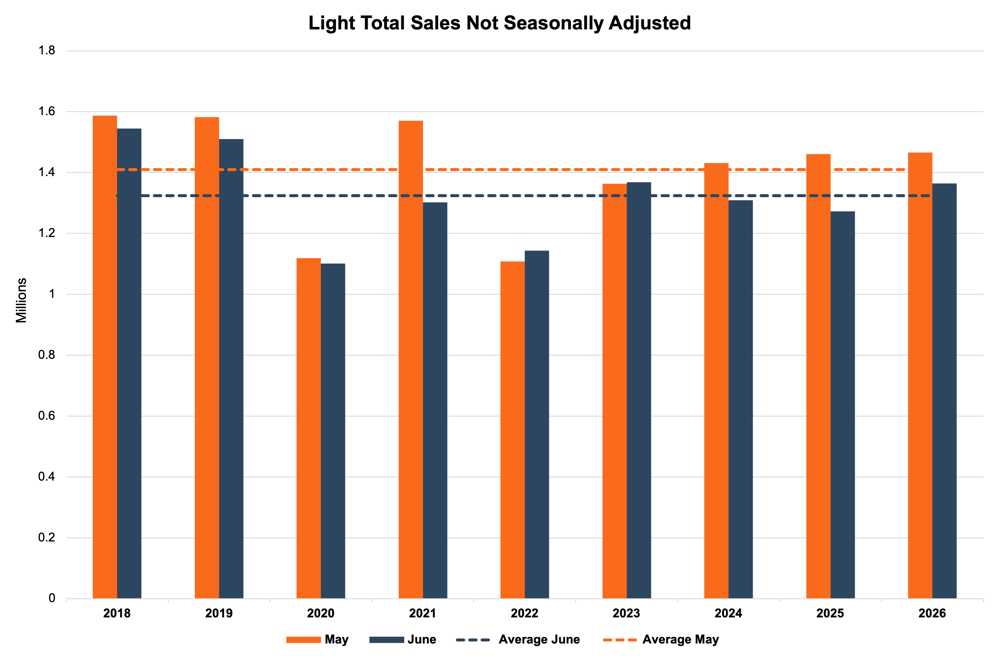
On an unadjusted basis, June 2026 industry sales reached approximately 1.36 million units, down 6.9% from 1.47 million units in May. This decrease reflects slower seasonal demand as Memorial Day sales fade away and summer travel shifts household spending toward seasonal activities rather than large purchases.
Additionally, June often falls between major promotional periods and clearance activity on outgoing models becomes more aggressive later in the summer. This promotional lull incentivizes consumers to wait for either clearance activity or new models to be released.
While unadjusted June selling volumes decreased in 2026, the contraction is in line with prior years. Over the past nine years, selling volumes between May and June have increased just twice, indicating that the decline in 2026 is indicative of typical seasonality. For comparison, unadjusted sales volumes decreased 12.9% in 2025 and were affected by tariff activity while the 6.9% decline in 2026 took place in a relatively more stable macroeconomic environment.
Days' Supply
Cox Automotive indicates that national days' supply remained steady at 76 in May. Total new-vehicle inventory increased to 2.89 million units in May from 2.86 million in April, but accelerating sales tightened days' supply across most brands. Nissan's days' supply declined to 82 days as sales improved, while Stellantis brands continue to carry elevated inventories, with Chrysler, Dodge, and Jeep posting materially higher days' supply than both last month and a year ago as inventory growth continued to outpace demand.
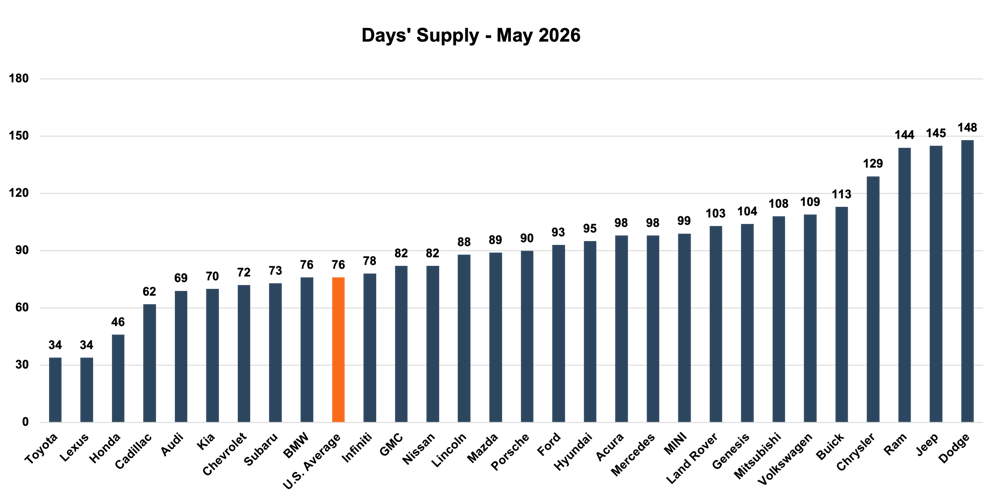
Although inventory levels have increased 13% year over year, the market remains considerably more balanced than it was in 2025.
Higher inventory largely reflects comparisons to last spring, when a sales pace exceeding 17 million SAAR significantly depleted dealer lots.
Rather than signaling oversupply, current inventory levels suggest manufacturers have maintained production discipline while stronger retail demand has prevented inventories from accumulating meaningfully.
The average new-vehicle listing price increased to $49,307 in May, the highest level of 2026, while the average transaction price declined modestly to $49,220.
Despite stable pricing, affordability remains a challenge as elevated financing costs continue to pressure household budgets. Incentives increased to 7.1% of average transaction price, providing additional support for demand, although manufacturers have largely maintained pricing discipline rather than relying on widespread discounting.
Approximately 56% of available inventory remains priced below $50,000, indicating that the industry's inventory mix continues to be concentrated in core volume segments despite persistent affordability concerns.
The disparity between inventory-rich and inventory-constrained brands continues to characterize the new-vehicle market, although overall inventory conditions have become more balanced as stronger sales have absorbed much of the recent inventory growth.
Manufacturers with elevated days' supply, particularly several Stellantis brands, will likely continue to rely on incentives and financing offers to stimulate demand, while brands with tighter inventories, including Toyota, Lexus, and Honda, remain well-positioned to maintain pricing discipline. As a result, competitive conditions are expected to remain uneven across manufacturers through the remainder of the year.
Transaction Prices
According to JD Power, total new-vehicle retail sales for June 2026 are expected to increase 2.7% year over year. Average transaction prices increased 0.8% to $46,387 from this time last year. Additionally, the average interest rate on new vehicle loans is expected to fall 0.35 percentage points to 6.66%, the lowest June reading since 2022. Despite lower financing rates, average monthly payments increased to a record $813, reflecting continued affordability pressures.
The proportion of trade-ins with negative equity rose 1.4 percentage points to 29.5%, while the percentage of loans with terms greater than or equal to 84 months increased to 13.6%, indicating that consumers continue to rely on longer loan terms to manage elevated vehicle prices and monthly payments.
Rising negative equity will be important to track as consumers who bought vehicles above MSRP during peak 2021–2022 levels begin to return to the dealership for the next vehicle.
From a mix perspective, hybrid powertrain sales increased by 2.3 percentage points to 16.0% of retail sales as fuel prices and increased availability of hybrids impacted consumer demand. EV demand softened to 7.4% of retail sales.
Thomas King, President of OEM Solutions at JD Power, discussed the factors impacting incentive spending in June:
“Evaluating the year-over-year results requires consideration of what happened a year ago. Last year, consumers were reacting to the perceived risk of higher prices from vehicle tariffs, and the resulting volatility makes simple year-over-year comparisons murky.
Sales in March and April of 2025 were inflated as consumers rushed to showrooms and ‘pulled ahead’ their purchases ahead of anticipated tariffs. By May that pull-ahead had reversed into ‘payback’, with an estimated 63,000 sales pulled out of May, and an additional 12,000 sales pulled out of June and into the preceding months. This explains the growth in retail sales in June compared to a year ago.
On a full-year basis, the decline in retail sales, more than offset by rising sales to fleets, is notable, but not alarming. Supply constraints on several of the best-selling vehicles in the market account for most of the decline. That said, macroeconomic uncertainty, higher fuel prices and persistent affordability challenges present headwinds to new vehicle demand.”
July 2026 Outlook
July is expected to build on the positive momentum established over the past two months, with U.S. new-vehicle sales likely to remain in the mid-16 million SAAR range.
Replacement demand, improving inventory availability, and relatively stable labor market conditions should continue to support sales activity. However, affordability remains the industry's primary challenge as elevated vehicle prices, high financing costs, and the gradual pass-through of tariff-related cost increases continue to pressure consumers. As a result of these offsetting factors, absent a macro shock, it is unlikely sales levels will materially move in one direction or the other.
Inventory conditions should remain generally balanced through July, although substantial differences persist across manufacturers.
Brands carrying above-average inventory levels will likely continue utilizing incentives and financing offers to support sales, while manufacturers with tighter inventories can maintain greater pricing discipline.
Overall inventory has largely normalized from the constrained levels experienced over the past several years, but demand remains concentrated in affordable, high-volume vehicle segments. Consequently, competitive dynamics are expected to continue varying by manufacturer and vehicle segment, with pricing, incentives, and inventory availability playing an increasingly important role in determining market share throughout the remainder of 2026.