
Key Takeaways
Group 1 Automotive’s approximately $1.3 billion acquisition of Hennessy Automobile Companies reflects a willingness to prioritize scarce, strategically valuable dealership clusters over near-term share repurchases, even at the cost of temporarily higher leverage.
Penske Automotive Group’s proposed take-private transaction highlights the continuing debate over whether dealership assets may command higher valuations in private markets than in public markets, particularly amid significant share-price volatility across the publicly traded dealer groups.
Beyond capital allocation, dealers are watching two operating trends with longer-term implications: the return of off-lease vehicle supply as a source of used inventory and customer retention, and the emergence of Chinese OEMs in the U.K. as an early indicator of the economics U.S. dealers may face if those brands expand in North America.
Second quarter earnings season brought two notable developments involving public auto retailers. Group 1 Automotive announced a significant acquisition in Atlanta, while Penske Automotive Group (PAG) disclosed that Penske Corporation and Mitsui & Co. had proposed acquiring the shares of PAG they do not already own, taking Penske private. While the transactions are different in structure and circumstance, both are noteworthy for dealership owners and industry participants.
Group 1 Makes a Significant Bet on Atlanta
Group 1 announced an agreement to acquire Hennessy Automobile Companies for approximately $1.3 billion. The transaction is expected to add approximately $1.7 billion of annualized revenue, and management described Hennessy as both a “unique opportunity” and, later in the call, a “generational asset.” The size of the transaction drew attention, but management spent considerable time explaining why these particular dealerships fit Group 1's strategy.
Hennessy includes ten dealerships representing brands such as Lexus, Porsche, Land Rover, and Cadillac. Management highlighted that the acquired stores average approximately $170 million of annual revenue, significantly more than the average Group 1 dealership. Management also noted that Hennessy's fixed operations gross margins are above the national average and that EBITDA margins exceed 7% before any potential synergies.
Geography is another important component that was specifically mentioned as a core part of the deal. Atlanta is the fastest growing metropolitan statistical area outside of Texas and is the largest luxury market in the Southeast. The acquisition (together with the two Stone Mountain dealerships acquired during the quarter) will increase the company's Atlanta presence from 3 to 15 dealerships. Management expects Atlanta to become Group 1's second-largest market by revenue and their ninth “cluster market” in the U.S.
The operating leverage derived from density was a specific deal rationale that aligns with a trend we’ve noted executives mentioning in prior quarters.
While operating synergies in Atlanta are a clear motivation behind the acquisition, Group 1 reports that additional dispositions are planned, and management estimated proceeds from those sales to fund approximately half of the Hennessy acquisition. Group 1 expects rent-adjusted leverage to be just under 4x when the transaction closes, compared with its longer-term target closer to 3x, with management expecting leverage to return toward that target by mid- to late-2027.
The transaction also affects another potential use of capital: management said additional repurchases were unlikely before Hennessy closes. When an analyst questioned whether the acquisition appeared expensive relative to repurchasing Group 1 shares, management emphasized the scarcity of an opportunity like Hennessy and concluded that continuing to grow the company through the acquisition was the better use of capital. It is particularly notable in contrast to executives of the other publics (most directly Asbury) who currently prefer buybacks to M&A.
Penske's Largest Owners Want More
Penske Automotive Group presented a different development. At the beginning of its Q2 earnings call, PAG disclosed that it had received an unsolicited, preliminary, and non-binding proposal from Penske Corporation and Mitsui & Co. to acquire the remaining shares of PAG common stock they do not currently own for $210 per share in cash. The board established a special committee of independent directors to evaluate the proposal, and management expressly declined to provide further comments or take questions on the matter. Interestingly, the market thinks the “preliminary and non-binding” offer will be increased by the special committee as the stock is currently trading at about $220. For reference, $210 represents a 20-25% premium to the 60-and 90-day VWAPs through July 20, but only 7.5% above the closing price just before announcement.
The remainder of the earnings call provides some context for the business in which they are proposing to increase their ownership. Management echoed that Penske Automotive is considerably more diversified than a traditional dealership group with its commercial truck dealerships and investment in Penske Transportation Solutions. Penske also remains an active buyer of dealerships. During the first half of 2026, the company completed acquisitions of two Lexus dealerships representing approximately $450 million of estimated annualized revenue. Roger Penske said the company remained “open for business” and later indicated that he expected the company to continue roughly the same acquisition cadence it had followed during the first half of 2026.
These two deals may provide a test to the narrative offered by many in the auto industry that dealerships may be “more valuable” in the private markets than the public markets. Group 1 is halting buybacks, a popular mechanism for shareholder returns, to pay a significant amount of money to bring a premium cluster of dealerships public, so to speak. Simultaneously PAG’s largest shareholders are submitting a proposal to pay more than the public markets were willing to offer for their shares.
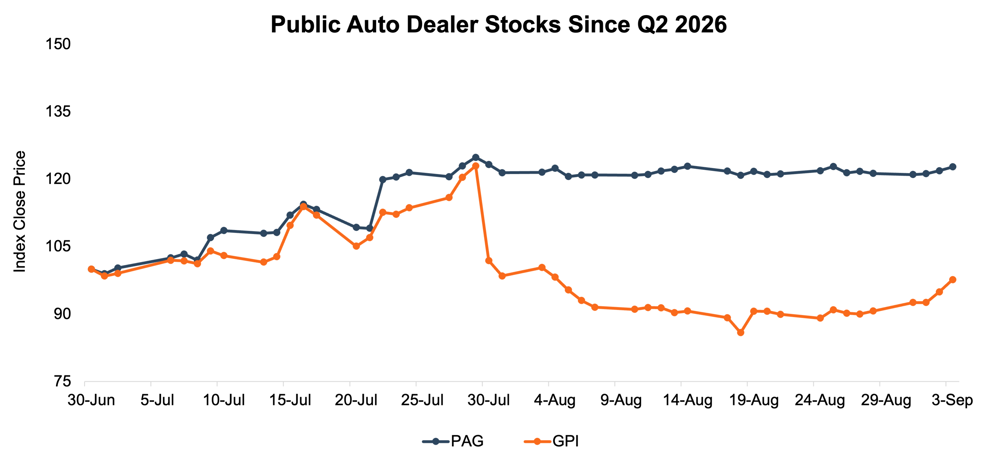
With Group 1’s stock declining on deal announcement and Penske’s going up, some may contend dealerships are worth more privately than publicly. As seen below, Penske’s stock is up ~23% in the quarter while Group 1 is down~3%.
But further context is warranted. If you’re wondering about the other four publics, you’re asking the right questions. As seen below, all the publics saw a run-up in stock price of at least 23% through July 29 (while the S&P 500 was roughly flat) before falling an average of 14% over the next week while the S&P 500 rose 5%.
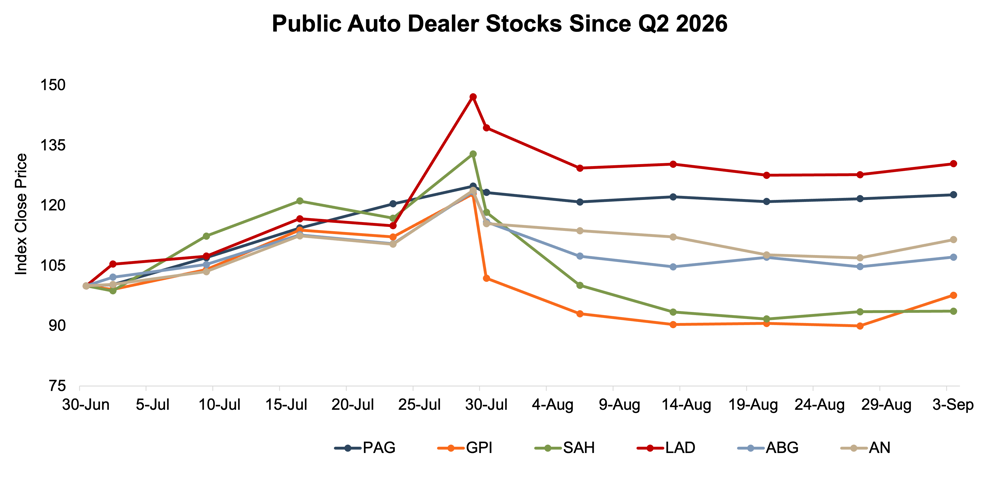
Indexed closing prices. Selected weekly dates to show earnings period
While Group 1 experienced the sharpest decline after its earnings release, it’s eked back above Sonic for the quarter. And while Penske’s price is held above its industry participants, somewhat artificially by the deal announcement, Lithia is having the strongest third quarter. The jury may still be out on whether dealerships are valued higher in the public or private markets, but this earnings season has surely demonstrated that investing in the public markets isn’t for the faint of heart.
Other Trends to Watch
Off-Lease Supply Is Beginning to Return
A more operational development across several calls was the return of vehicles reaching the end of their leases.
AutoNation expects lease-return volumes to increase meaningfully during the second half of 2026. Asbury was more explicit about the implications for used-vehicle sourcing, explaining that its strategy had been timed in part around lease returns beginning to come back and management noted that acquiring those vehicles can offer better economics than competing aggressively at auction. Penske noted that Toyota lease maturities are expected to increase from approximately 4,200 vehicles this year to 5,600 next year; Lexus from 2,500 to 3,100; and BMW from 9,500 to 10,700. Audi has approximately 4,600 maturities this year, with 58% expected in the second half. Penske views those vehicles as both a source of used inventory and a customer-retention opportunity, including through certified pre-owned sales.
For dealers, greater off-lease supply could improve access to late-model used inventory after several years of constrained availability and reduce some dependence on highly competitive auction channels.
U.S. Dealer Groups Are Getting an Early Look at Chinese OEM Economics
Chinese manufacturers are already becoming a meaningful factor for the U.K. operations of several U.S.-based public dealership groups.
Penske said Chinese brands had increased their U.K. market share from 7.5% to more than 15%, including more than 16% in June. Penske is approaching the opportunity pragmatically, often placing Chinese franchises in existing facilities rather than immediately committing to stand-alone stores. Penske management also emphasized the challenge of operating a new franchise without an established used-vehicle or fixed-operations business to help absorb dealership overhead.
Lithia management concurred, saying Chinese brands accounted for roughly half of its U.K. new-vehicle growth, while contributing relatively little to aftersales because there are few vehicles in operation and little to used vehicles because certified-used programs have not yet developed.
Lithia also contrasted the upfront capital investment required in the U.K. as compared to the U.S. In the U.K., dealership owners can often add these brands quickly with limited incremental investment. Management contrasted that with discussions in North America involving exclusive dealerships that could require $5 million, $10 million, or $20 million of investment while initially providing little aftersales contribution. Lithia therefore indicated that it expects to take a wait-and-see approach to how the opportunity develops in North America.
The experience overseas gives U.S. dealers an early look at the economics that could matter if additional Chinese OEM opportunities eventually develop here: required facility investment, new-vehicle throughput, development of used-car demand, and how long it takes to build enough parts-and-service activity to support the dealership's fixed-cost structure.