Corporate Valuation, Oil & Gas
shutterstock_2364977019.jpg

December 18, 2017

A Tale of Two Bakkens: Cashing Out or Doubling Down

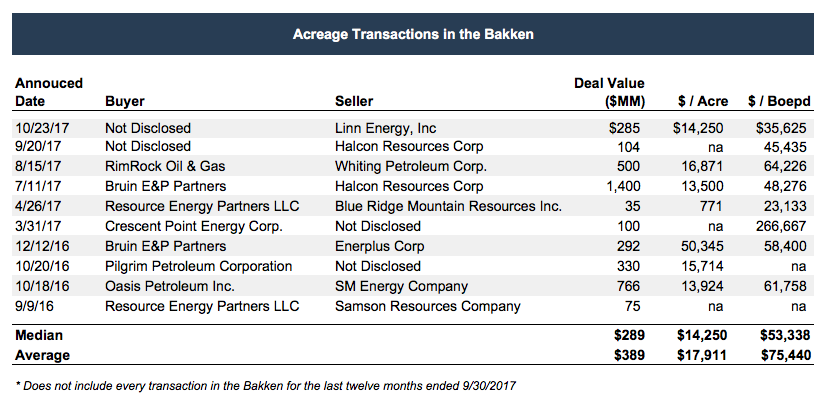
Transaction activity in the Bakken shale was both busy and revealing in the second half of 2017.  Many of these deals marked the departure of a number of companies that were known to be active in the play, particularly Halcon Resources. Other companies, however, have remained. The table below, drawn from Mercer Capital’s 3Q17 Bakken-focused newsletter, shows some details in regards to recent transactions, including some comparative valuation metrics.
Cashing Out

The first major transaction was Halcon’s $1.4 billion sale of the majority of its North Dakota operations to Bruin E&P Partners LLC (a private company).  Through this sale, as expected while resurfacing from bankruptcy, Halcon shifted focus to the Permian Basin.  In addition, the Company cited the possibility of an outright sale as well.  Two months later, Halcon sold its remaining Bakken assets (about 2,300 boe/day of production) for $110 million.

In addition Earthstone Energy, and more notably, Linn Energy exited the Bakken in the past several weeks. Linn entered the Bakken play in 2011 by buying out a position previously held primarily by Concho Energy for $434 million. They exited for $285 million which was approximately a 1.5x multiple of the PDP value of $186 million as of YE 2016.  It appears that Linn struggled with maximizing its production profile in light of the major price shift in 2014.  Earthstone Energy also left, with a small $27 million non-operating sale.  They, too, are shifting their focus to the Permian Basin.

Valuations for these transactions were relatively tight. The Linn and larger Halcon sales were priced around approximately $14,000 per acre. The Earthstone deal was much smaller, and its valuation on a per acre basis was much smaller as well at around $1,100 per acre.

Doubling Down

However, amid the struggles of these other operators, Whiting and Continental demonstrated signs of commitment and improvement in the Williston Basin.  Whiting sold its acreage position in Dunn County, North Dakota for $500 million. This amounted to a pricing of around $17,000 per acre, a premium to the Linn and Halcon sales.  This, of course, is a relative bargain on a per acre basis compared to the pricing in the Permian these days. Then again, the economics between the two basins at current pricing is also a far cry from each other, with the Permian having clearly superior characteristics.  Nonetheless, this did not signal an exit for Whiting, but was a signal to reduce leverage and give it balance sheet flexibility for its remaining Bakken acreage.  Whiting is optimistic that recent improvements in oil pricing differentials and improved enhanced completion techniques will press to its advantage going forward in the play.

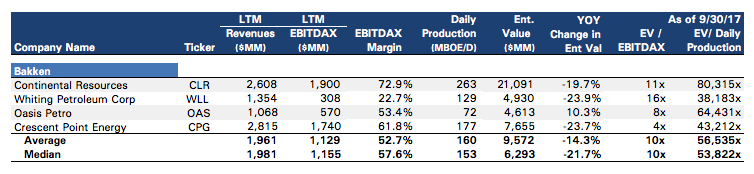
While Whiting has not yet been able to scale its optimism, Continental has surprised many in the past year with its recent performance.  In light of the challenges of the play, Continental has continued to improve its drilling and completion techniques, while elements they can’t control (such as oil prices) begin to swing back in their favor.  As such, they have dropped LOE's and G&A to the lower end of their peer range, while netbacks are rising.  All of this has happened, while many peers (as demonstrated above) have struggled or are leaving the area.
Not all is the same.  Performance and valuations in the Bakken appear to be mixed and right now it appears that the operator’s skill and knowledge is as important a value driver as the acreage they drill on. Mercer Capital has significant experience valuing assets and companies in the oil and gas industry, primarily oil and gas, bio fuels, and other minerals. Our oil and gas valuations have been reviewed and relied on by buyers and sellers and Big 4 auditors. These oil and gas-related valuations have been utilized to support valuations for IRS estate and gift tax, GAAP accounting, and litigation purposes. We have performed oil and gas valuations and associated oil and gas reserves domestically throughout the United States and in foreign countries. Contact a Mercer Capital professional today to discuss your valuation needs in confidence.

Continue Reading

Defying the Cycle: Haynesville Production Strength in a Shifting Gas Market
Haynesville shale production defied broader market softness in 2025, leading major U.S. basins with double-digit year-over-year growth despite heightened volatility and sub-cycle drilling activity. Efficiency gains, DUC drawdowns, and Gulf Coast demand dynamics allowed operators to sustain output even as natural gas prices fluctuated sharply.
Haynesville Shale M&A Update: 2025 in Review
Key TakeawaysHaynesville remains a strategic LNG-linked basin. 2025 transactions emphasized long-duration natural gas exposure and proximity to Gulf Coast export infrastructure, reinforcing the basin’s importance in meeting global LNG demand.International utilities drove much of the activity. Japanese power and gas companies pursued direct upstream ownership, signaling a shift from traditional offtake agreements toward greater control over U.S. gas supply.M&A was selective but meaningful in scale and intent. While overall deal volume was limited, announced transactions and reported negotiations reflected deliberate, long-term positioning rather than opportunistic shale consolidation.OverviewM&A activity in the Haynesville Shale during 2025 was marked by strategic, LNG-linked transactions and renewed international investor interest in U.S. natural gas assets. While investors remained selective relative to prior shale upcycles, transactions that did occur reflected a clear pattern: buyers focused on long-duration gas exposure, scale, and proximity to Gulf Coast export markets rather than short-term development upside.Producers and capital providers increasingly refocused efforts on the Haynesville basin during the year, including raising capital to acquire both operating assets and mineral positions. This renewed attention followed a period of subdued transaction activity and underscored the basin’s continued relevance within global natural gas portfolios.Although the Haynesville did not experience the breadth of consolidation seen in some oil-weighted plays, the size, counterparties, and strategic motivations behind 2025 transactions reinforced the basin’s role as a long-term supply source for LNG-linked demand.Announced Upstream TransactionsTokyo Gas (TG Natural Resources) / ChevronIn April 2025, Tokyo Gas Co., through its U.S. joint venture TG Natural Resources, entered into an agreement to acquire a 70% interest in Chevron’s East Texas natural gas assets for $525 million. The assets include significant Haynesville exposure and were acquired through a combination of cash consideration and capital commitments.The transaction was characterized as part of Tokyo Gas’s broader strategy to secure long-term U.S. natural gas supply and expand its upstream footprint. The deal reflects a growing trend among international utilities to obtain direct exposure to U.S. shale gas through ownership interests rather than relying solely on long-term offtake contracts or third-party supply arrangements.From an M&A perspective, the transaction highlights continued willingness among major operators to monetize non-core or minority positions while retaining operational involvement, and it underscores the Haynesville’s attractiveness to buyers with a long-term, strategic view of gas demand.JERA / Williams & GEP Haynesville IIIn October 2025, JERA Co., Japan’s largest power generator, announced an agreement to acquire Haynesville shale gas production assets from Williams Companies and GEP Haynesville II, a joint venture between GeoSouthern Energy and Blackstone. The transaction was valued at approximately $1.5 billion.This acquisition marked JERA’s first direct investment in U.S. shale gas production, representing a notable expansion of the company’s upstream exposure and reinforcing JERA’s interest in securing supply from regions with strong connectivity to U.S. LNG export infrastructure.This transaction further illustrates the appeal of the Haynesville to international buyers seeking stable, scalable gas assets and highlights the role of upstream M&A as a tool for portfolio diversification among global utilities and energy companies.Reported Negotiations (Not Announced)Mitsubishi / Aethon Energy ManagementIn June 2025, Reuters reported that Mitsubishi Corp. was in discussions to acquire Aethon Energy Management, a privately held operator with substantial Haynesville production and midstream assets. The potential transaction was reported to be valued at approximately $8 billion, though Reuters emphasized that talks were ongoing and that no deal had been finalized at the time.While the transaction was not announced during 2025, the reported discussions were notable for both their scale and the identity of the potential buyer. Aethon has long been viewed as one of the largest private platforms in the Haynesville, and any transaction involving the company would represent a significant consolidation event within the basin.The reported talks underscored the depth of international interest in Haynesville-oriented platforms and highlighted the potential for large-scale transactions even in an otherwise measured M&A environment.ConclusionWhile overall deal volume remained selective, the transactions and reported negotiations in 2025 reflected sustained global interest in U.S. natural gas assets with long-term relevance. Collectively, the transactions and negotiations discussed above point to a Haynesville M&A landscape driven less by opportunistic consolidation and more by deliberate, long-term positioning. As global energy portfolios continue to evolve, the Haynesville basin remains a focal point for strategic investment, particularly for buyers seeking exposure tied to U.S. natural gas supply and LNG export linkages.
Mineral Aggregator Valuation Multiples Study Released-Data as of 06-11-2025
Mineral Aggregator Valuation Multiples Study Released

With Market Data as of June 11, 2025

Mercer Capital has thoughtfully analyzed the corporate and capital structures of the publicly traded mineral aggregators to derive meaningful indications of enterprise value. We have also calculated valuation multiples based on a variety of metrics, including distributions and reserves, as well as earnings and production on both a historical and forward-looking basis.

Cart

Your cart is empty