Corporate Valuation, Oil & Gas
shutterstock_2364977019.jpg

March 1, 2017

Are S&P Energy Stock Valuations Really Crazy Right Now?

A few days ago the Wall Street Journal published an article discussing what the author described as “crazy” stock valuations, and in particular the inflated valuations of oil and gas stocks from the perspective of operating earnings ratios.

“The energy sector stands at more than 30 times Thomson Reuters IBES’s estimate of operating earnings over the next 12 months, higher than any time from when the sector data started in 1995 up to last year – when it briefly reached an extreme of almost 60 times.”

The article also mentions that the S&P 500 as a whole is trading at almost 18 times estimated future operating margins.  This got us to thinking - In light of what has transpired over the past two plus years in the energy sector, could it really be that stocks are overvalued?  That certainly hasn’t been the sentiment that we hear from our clients.  Maybe we’re all wrong?  If so, what could be driving this?

While we certainly are believers that value is driven by future operating earnings, and that earnings in the energy sector have fallen precipitously since 2014, is this all that determines the market’s pricing of the S&P 500 energy sector?  As we reflect on this for a moment, a few additional considerations came to mind that may explain these “crazy” valuations more fully.

Anticipated Tax Relief

One consideration not captured in an operating earnings ratio that markets are using to impact values is expectations for future tax reform.  Since the new administration has been inaugurated the stock market has risen significantly.  Clearly, one of the sources of this market optimism is the platform of tax reform – including corporate taxes.  There are a number of sources describing what this new structure may look like.  One particularly insightful article was written by Jason B. Freeman in the January/February issue of Today’s CPA titled "Tax Reform Under a Trump Administration".

President Trump’s plan would drop the corporate tax rate from 35% (among the highest in the world) to 15% or 20%.  This would immediately bring tax relief at a corporate level and boost earnings.  Judging by the equity market’s early reaction this morning to Mr. Trump’s State of the Union address, in which he highlighted this issue, anticipation of this action is fueling higher stock prices.

Anticipated Regulation Reform

The market may also be considering the future impact President Trump’s regulation reform.  While there is much uncertainty surrounding the future regulation of the oil and gas industry, President Trump ran as a friend to the oil and gas sector and promised to reduce regulations on the industry in order to boost the U.S. economy. Additionally, Oklahoma Attorney General Scott Pruitt was confirmed as the Environmental Protection Agency administrator.  Pruitt has openly opposed the EPA, which is one of the main regulators of the oil and gas industry.  Looser regulations on the oil and gas industry could reduce operating expenses associated with meeting current regulation and could provide new opportunities for the industry.

Growth Underpinnings

The energy sector has been hit hard, but a less visible aspect of the WSJ article’s premise is that there are signs that the energy sector’s depression in earnings may be short lived and the market is forecasting a rebound.  Consider this, the price of oil is at or near decade lows and earnings are sensitive to commodity prices, particularly when the price of oil hovers close to breakeven costs for producers (which it is currently).  Slight upward changes in oil and gas prices could have significant upward impacts on profits.  In addition, due to the drop in commodity prices, the industry has responded by innovating and pushing costs downward for drilling shale wells.

Reserves Reserves Reserves!

Another aspect that can’t be detected by an operating earnings ratio is how awash in reserves we currently are.  U.S. crude oil inventories have hit all-time highs, and demonstrate how poised the energy sector is to respond to manufacturing and consumer growth.
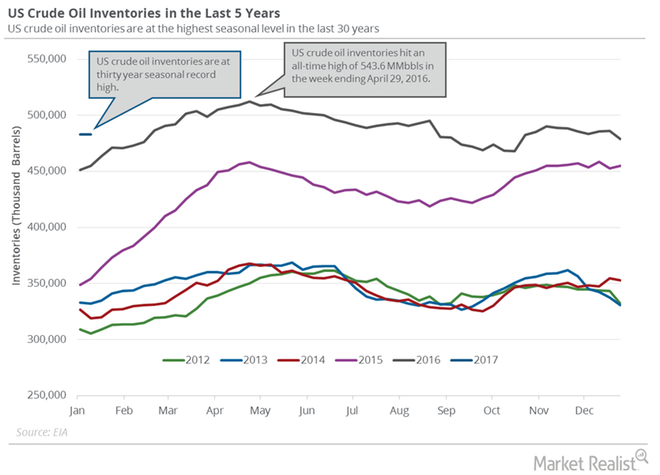
us-crude-oil-inventories Reserves are the foundation of value for E&P companies which is why this metric is oftentimes much more important than mere earnings.  It shows the potential for earnings 5 to 10 years or even 20 years down the road, which is something one year earnings estimates do not consider.  Better ratios to consider here are equity values relative to daily or annual production or total proved reserves.

The Big Picture

At any given moment it can be hard to say if equities, sectors or companies are “overvalued”.  Valuation is relative to begin with and ultimately at a point in time the “value” is what market participants will pay.  As it pertains to oil and gas companies, it appears clear that earnings are low as the sector better copes with $50-55 oil and $3 gas.  However, the market appears to see brighter days ahead, beyond 2017 and that confidence along with optimism for tax reform, operating efficiencies, and positioning for future growth are buoying prices.  Perhaps investors aren’t crazy after all.  Of course that’s just my opinion….I could be wrong.

Continue Reading

Defying the Cycle: Haynesville Production Strength in a Shifting Gas Market
Haynesville shale production defied broader market softness in 2025, leading major U.S. basins with double-digit year-over-year growth despite heightened volatility and sub-cycle drilling activity. Efficiency gains, DUC drawdowns, and Gulf Coast demand dynamics allowed operators to sustain output even as natural gas prices fluctuated sharply.
Haynesville Shale M&A Update: 2025 in Review
Key TakeawaysHaynesville remains a strategic LNG-linked basin. 2025 transactions emphasized long-duration natural gas exposure and proximity to Gulf Coast export infrastructure, reinforcing the basin’s importance in meeting global LNG demand.International utilities drove much of the activity. Japanese power and gas companies pursued direct upstream ownership, signaling a shift from traditional offtake agreements toward greater control over U.S. gas supply.M&A was selective but meaningful in scale and intent. While overall deal volume was limited, announced transactions and reported negotiations reflected deliberate, long-term positioning rather than opportunistic shale consolidation.OverviewM&A activity in the Haynesville Shale during 2025 was marked by strategic, LNG-linked transactions and renewed international investor interest in U.S. natural gas assets. While investors remained selective relative to prior shale upcycles, transactions that did occur reflected a clear pattern: buyers focused on long-duration gas exposure, scale, and proximity to Gulf Coast export markets rather than short-term development upside.Producers and capital providers increasingly refocused efforts on the Haynesville basin during the year, including raising capital to acquire both operating assets and mineral positions. This renewed attention followed a period of subdued transaction activity and underscored the basin’s continued relevance within global natural gas portfolios.Although the Haynesville did not experience the breadth of consolidation seen in some oil-weighted plays, the size, counterparties, and strategic motivations behind 2025 transactions reinforced the basin’s role as a long-term supply source for LNG-linked demand.Announced Upstream TransactionsTokyo Gas (TG Natural Resources) / ChevronIn April 2025, Tokyo Gas Co., through its U.S. joint venture TG Natural Resources, entered into an agreement to acquire a 70% interest in Chevron’s East Texas natural gas assets for $525 million. The assets include significant Haynesville exposure and were acquired through a combination of cash consideration and capital commitments.The transaction was characterized as part of Tokyo Gas’s broader strategy to secure long-term U.S. natural gas supply and expand its upstream footprint. The deal reflects a growing trend among international utilities to obtain direct exposure to U.S. shale gas through ownership interests rather than relying solely on long-term offtake contracts or third-party supply arrangements.From an M&A perspective, the transaction highlights continued willingness among major operators to monetize non-core or minority positions while retaining operational involvement, and it underscores the Haynesville’s attractiveness to buyers with a long-term, strategic view of gas demand.JERA / Williams & GEP Haynesville IIIn October 2025, JERA Co., Japan’s largest power generator, announced an agreement to acquire Haynesville shale gas production assets from Williams Companies and GEP Haynesville II, a joint venture between GeoSouthern Energy and Blackstone. The transaction was valued at approximately $1.5 billion.This acquisition marked JERA’s first direct investment in U.S. shale gas production, representing a notable expansion of the company’s upstream exposure and reinforcing JERA’s interest in securing supply from regions with strong connectivity to U.S. LNG export infrastructure.This transaction further illustrates the appeal of the Haynesville to international buyers seeking stable, scalable gas assets and highlights the role of upstream M&A as a tool for portfolio diversification among global utilities and energy companies.Reported Negotiations (Not Announced)Mitsubishi / Aethon Energy ManagementIn June 2025, Reuters reported that Mitsubishi Corp. was in discussions to acquire Aethon Energy Management, a privately held operator with substantial Haynesville production and midstream assets. The potential transaction was reported to be valued at approximately $8 billion, though Reuters emphasized that talks were ongoing and that no deal had been finalized at the time.While the transaction was not announced during 2025, the reported discussions were notable for both their scale and the identity of the potential buyer. Aethon has long been viewed as one of the largest private platforms in the Haynesville, and any transaction involving the company would represent a significant consolidation event within the basin.The reported talks underscored the depth of international interest in Haynesville-oriented platforms and highlighted the potential for large-scale transactions even in an otherwise measured M&A environment.ConclusionWhile overall deal volume remained selective, the transactions and reported negotiations in 2025 reflected sustained global interest in U.S. natural gas assets with long-term relevance. Collectively, the transactions and negotiations discussed above point to a Haynesville M&A landscape driven less by opportunistic consolidation and more by deliberate, long-term positioning. As global energy portfolios continue to evolve, the Haynesville basin remains a focal point for strategic investment, particularly for buyers seeking exposure tied to U.S. natural gas supply and LNG export linkages.
Mineral Aggregator Valuation Multiples Study Released-Data as of 06-11-2025
Mineral Aggregator Valuation Multiples Study Released

With Market Data as of June 11, 2025

Mercer Capital has thoughtfully analyzed the corporate and capital structures of the publicly traded mineral aggregators to derive meaningful indications of enterprise value. We have also calculated valuation multiples based on a variety of metrics, including distributions and reserves, as well as earnings and production on both a historical and forward-looking basis.

Cart

Your cart is empty