Corporate Valuation, Oil & Gas

September 11, 2017

How to Use Reserve Reports When Determining Fair Market Value

Last week, Lucas Paris analyzed the SEC’s $6.2 million settlement with a Big 4 audit firm relating to auditing failures associated with Miller Energy Resources, an oil and gas company with activities in the Appalachian region of Tennessee and in Alaska. In late 2009, Miller acquired certain Alaskan oil and gas interests for an amount the company estimated at $4.5 million. The company subsequently assigned a value of $480 million to the acquired assets, resulting in a one-time after-tax bargain purchase gain of $277 million. Following the deal, the newly acquired assets comprised more than 95% of Miller’s total reported assets.

The SEC order determines that the Big 4 audit firm did not properly use the reserve reports conclusion of PV-10 (present value at 10%).

This post considers the proper use of reserve reports and risk adjustment factors when determining fair market value.

What Is Fair Market Value?

The American Society of Appraisers defines the fair market value as:

The price, expressed in terms of cash equivalents, at which property would change hands between a hypothetical willing and able buyer and a hypothetical willing and able seller, acting at arm’s length in an open and unrestricted market, when neither is under compulsion to buy or sell and when both have reasonable knowledge of the relevant facts.1

Treasury Regulation Section 1.611-1(d)(2) provides guidance in determining the fair market value of oil and gas properties.  It similarly provides that “the fair market value of an [oil and gas] property is the amount which would induce a willing seller to sell and a willing buyer to purchase.”  Additionally, Section 1.611-2(g) outlines some considerations that a valuation of mineral properties must include for tax-oriented appraisals.  A summary of these considerations is shown in the chart below.
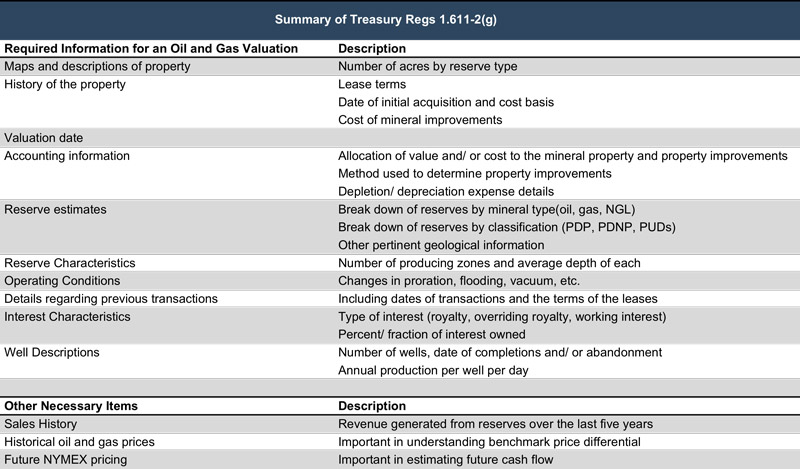
A review of Treasury Regulations 1.611-2(g) clearly demonstrates that an analyst must do more than rely on reserve reports when determining fair market value.

What Is a Reserve Report?

The SEC defines reserves as “estimated remaining quantities of oil and gas and related substances anticipated to be economically producible, as of a given date, by application of development projects to known accumulations.”

A reserve report is prepared by a petroleum engineer who estimates the remaining quantities of oil and gas and categorizes them based on the likelihood that they will be produced.  There are three main categories of proved reserves (P1) which are distinguished in a reserve report. Proven reserves are defined to have at least a 90% probability of being recovered.

  1. Proved Developed Producing (PDP) reserves are defined by the OJFG as “the estimated remaining quantities of oil and gas anticipated to be economically producible, as of a given date, by application of development projects to known accumulations under existing economic and operating conditions.”
  2. Proved Developed Non-Producing (PDNP) reserves are proven reserves “that can be expected to be recovered through existing wells and existing equipment and operating methods.”
  3. Proved Undeveloped (PUDs) reserves are proven reserves “that are expected to be recovered from new wells on undrilled acreage or from existing wells where a relatively major expenditure is required for completion.”
Other reserve categories include probable (P2) and possible (P3) reserves, which must exceed 50% and 10% probability of recovery, respectively. Reserve reports estimate future production of all proved reserves. From this, they predict future revenue and future expenses and discount the net income using a 10% standard discount rate.  PV-10 is the resulting estimate of the present value of the company’s cash flow from proved oil and gas reserves. It is standardized value which provides consistency across public companies filings.  However, PV-10 is not necessarily an accurate representation of fair market value. PV-10 assumes that all categories or proved reserves are equally risky.  In reality, a potential buyer would not pay as much for an interest in PUD acreage as they would for PDP acreage because there is substantially more risk associated with the PUD acreage. If a valuation expert had been hired to do a purchase price allocation for Miller Energy’s acquisition of oil and gas interest in Alaska, PV-10 would not have been used as the fair market value.  Rather, a valuation specialist with industry expertise would have performed a discounted cash flow analysis and evaluated how certain risks that pertain to each asset affect the value.

How to Use a Reserve Report

The income approach is generally accepted among industry professionals as the most accurate representation of fair market value of oil and gas interests, and the reserve report can be used as one of the main sources of information for the inputs of the discounted cash flow.  Treasury Reg 1.611-2(e)(4) provides a straightforward outline of how the approach should be used.  In general, a discounted cash flow analysis is the method of choice.

In practice, the income approach requires that:

  1. The appraiser project income, expense, and net income on an annual basis
Thus, revenue and expense projections used in the income approach can be directly harvested from this report.
  1. Each year’s net income is discounted for interest at the “going rate” to determine the present worth of the future income on an annual and total basis
This is where a reserve report and a calculation of fair market value differ.  While a reserve report uses a standard 10% discount rate, when determining fair market value a discount rate which considers potential risk factors should be developed.  An analyst could add a risk premium for each reserve category to adjust a baseline WACC or they could account for this risk in a separate adjustment.
  1. The total present worth of future income is then discounted further, a percentage based on market conditions, to determine the fair market value.
PV-10 treats PDP, PDNP, and PUDs the same. However, there are uncertainties and opportunities associated with PUDs that are not captured in the discount rate used for all proved reserves.  A risk adjustment factor could be used to the discounted present value of cash flows according to the category of the reserves being valued to account for PUDs upside and uncertainty by reducing expected returns from an industry weighted average cost of capital (WACC)

What About Probable and Possible Reserves?

Reserve reports only account for proven reserves; they do not estimate the value of possible and probably reserves which are less likely to be recovered.  While less certain, there is still some potential upside of the Probable and Possible reserve categories.  In order to estimate the value of probable and possible reserves the market approach can be used.

The market approach is a general way of determining a value indication of an asset by using one or more methods that compare the subject to similar assets that have been sold.  Because reserve values vary between oil and gas plays and even within a single play, finding comparable transactions is difficult. A comparable sale must have occurred at a similar time due to the volatile nature of oil and gas prices.  A comparable sale should be for a property that is located within the same play and within a field of similar maturity.

If transactions show premiums over the value of proven reserves, then the buyer likely was paying for something else in addition to the proved reserves; he was likely paying for the less certain upside potential of probable and possible reserves.  Through these transactions, the value of these reserves can be understood as they vary by basin and between fields.  In many basins probable and possible reserves may currently be worthless because the price of oil may not rebound to a point where it would be economical to explore for and drill these reserves; however, in fields such as the Delaware and Midland Basins in the Permian recent transactions tell a different story.

The valuation implications of reserves and acreage rights can swing dramatically in resource plays. While a reserve report is helpful, it does not measure fair market value or fair value.  Utilizing an experienced oil and gas reserve appraiser can help to understand how location impacts valuation issues in this current environment. Contact Mercer Capital to discuss your needs and learn more about how we can help you succeed.


End Notes

1 American Society of Appraisers, ASA Business Valuation Standards© (Revision published November 2009), “Definitions,” p. 27.

Continue Reading

EP Second Quarter 2026 Permian Basin
E&P Second Quarter 2026

Region Focus: Permian Basin

The Permian Basin continued to demonstrate its resilience in the twelve-month period through June 30, 2026 (the review period). Despite a modest decline in rig counts, production reached new highs as operators continued to emphasize capital discipline, drilling efficiencies, and productivity improvements. Heightened geopolitical tensions introduced considerably greater volatility into commodity markets during the latter portion of the review period, yet oil prices ended above year-earlier levels and Permian public companies posted strong stock price appreciation. While basin operators continue to balance disciplined capital allocation with long-term production growth, the Permian remains the nation’s premier oil-producing basin and continues to demonstrate its ability to adapt to changing market conditions.
Just Released: Q2 2026 Oil & Gas Industry Newsletter
Regional Focus: The Permian BasinThe Permian continued to demonstrate its resilience in the twelve-month period through June 30, 2026 (the review period). Despite a modest decline in rig counts, production reached new highs as operators continued to emphasize capital discipline, drilling efficiencies, and productivity improvements. Heightened geopolitical tensions introduced considerably greater volatility into commodity markets during the latter portion of the review period, yet oil prices ended above year-earlier levels and Permian public companies posted strong stock price appreciation. While basin operators continue to balance disciplined capital allocation with long-term production growth, the Permian remains the nation’s premier oil-producing basin and continues to demonstrate its ability to adapt to changing market conditions.
Bryce Erickson Discusses the Changing Economics of Upstream Asset Valuations with Hart Energy
Mercer Capital’s Energy Industry Team Leader, Bryce Erickson, ASA, MRICS, recently shared his perspective on upstream asset valuations in two features published by Hart Energy.Bryce joined other industry professionals at Hart Energy’s 2026 Energy Capital Conference, where he participated in the panel, “Asset Valuations in a High-Price World: Separating Signal from Noise.” The discussion examined how investors, lenders, and operators are assessing energy assets amid elevated commodity prices, increasingly scarce drilling inventory, and continued consolidation across the upstream sector.Markets Turn Their Attention to Tier 2 and Tier 3 AcreageIn a video interview with Hart Energy’s Chris Mathews, Bryce discusses how the scarcity of available Tier 1 acreage is directing greater attention toward Tier 2 and Tier 3 opportunities.As the inventory of premium drilling locations becomes increasingly concentrated, buyers are looking more closely at assets that may previously have received less attention. Higher commodity prices and continued improvements in drilling and completion techniques can make some of these locations more economically attractive. However, broad acreage classifications tell only part of the story. Investors must still examine the specific geology, operating costs, development plans, decline expectations, and risks associated with each asset. Bryce’s comments underscore the importance of disciplined, asset-specific underwriting as competition expands beyond traditionally defined core acreage.How the “Last Cheap Barrels” May Influence BidsHart Energy’s Lisa El-Amin further explores the relationship between inventory scarcity and upstream deal values in “How the Last Cheap Barrels May Be Shaping Today’s Bids” (subscription required).The article considers how competition is shifting toward a diminishing pool of drilling locations capable of generating attractive returns at approximately $50 oil, with much of that inventory concentrated in the Permian Basin. As low-breakeven locations become harder to acquire or replace, buyers may be willing to place greater value on assets offering durable inventory, favorable cost structures, and a long development runway. The result is an M&A market in which bids are increasingly influenced by the quality and scarcity of future drilling opportunities—not simply current production or near-term commodity prices.Valuation ImplicationsTogether, the two Hart Energy features highlight that asset quality and inventory durability are becoming more visible, and potentially more valuable, as the shale sector matures.Determining how these factors affect a particular company or asset requires careful analysis of its reserves, development inventory, cost structure, operating assumptions, and expected cash flows. Mercer Capital has assisted clients with a wide range of valuation needs in the upstream oil and gas industry across both conventional and unconventional plays in North America and around the world. Contact a Mercer Capital professional to discuss your valuation needs in confidence.

Cart

Your cart is empty