Oil & Gas
shutterstock_2364977019.jpg

February 12, 2018

2018 NAPE Expo Observations & Thoughts

Mercer Capital again attended the NAPE Expo in Houston this past week.  People, information, and ideas abounded with over 11,000 participants and 800 exhibitors.

We met and had numerous discussions with company representatives, dealmakers, and service providers alike.  The marketplace remains excited about the potential for 2018.

A recurring theme of the Wednesday conference was restructuring and bankruptcy in light of the continuing bankruptcy activity in 2017.  The ramp up in M&A activity in 2017 was also discussed. We summarize that information here.

Restructuring & Bankruptcies

Success stories were presented, such as Samson Resources’ CEO Joseph Mills discussing their successful emergence from Chapter 11 bankruptcy whereby approximately $4 billion of debt and $300 million in interest expense was discharged.

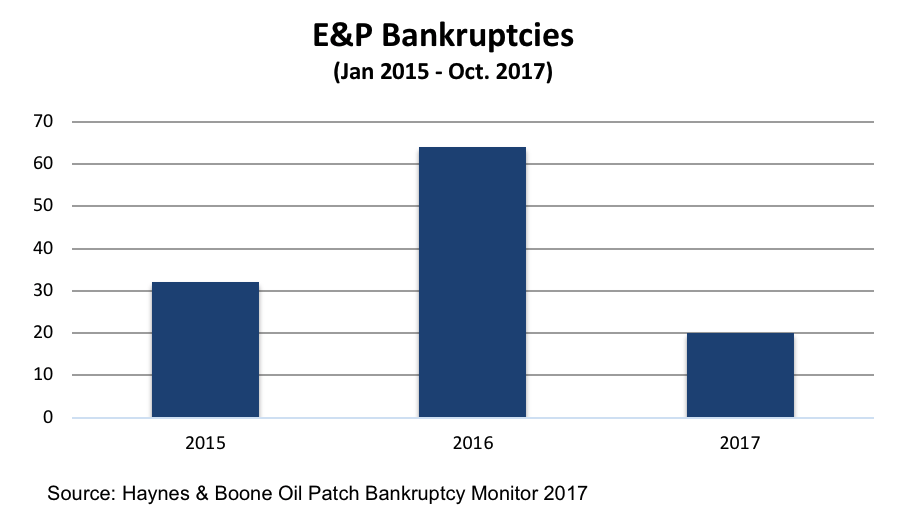
A panel discussion on navigating the distressed oil and gas world was thought-provoking.  The panel participants provided an overview of the 2017 bankruptcy environment as well as where we are headed in 2018 (including statistics and commentary).  From 2015 through October 2017, there were a total of 116 U.S. producer bankruptcies representing $80 billion of secured and unsecured debt.
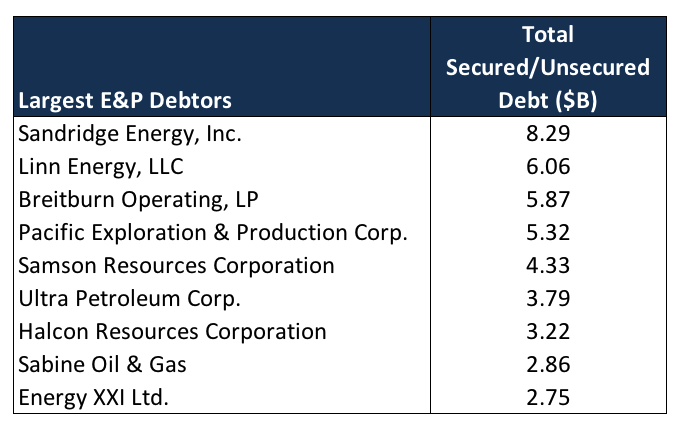
Because some of these bankruptcies were very large and complicated, the panel discussed the cost/benefit factors of various restructuring and bankruptcy scenarios. Cautionary commentary acknowledged that it’s expensive to file bankruptcy (sort of an oxymoron) and that even the best laid plans can fall apart when various creditors and equity holders come into contact in a bankruptcy court.  One panelist (Jason Binford) noted that it’s also expensive and potentially fatal to wait to file bankruptcy. Many times there’s a lot at stake as the table below demonstrates. Strategies to avoid bankruptcy were categorized between internal & external options.  Internal options included (i) operational improvements, (ii) portfolio management, and (iii) liquidity management. External solutions included (i) capital markets/M&A, and (ii) liability management – including Chapter 11 bankruptcy, in which the audience was reminded that a company does not have to be insolvent to enter into Chapter 11.
3rd Party Valuations Can Be Critically Important in Bankruptcies

The importance and contentiousness of valuations was emphasized, particularly when equity committees believe that there is more value to the company than what other participants may think.  In those situations, a quality and persuasive valuation can be critical and be the difference between the court wiping out prior equity holders and replacing them with new equity holders.

The panel also advised not letting short-term price movements overly dictate strategy in this volatile priced industry.

Increasing M&A Activity Pace in 2017

Upstream M&A activity accelerated quickly in 2017; however, deal activity declined as commodity prices increased during the year.  There were 224 deals in 2017 (a 13% increase over 2016) totaling $181.97 billion (a 10% decrease).

Of the 224 deals, 106 were shale deals valued at $66.55 billion.  The most active basins were the Permian (unsurprisingly), followed by the Marcellus and then Eagle Ford.

From our standpoint, it was notable that on the Expo floor, away from the conference where shale plays took precedence, there was an incredible array of conventional, offshore, and international prospects that were still attractive and receiving attention.

Our Takeaways from 2018 NAPE Expo

Again, the marketplace remains excited about the potential for 2018.  The rise in commodity prices will likely not last through the year given the potential supply that is available to come online – whether through OPEC policy changes, reduction of DUC well inventory, or another means of changing supply and demand dynamics.

The U.S. upstream segment is well-positioned to continue to have positive economics due to increasingly efficient operations, technology, and innovation.

Thanks again to everyone we connected with this week.  The conversations were terrific, and we enjoyed getting to know all of you.  If you were there, let us know your thoughts and comments about NAPE.  We would love to hear them.  Have a great Valentine’s Day!

Continue Reading

Defying the Cycle: Haynesville Production Strength in a Shifting Gas Market
Haynesville shale production defied broader market softness in 2025, leading major U.S. basins with double-digit year-over-year growth despite heightened volatility and sub-cycle drilling activity. Efficiency gains, DUC drawdowns, and Gulf Coast demand dynamics allowed operators to sustain output even as natural gas prices fluctuated sharply.
Haynesville Shale M&A Update: 2025 in Review
Key TakeawaysHaynesville remains a strategic LNG-linked basin. 2025 transactions emphasized long-duration natural gas exposure and proximity to Gulf Coast export infrastructure, reinforcing the basin’s importance in meeting global LNG demand.International utilities drove much of the activity. Japanese power and gas companies pursued direct upstream ownership, signaling a shift from traditional offtake agreements toward greater control over U.S. gas supply.M&A was selective but meaningful in scale and intent. While overall deal volume was limited, announced transactions and reported negotiations reflected deliberate, long-term positioning rather than opportunistic shale consolidation.OverviewM&A activity in the Haynesville Shale during 2025 was marked by strategic, LNG-linked transactions and renewed international investor interest in U.S. natural gas assets. While investors remained selective relative to prior shale upcycles, transactions that did occur reflected a clear pattern: buyers focused on long-duration gas exposure, scale, and proximity to Gulf Coast export markets rather than short-term development upside.Producers and capital providers increasingly refocused efforts on the Haynesville basin during the year, including raising capital to acquire both operating assets and mineral positions. This renewed attention followed a period of subdued transaction activity and underscored the basin’s continued relevance within global natural gas portfolios.Although the Haynesville did not experience the breadth of consolidation seen in some oil-weighted plays, the size, counterparties, and strategic motivations behind 2025 transactions reinforced the basin’s role as a long-term supply source for LNG-linked demand.Announced Upstream TransactionsTokyo Gas (TG Natural Resources) / ChevronIn April 2025, Tokyo Gas Co., through its U.S. joint venture TG Natural Resources, entered into an agreement to acquire a 70% interest in Chevron’s East Texas natural gas assets for $525 million. The assets include significant Haynesville exposure and were acquired through a combination of cash consideration and capital commitments.The transaction was characterized as part of Tokyo Gas’s broader strategy to secure long-term U.S. natural gas supply and expand its upstream footprint. The deal reflects a growing trend among international utilities to obtain direct exposure to U.S. shale gas through ownership interests rather than relying solely on long-term offtake contracts or third-party supply arrangements.From an M&A perspective, the transaction highlights continued willingness among major operators to monetize non-core or minority positions while retaining operational involvement, and it underscores the Haynesville’s attractiveness to buyers with a long-term, strategic view of gas demand.JERA / Williams & GEP Haynesville IIIn October 2025, JERA Co., Japan’s largest power generator, announced an agreement to acquire Haynesville shale gas production assets from Williams Companies and GEP Haynesville II, a joint venture between GeoSouthern Energy and Blackstone. The transaction was valued at approximately $1.5 billion.This acquisition marked JERA’s first direct investment in U.S. shale gas production, representing a notable expansion of the company’s upstream exposure and reinforcing JERA’s interest in securing supply from regions with strong connectivity to U.S. LNG export infrastructure.This transaction further illustrates the appeal of the Haynesville to international buyers seeking stable, scalable gas assets and highlights the role of upstream M&A as a tool for portfolio diversification among global utilities and energy companies.Reported Negotiations (Not Announced)Mitsubishi / Aethon Energy ManagementIn June 2025, Reuters reported that Mitsubishi Corp. was in discussions to acquire Aethon Energy Management, a privately held operator with substantial Haynesville production and midstream assets. The potential transaction was reported to be valued at approximately $8 billion, though Reuters emphasized that talks were ongoing and that no deal had been finalized at the time.While the transaction was not announced during 2025, the reported discussions were notable for both their scale and the identity of the potential buyer. Aethon has long been viewed as one of the largest private platforms in the Haynesville, and any transaction involving the company would represent a significant consolidation event within the basin.The reported talks underscored the depth of international interest in Haynesville-oriented platforms and highlighted the potential for large-scale transactions even in an otherwise measured M&A environment.ConclusionWhile overall deal volume remained selective, the transactions and reported negotiations in 2025 reflected sustained global interest in U.S. natural gas assets with long-term relevance. Collectively, the transactions and negotiations discussed above point to a Haynesville M&A landscape driven less by opportunistic consolidation and more by deliberate, long-term positioning. As global energy portfolios continue to evolve, the Haynesville basin remains a focal point for strategic investment, particularly for buyers seeking exposure tied to U.S. natural gas supply and LNG export linkages.
Mineral Aggregator Valuation Multiples Study Released-Data as of 06-11-2025
Mineral Aggregator Valuation Multiples Study Released

With Market Data as of June 11, 2025

Mercer Capital has thoughtfully analyzed the corporate and capital structures of the publicly traded mineral aggregators to derive meaningful indications of enterprise value. We have also calculated valuation multiples based on a variety of metrics, including distributions and reserves, as well as earnings and production on both a historical and forward-looking basis.

Cart

Your cart is empty