Corporate Valuation, Oil & Gas
shutterstock_2364977019.jpg

September 26, 2018

Bakken Business

Companies that have maintained a presence in the Bakken since the downturn in oil prices are beginning to reap the rewards of their patience. Rising oil prices have begat increases in production, and efficiencies gained in recent years have led to higher margins and increased production. As noted in last week’s post about transaction activity in the region, while the Permian Basin has received much of the attention recently, the Bakken certainly appears to be back in business.

Efficient and Engaged Operators

Continental Resources, Hess Corporation, and Whiting Petroleum Corporation are among the biggest players in the region. Whiting has rebounded with its stock price up 141% in the past twelve months, and their related royalty trust Whiting USA Trust II has also shown improved performance. Speaking of the decline in oil prices, Continental’s CEO Harold Hamm said recently, “We would never have gained the efficiencies that we have today without going through that.” This can be further illustrated by looking at breakeven prices in the Bakken, which have dropped from about $77 in September 2014 to below $39 per barrel in the third quarter of 2018, lower than those seen in Texas.

Greg Hill, President and COO of Hess, recently emphasized the importance of the Bakken in their portfolio, saying about 43% of Hess’ capex budget would be devoted to the region over the next three years, targeting $1 billion annually.  He added that production constraints seen now in the Permian are very similar to those seen in the Bakken a few years ago.

Infrastructure Issues

The United States has long trailed other countries in terms of energy production.  With the leaps and bounds made in production, the question for industry executives and investors alike is now what? Increased production has led to the need for better infrastructure, a problem currently besetting the Permian basin in particular.  Extreme pricing differentials have occurred and plenty of natural gas coming off as a byproduct of oil production is being flared as a result.

About 388 million cubic feet per day of natural gas was flared in June in North Dakota. Kinder Morgan, one of the largest energy infrastructure companies has proposed a $30 million natural gas pipeline that would alleviate 130 million cubic feet per day, with the project slated to begin construction mid-2019 and be finished by year-end, pending regulatory approval. Pipelines have been cast by industry executives as a safer alternative to rail transportation, though critics view this as a straw man argument. With the introduction of the Dakota Access pipeline (DAPL) in mid-2017, about half of the region's production (470,000 barrels per day of crude oil) will travel by this pipeline.  Despite the DAPL and other pipelines like the one proposed by Kinder Morgan, rail travel will still figure heavily into the equation as refiners on the East and West coast have low pipeline connectivity and much of the oil from other regions ends up with one of the numerous refiners in the Gulf of Mexico.

The Minneapolis Fed recently outlined five other projects aimed at increasing gas processing capacity, including a $100 million expansion of a natural gas processing plant near Killdeer, ND. While companies seek high levels of production to take advantage of higher oil prices, these infrastructure constraints have a negative impact. Hamm emphasized this point saying, “Instead of just producing oil, we’re going to make sure we produce shareholder return.”

Rig Counts and Production

According to Baker Hughes, rig counts in North America declined 1.0% in the last three months, but increased 11.4% over the last twelve months. The Permian Basin has led the way with an increase of 26.2% in the past year, leading them to have 46.5% of total rigs. Rig counts peaked in the Bakken in May 2018, reaching heights unseen since 2015, but the Bakken continues to trail the Eagle Ford, Permian, and Appalachia regions. While rig counts aren’t ballooning in Bakken, this may be because operators like Continental are focusing on completing wells that have already been drilled (“DUCs”), a cheaper alternative to drilling new ones.

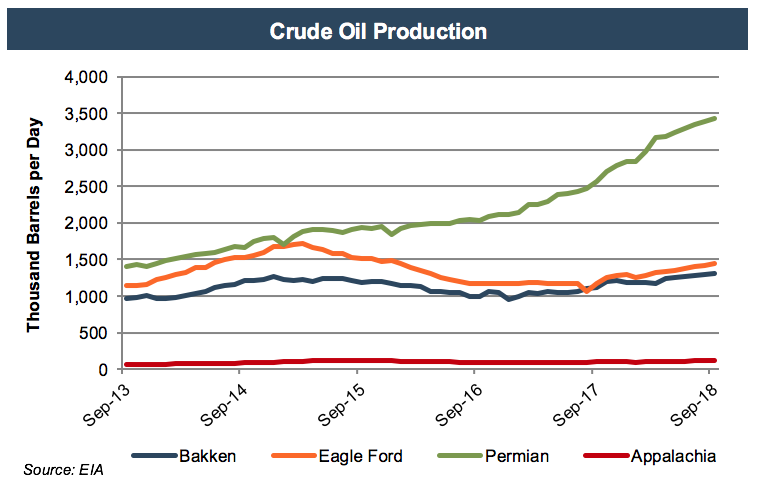
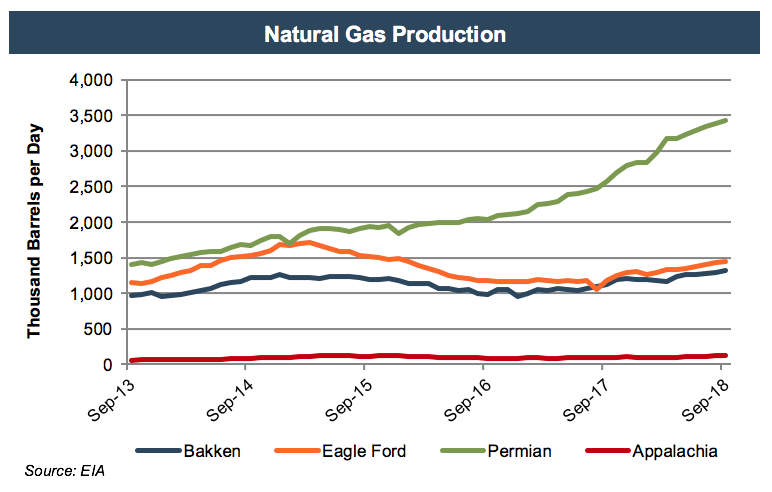
Although oil production in the Bakken has increased 9.9% in the past year, it lagged the other four regions covered with the Permian setting the pace with a 26.6% increase. Natural gas production in the Bakken increased 17.2% in that same time, again trailing the Permian’s growth of 25.5%. Given the Bakken only produces a little over a third as much crude oil and a fifth of the natural gas, it will be interesting to see if the Permian can maintain its torrid pace or if capacity constraints will allow others to close the gap.
Valuation Implications

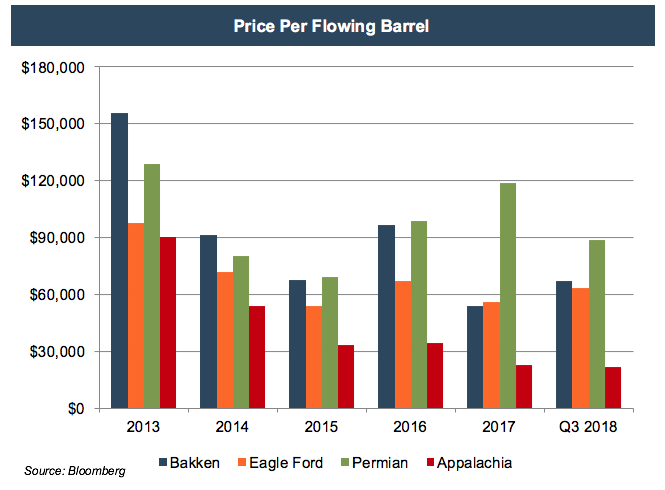
Before the crash in oil prices, the Bakken was booming with the highest EV/production multiples, also known as price per flowing barrel.  The Permian took center stage in 2017, but the Bakken is closing that gap as the Permian has come back to the pack a bit in 2018.
Conclusion

A rising tide raises all boats, and a rising oil price raises production in all regions. With the efficiencies gained, operators and investors in the Bakken and elsewhere will seek higher revenue and higher returns. Soaring production has led to unintended consequences such as flaring and inadequate infrastructure constraining capacity. Increasing this capacity will allow E&P Companies to increase returns and continue to ramp up production.

We have assisted many clients with various valuation needs in the upstream oil and gas space in both conventional and unconventional plays in North America, and around the world.  Contact a Mercer Capital professional to discuss your needs in confidence and learn more about how we can help you succeed.

Continue Reading

Defying the Cycle: Haynesville Production Strength in a Shifting Gas Market
Haynesville shale production defied broader market softness in 2025, leading major U.S. basins with double-digit year-over-year growth despite heightened volatility and sub-cycle drilling activity. Efficiency gains, DUC drawdowns, and Gulf Coast demand dynamics allowed operators to sustain output even as natural gas prices fluctuated sharply.
Haynesville Shale M&A Update: 2025 in Review
Key TakeawaysHaynesville remains a strategic LNG-linked basin. 2025 transactions emphasized long-duration natural gas exposure and proximity to Gulf Coast export infrastructure, reinforcing the basin’s importance in meeting global LNG demand.International utilities drove much of the activity. Japanese power and gas companies pursued direct upstream ownership, signaling a shift from traditional offtake agreements toward greater control over U.S. gas supply.M&A was selective but meaningful in scale and intent. While overall deal volume was limited, announced transactions and reported negotiations reflected deliberate, long-term positioning rather than opportunistic shale consolidation.OverviewM&A activity in the Haynesville Shale during 2025 was marked by strategic, LNG-linked transactions and renewed international investor interest in U.S. natural gas assets. While investors remained selective relative to prior shale upcycles, transactions that did occur reflected a clear pattern: buyers focused on long-duration gas exposure, scale, and proximity to Gulf Coast export markets rather than short-term development upside.Producers and capital providers increasingly refocused efforts on the Haynesville basin during the year, including raising capital to acquire both operating assets and mineral positions. This renewed attention followed a period of subdued transaction activity and underscored the basin’s continued relevance within global natural gas portfolios.Although the Haynesville did not experience the breadth of consolidation seen in some oil-weighted plays, the size, counterparties, and strategic motivations behind 2025 transactions reinforced the basin’s role as a long-term supply source for LNG-linked demand.Announced Upstream TransactionsTokyo Gas (TG Natural Resources) / ChevronIn April 2025, Tokyo Gas Co., through its U.S. joint venture TG Natural Resources, entered into an agreement to acquire a 70% interest in Chevron’s East Texas natural gas assets for $525 million. The assets include significant Haynesville exposure and were acquired through a combination of cash consideration and capital commitments.The transaction was characterized as part of Tokyo Gas’s broader strategy to secure long-term U.S. natural gas supply and expand its upstream footprint. The deal reflects a growing trend among international utilities to obtain direct exposure to U.S. shale gas through ownership interests rather than relying solely on long-term offtake contracts or third-party supply arrangements.From an M&A perspective, the transaction highlights continued willingness among major operators to monetize non-core or minority positions while retaining operational involvement, and it underscores the Haynesville’s attractiveness to buyers with a long-term, strategic view of gas demand.JERA / Williams & GEP Haynesville IIIn October 2025, JERA Co., Japan’s largest power generator, announced an agreement to acquire Haynesville shale gas production assets from Williams Companies and GEP Haynesville II, a joint venture between GeoSouthern Energy and Blackstone. The transaction was valued at approximately $1.5 billion.This acquisition marked JERA’s first direct investment in U.S. shale gas production, representing a notable expansion of the company’s upstream exposure and reinforcing JERA’s interest in securing supply from regions with strong connectivity to U.S. LNG export infrastructure.This transaction further illustrates the appeal of the Haynesville to international buyers seeking stable, scalable gas assets and highlights the role of upstream M&A as a tool for portfolio diversification among global utilities and energy companies.Reported Negotiations (Not Announced)Mitsubishi / Aethon Energy ManagementIn June 2025, Reuters reported that Mitsubishi Corp. was in discussions to acquire Aethon Energy Management, a privately held operator with substantial Haynesville production and midstream assets. The potential transaction was reported to be valued at approximately $8 billion, though Reuters emphasized that talks were ongoing and that no deal had been finalized at the time.While the transaction was not announced during 2025, the reported discussions were notable for both their scale and the identity of the potential buyer. Aethon has long been viewed as one of the largest private platforms in the Haynesville, and any transaction involving the company would represent a significant consolidation event within the basin.The reported talks underscored the depth of international interest in Haynesville-oriented platforms and highlighted the potential for large-scale transactions even in an otherwise measured M&A environment.ConclusionWhile overall deal volume remained selective, the transactions and reported negotiations in 2025 reflected sustained global interest in U.S. natural gas assets with long-term relevance. Collectively, the transactions and negotiations discussed above point to a Haynesville M&A landscape driven less by opportunistic consolidation and more by deliberate, long-term positioning. As global energy portfolios continue to evolve, the Haynesville basin remains a focal point for strategic investment, particularly for buyers seeking exposure tied to U.S. natural gas supply and LNG export linkages.
Mineral Aggregator Valuation Multiples Study Released-Data as of 06-11-2025
Mineral Aggregator Valuation Multiples Study Released

With Market Data as of June 11, 2025

Mercer Capital has thoughtfully analyzed the corporate and capital structures of the publicly traded mineral aggregators to derive meaningful indications of enterprise value. We have also calculated valuation multiples based on a variety of metrics, including distributions and reserves, as well as earnings and production on both a historical and forward-looking basis.

Cart

Your cart is empty