Corporate Valuation, Oil & Gas

April 17, 2018

Capital Structure in 30 Minutes Whitepaper

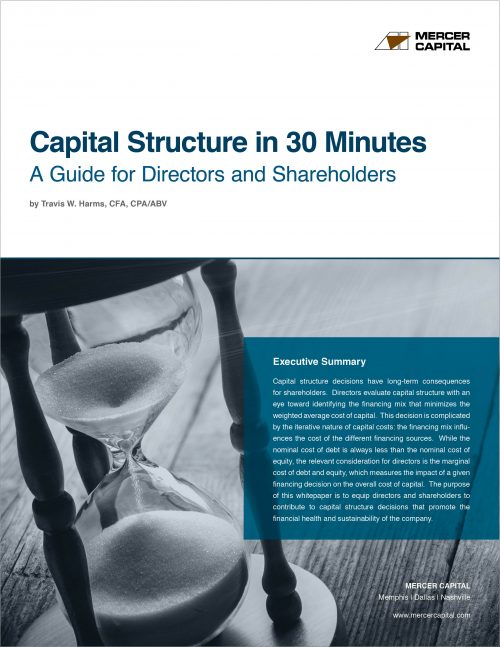
In this post, we share a recent whitepaper: "Capital Structure in 30 Minutes." Capital structure decisions have long-term consequences for shareholders.  Directors evaluate capital structure with an eye toward identifying the financing mix that minimizes the weighted average cost of capital.  This decision is complicated by the iterative nature of capital costs: the financing mix influences the cost of the different financing sources.  While the nominal cost of debt is always less than the nominal cost of equity, the relevant consideration for directors is the marginal cost of debt and equity, which measures the impact of a given financing decision on the overall cost of capital.  The purpose of this whitepaper is to equip directors and shareholders to contribute to capital structure decisions that promote the financial health and sustainability of the company. This whitepaper is the second in the "Corporate Finance in 30 Minutes Series." Learn more about the whitepaper series below.
  • Corporate Finance in 30 Minutes
    • In this whitepaper, we distill the fundamental principles of corporate finance into an accessible and non-technical primer.
  • Capital Structure in 30 Minutes
    • Through this whitepaper, we equip directors and shareholders to contribute to capital structure decisions that promote the financial health and sustainability of their companies.
  • Capital Budgeting in 30 Minutes
    • Capital Budgeting in 30 Minutes assists directors and shareholders evaluate proposed capital projects and contribute to capital budgeting decisions that enhance value.
  • Distribution Policy in 30 Minutes
    • Of the three primary corporate finance decisions, distribution policy is the most transparent to shareholders. This whitepaper helps directors formulate and communicate a distribution policy that contributes to shareholder wealth and satisfaction.

Continue Reading

EP Second Quarter 2026 Permian Basin
E&P Second Quarter 2026

Region Focus: Permian Basin

The Permian Basin continued to demonstrate its resilience in the twelve-month period through June 30, 2026 (the review period). Despite a modest decline in rig counts, production reached new highs as operators continued to emphasize capital discipline, drilling efficiencies, and productivity improvements. Heightened geopolitical tensions introduced considerably greater volatility into commodity markets during the latter portion of the review period, yet oil prices ended above year-earlier levels and Permian public companies posted strong stock price appreciation. While basin operators continue to balance disciplined capital allocation with long-term production growth, the Permian remains the nation’s premier oil-producing basin and continues to demonstrate its ability to adapt to changing market conditions.
Just Released: Q2 2026 Oil & Gas Industry Newsletter
Regional Focus: The Permian BasinThe Permian continued to demonstrate its resilience in the twelve-month period through June 30, 2026 (the review period). Despite a modest decline in rig counts, production reached new highs as operators continued to emphasize capital discipline, drilling efficiencies, and productivity improvements. Heightened geopolitical tensions introduced considerably greater volatility into commodity markets during the latter portion of the review period, yet oil prices ended above year-earlier levels and Permian public companies posted strong stock price appreciation. While basin operators continue to balance disciplined capital allocation with long-term production growth, the Permian remains the nation’s premier oil-producing basin and continues to demonstrate its ability to adapt to changing market conditions.
Bryce Erickson Discusses the Changing Economics of Upstream Asset Valuations with Hart Energy
Mercer Capital’s Energy Industry Team Leader, Bryce Erickson, ASA, MRICS, recently shared his perspective on upstream asset valuations in two features published by Hart Energy.Bryce joined other industry professionals at Hart Energy’s 2026 Energy Capital Conference, where he participated in the panel, “Asset Valuations in a High-Price World: Separating Signal from Noise.” The discussion examined how investors, lenders, and operators are assessing energy assets amid elevated commodity prices, increasingly scarce drilling inventory, and continued consolidation across the upstream sector.Markets Turn Their Attention to Tier 2 and Tier 3 AcreageIn a video interview with Hart Energy’s Chris Mathews, Bryce discusses how the scarcity of available Tier 1 acreage is directing greater attention toward Tier 2 and Tier 3 opportunities.As the inventory of premium drilling locations becomes increasingly concentrated, buyers are looking more closely at assets that may previously have received less attention. Higher commodity prices and continued improvements in drilling and completion techniques can make some of these locations more economically attractive. However, broad acreage classifications tell only part of the story. Investors must still examine the specific geology, operating costs, development plans, decline expectations, and risks associated with each asset. Bryce’s comments underscore the importance of disciplined, asset-specific underwriting as competition expands beyond traditionally defined core acreage.How the “Last Cheap Barrels” May Influence BidsHart Energy’s Lisa El-Amin further explores the relationship between inventory scarcity and upstream deal values in “How the Last Cheap Barrels May Be Shaping Today’s Bids” (subscription required).The article considers how competition is shifting toward a diminishing pool of drilling locations capable of generating attractive returns at approximately $50 oil, with much of that inventory concentrated in the Permian Basin. As low-breakeven locations become harder to acquire or replace, buyers may be willing to place greater value on assets offering durable inventory, favorable cost structures, and a long development runway. The result is an M&A market in which bids are increasingly influenced by the quality and scarcity of future drilling opportunities—not simply current production or near-term commodity prices.Valuation ImplicationsTogether, the two Hart Energy features highlight that asset quality and inventory durability are becoming more visible, and potentially more valuable, as the shale sector matures.Determining how these factors affect a particular company or asset requires careful analysis of its reserves, development inventory, cost structure, operating assumptions, and expected cash flows. Mercer Capital has assisted clients with a wide range of valuation needs in the upstream oil and gas industry across both conventional and unconventional plays in North America and around the world. Contact a Mercer Capital professional to discuss your valuation needs in confidence.

Cart

Your cart is empty