Corporate Valuation, Oil & Gas
shutterstock_2364977019.jpg

April 9, 2018

Was 2014 a Lesson Learned?

Overview of the Macro Oil and Gas Environment at the End of 1Q 2018

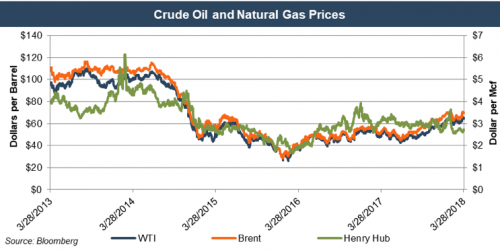
The oil and gas market continued to show improvement in the first quarter of 2018.  Positive momentum in production growth in the U.S. continued and prices increased from an average of $55 in Q4 2017 to an average of $63 in Q1 2018.   Mercer Capital’s Senior VP, Grant Farrell, at the beginning of the quarter said, “a repeat of 2017 would be a welcomed event” and it appears we are on track. Oil prices are ticking up, domestic production has increased to a 50 year high, and the U.S. is exporting more crude oil than ever before.
Too Good to be True

If you are like me, you can’t ignore the wary feeling in your gut that makes you ask, “Is it too good to be true?”

According to Reuters, global inventories could increase due to the rapid increase in production in the U.S. which “could well outweigh any pick-up in demand.”
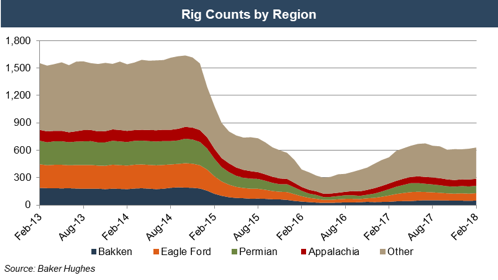
Rig counts in 2018 were expected to increase to 945 active rigs. [1] However, Baker Hughes reports that we have already met this target and currently have 993 active rigs versus 824 a year ago. Have we already forgotten the lesson we learned in 2014: too much supply, too fast leads to a decline in prices? Additionally, what will happen to demand as transportation becomes more fuel efficient and we shift further away from oil in favor of renewable energy resources?

Easing Concerns

Thankfully, I am not the only one asking these questions. A survey of oil and gas professionals in the February 2018 Issue of the Oil and Gas Journal showed that 63% of oil and gas senior professionals are optimistic about 2018.  However, this optimism does not stem from a forecasted favorable price environment.  Rather, their confidence is supported by the knowledge that they can now operate profitably in a $55 per barrel price environment.[2]   Oil and gas exploration companies today are more cost-efficient than ever.   The collapse in prices in mid-2014 gave companies two options: adapt to the new price environment or go away.  Today we are left with a more cost-aware sector that has used technology to reduce risks and cut costs.

Further, domestic E&P companies today have the ability to quickly adjust their operations in response to price changes.  Jude Clemente, a recent contributor for Forbes recently wrote, “The U.S. has now become the world's swing oil producer and is the main factor that will limit how high prices can go.”

BP Chief Economist Spencer Dale recently responded to similar questions asked across the energy industry: “Will oil and gas lose dominance to renewable fuels in the future?”  BP argues that crude oil demand will continue to increase in the foreseeable future but will begin to reach a plateau in the next twenty years.  While renewable energy is the fastest growing energy source, developing nations across the world will drive energy demand in the future.  The mix of crude oil and renewable energy will shift, and crude oil will likely meet 85% of oil demand in 2040 instead of 94% of demand today.  This does not, however, mean demand for crude oil will disappear.

Overview

The forecast for the oil and gas industry in 2018 was positive and we seem to be meeting or even exceeding investor expectations.  The U.S. is expected to give up its title of the largest crude oil importer and exports are expected to continue growing as new pipelines and export terminals allow for increased capacity.

The positive momentum in the industry is being reflected in private company valuations both as a result of improved earnings forecasts and reductions in risk.  Growth in production and increases in price are increasing revenue, and more of the top line is flowing down to net income as companies have cut costs.  Earnings improvement is being magnified by the recent tax cuts which have significantly increased net income.  Further, the risk profiles of E&P companies have improved as companies are better equipped to handle price volatility and E&P companies are generally taking on projects with shorter payback periods.

Mercer Capital has significant experience valuing assets and companies in the energy industry. Because drilling economics vary by region it is imperative that your valuation specialist understands the local economics faced by your oilfield service company.  Our oil and gas valuations have been reviewed and relied on by buyers and sellers and Big 4 Auditors. These oil and gas related valuations have been utilized to support valuations for IRS Estate and Gift Tax, GAAP accounting, and litigation purposes. Contact a Mercer Capital professional today to discuss your valuation needs in confidence.

Endnote

[1] US oil, gas industry capital spending to increase in 2018. US Oil and Gas Journal.March 2018. [2] Survey: Oil, gas professionals express optimism for 2018 challenges.  Oil and Gas Journal. February 2018

Continue Reading

Defying the Cycle: Haynesville Production Strength in a Shifting Gas Market
Haynesville shale production defied broader market softness in 2025, leading major U.S. basins with double-digit year-over-year growth despite heightened volatility and sub-cycle drilling activity. Efficiency gains, DUC drawdowns, and Gulf Coast demand dynamics allowed operators to sustain output even as natural gas prices fluctuated sharply.
Haynesville Shale M&A Update: 2025 in Review
Key TakeawaysHaynesville remains a strategic LNG-linked basin. 2025 transactions emphasized long-duration natural gas exposure and proximity to Gulf Coast export infrastructure, reinforcing the basin’s importance in meeting global LNG demand.International utilities drove much of the activity. Japanese power and gas companies pursued direct upstream ownership, signaling a shift from traditional offtake agreements toward greater control over U.S. gas supply.M&A was selective but meaningful in scale and intent. While overall deal volume was limited, announced transactions and reported negotiations reflected deliberate, long-term positioning rather than opportunistic shale consolidation.OverviewM&A activity in the Haynesville Shale during 2025 was marked by strategic, LNG-linked transactions and renewed international investor interest in U.S. natural gas assets. While investors remained selective relative to prior shale upcycles, transactions that did occur reflected a clear pattern: buyers focused on long-duration gas exposure, scale, and proximity to Gulf Coast export markets rather than short-term development upside.Producers and capital providers increasingly refocused efforts on the Haynesville basin during the year, including raising capital to acquire both operating assets and mineral positions. This renewed attention followed a period of subdued transaction activity and underscored the basin’s continued relevance within global natural gas portfolios.Although the Haynesville did not experience the breadth of consolidation seen in some oil-weighted plays, the size, counterparties, and strategic motivations behind 2025 transactions reinforced the basin’s role as a long-term supply source for LNG-linked demand.Announced Upstream TransactionsTokyo Gas (TG Natural Resources) / ChevronIn April 2025, Tokyo Gas Co., through its U.S. joint venture TG Natural Resources, entered into an agreement to acquire a 70% interest in Chevron’s East Texas natural gas assets for $525 million. The assets include significant Haynesville exposure and were acquired through a combination of cash consideration and capital commitments.The transaction was characterized as part of Tokyo Gas’s broader strategy to secure long-term U.S. natural gas supply and expand its upstream footprint. The deal reflects a growing trend among international utilities to obtain direct exposure to U.S. shale gas through ownership interests rather than relying solely on long-term offtake contracts or third-party supply arrangements.From an M&A perspective, the transaction highlights continued willingness among major operators to monetize non-core or minority positions while retaining operational involvement, and it underscores the Haynesville’s attractiveness to buyers with a long-term, strategic view of gas demand.JERA / Williams & GEP Haynesville IIIn October 2025, JERA Co., Japan’s largest power generator, announced an agreement to acquire Haynesville shale gas production assets from Williams Companies and GEP Haynesville II, a joint venture between GeoSouthern Energy and Blackstone. The transaction was valued at approximately $1.5 billion.This acquisition marked JERA’s first direct investment in U.S. shale gas production, representing a notable expansion of the company’s upstream exposure and reinforcing JERA’s interest in securing supply from regions with strong connectivity to U.S. LNG export infrastructure.This transaction further illustrates the appeal of the Haynesville to international buyers seeking stable, scalable gas assets and highlights the role of upstream M&A as a tool for portfolio diversification among global utilities and energy companies.Reported Negotiations (Not Announced)Mitsubishi / Aethon Energy ManagementIn June 2025, Reuters reported that Mitsubishi Corp. was in discussions to acquire Aethon Energy Management, a privately held operator with substantial Haynesville production and midstream assets. The potential transaction was reported to be valued at approximately $8 billion, though Reuters emphasized that talks were ongoing and that no deal had been finalized at the time.While the transaction was not announced during 2025, the reported discussions were notable for both their scale and the identity of the potential buyer. Aethon has long been viewed as one of the largest private platforms in the Haynesville, and any transaction involving the company would represent a significant consolidation event within the basin.The reported talks underscored the depth of international interest in Haynesville-oriented platforms and highlighted the potential for large-scale transactions even in an otherwise measured M&A environment.ConclusionWhile overall deal volume remained selective, the transactions and reported negotiations in 2025 reflected sustained global interest in U.S. natural gas assets with long-term relevance. Collectively, the transactions and negotiations discussed above point to a Haynesville M&A landscape driven less by opportunistic consolidation and more by deliberate, long-term positioning. As global energy portfolios continue to evolve, the Haynesville basin remains a focal point for strategic investment, particularly for buyers seeking exposure tied to U.S. natural gas supply and LNG export linkages.
Mineral Aggregator Valuation Multiples Study Released-Data as of 06-11-2025
Mineral Aggregator Valuation Multiples Study Released

With Market Data as of June 11, 2025

Mercer Capital has thoughtfully analyzed the corporate and capital structures of the publicly traded mineral aggregators to derive meaningful indications of enterprise value. We have also calculated valuation multiples based on a variety of metrics, including distributions and reserves, as well as earnings and production on both a historical and forward-looking basis.

Cart

Your cart is empty