Corporate Valuation, Oil & Gas
shutterstock_65102062.jpg

November 6, 2019

Public Royalty Trusts: More Than Meets the Eye

Yield Traps, Depressed Commodity Prices, and Stage of Decline May Decrease Utility of Public Yields

In previous posts, we have discussed the relationship between public royalty interests and their market pricing implications to royalty owners.  We have differentiated between mineral aggregators and public royalty trusts and introduced some other considerations for how to pick the appropriate comparable. In this post, we will discuss the prevailing high dividend yields of public royalty trusts. We will also offer some reasons for why these trusts may be declining not just in production but also their comparability, from a valuation perspective, to some privately held mineral interests.

Market Data for Trusts and Aggregators

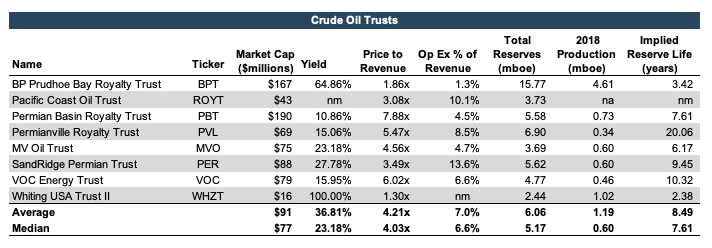
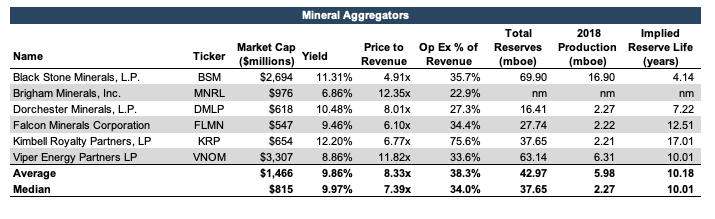
The following tables gives some critical market data for valuation purposes:
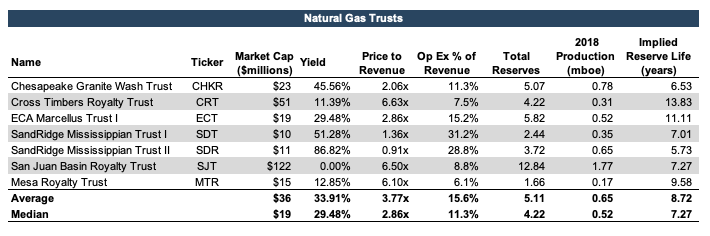
We note that the yields are significantly lower for mineral aggregators than the public royalty trusts, who also have significantly lower market caps. Previously, we’ve explained what a royalty trust is; however, to understand these recently elevated yields, we may need to back up and discuss why royalty trusts are started in the first place.

Why a Royalty Trust?

Royalty trusts represent a unique financing tool for E&P companies. Instead of holding onto wells and collecting revenue over a longer holding period, operators can monetize these wells upfront by selling the wells to a trust. This allows operators to reinvest the proceeds back into its operations in an industry where cash is key. Trust distributions are determined by the level of production of the wells and commodity prices. By selling the wells to a trust, the operator can avoid the need for hedging the price risk. Also, since production of the wells is expected to decline over time, operators can avoid the drawn out, declining marginal utility of the wells. This is particularly helpful considering a dollar today is worth more than a dollar down the road.

Potential Pitfalls of Public Dividend Yields as a Proxy for Risk

We’ve discussed the importance of scrutinizing each royalty trust individually in order to determine the comparability with private interests. Some of these considerations include:

  • Commodity mix (oil vs natural gas)
  • Idiosyncratic issues with the operator
  • Region/basin
However, these are not the only considerations, and they may not provide the proper sanity check in the context of the elevated yields that have persisted in recent months.

Some further considerations include:

  • Stage of production
  • Calculation method of the dividend yield
  • Friction in equity market pricing
  • Operating Expenses in a depressed commodity price environment

Where are you on the Production Decline Curve?

As oil and gas is extracted from a well, its production declines over time.  As production declines, the yields tend to increase (more on this later). This can misrepresent the risk to reward opportunity as timing must line up.  The value of a mineral interest that has been producing for an extended period of time should not be compared to a well that has just started production or is even still in the drilling or development stage. These situations are two different points on the production curve and represent different risk profiles. For a PDP (proved, developed, producing), there is less risk than any other stage (compared to PUD, P2 or P3). It is important to consider the relationship between these stages of production instead of simply looking to the public markets and being prisoners of the moment or uninformed of the differences between public trusts and a privately held interest. The stage of production and decline rate must reasonably reconcile to private interests to ensure that yields and commensurate risk are compared apples-to-apples.

Trusts are frequently prohibited from acquiring additional wells to replace production, unlike E&P companies and mineral aggregators. With production declining, the share price of trust units tends to decline as well, and the return comes almost exclusively from the dividend yield, with minimal opportunity for capital appreciation. Yield is dividends divided by price, and a declining denominator can lead to higher yields. As production declines, the yields may begin to shift from a reasonable expectation of the risk associated with expected future cash flows to a reflection of the minimal life of the well.

Different Dividend Calculations Can Lead to Significantly Different Indications

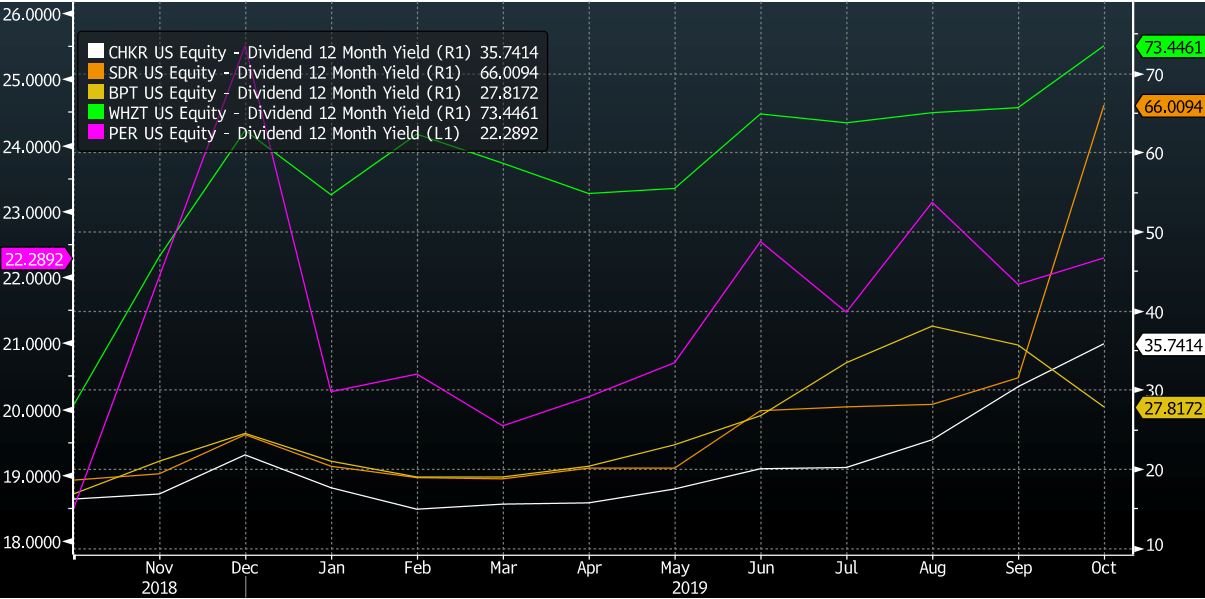
The calculation of dividend yield can also be crucial to understanding risk. Taking the dividends paid in the past year may not be representative of future dividends. While annualizing the most recent dividend may cause issues with seasonality, it may be more appropriate given the commodity price outlook. Annualizing the most recent dividend causes a significant divergence in the implied yield for more than half of the royalty trusts, while the yields change by less than 2% for all of the mineral aggregators.

Take Prudhoe Bay (BPT) for example. Its 63% yield as of October 30th includes a $1 dividend per share in January 2019. However, distributions have only been only $1.23 in the next three quarters combined as its 10-K estimated a significantly declining outlook. Annualizing the most recent dividend of 34 cents per share drops the dividend yield closer to 28%, notably lower than 63%. While 28% may seem high even in the context of mature production, current commodity prices indicate the trust may cease payouts after January 2020.  Calculating yields by annualizing more current dividends can help normalize yields to better indicate the underlying value of the trust’s production.

Public Equity Markets May Complicate Intrinsic Value of Royalty Trusts

In theory, trading in a public marketplace gives public royalty trusts an indication of market value.  There is friction, however, between the stock market price and the intrinsic value of the trust. It is common for public royalty trusts to have relatively small share prices.  Also, as they age and decline over time, they will become less productive, and investors would be less likely to want to incur the trading costs to build up a position in a stock with little to no residual value. Investing in a small stock creates the need to load up on shares to make a meaningful investment. Doing so, however, can cause the price to move unfavorably. This is particularly the case if the stock is thinly traded.

This problem can be compounded by float, that is, the number of shares actually available for trading. As an extreme example, Permianville Royalty Trust (PVL) has just over half of its shares free floating. These issues further complicate the ability to use yields from public royalty trusts as a proxy for risk for private interests.

Operating Expenses Become Increasingly Important

Since royalty trusts are not encumbered with production expenses, trust operating expenses tend to be fixed and minimal. However, revenue tends to be volatile with commodity prices. In the currently depressed commodity price environment, particularly for natural gas, these operating expenses become more pronounced. As we see with the SandRidge Trusts (SDT) (SDR) and ECA Marcellus Trust I (ECT), yields can be higher for trusts with higher operating expenses as a percentage of revenue. Lower prices make the sensitivity to operating expenses more apparent as margins are tighter.

Conclusion

When using it as a pricing benchmark for private royalty interests, there are many reasons to scrutinize the public royalty yields and their comparability. Further analysis is required to ensure these provide meaningful valuation indications.  It is important to assess the implied shelf life of the interest and stage of production. Yield also must be considered both in the context of historical and expected future dividends; they must also consider the equity market ecosystem in which the trusts trade. Lastly, yield and implied risk must consider the prevailing commodity price environment and its impact on royalty trust’s operating expenses.

We have assisted many clients with various valuation and cash flow questions regarding royalty interests. Contact Mercer Capital to discuss your needs in confidence and learn more about how we can help you succeed.

Continue Reading

Defying the Cycle: Haynesville Production Strength in a Shifting Gas Market
Haynesville shale production defied broader market softness in 2025, leading major U.S. basins with double-digit year-over-year growth despite heightened volatility and sub-cycle drilling activity. Efficiency gains, DUC drawdowns, and Gulf Coast demand dynamics allowed operators to sustain output even as natural gas prices fluctuated sharply.
Haynesville Shale M&A Update: 2025 in Review
Key TakeawaysHaynesville remains a strategic LNG-linked basin. 2025 transactions emphasized long-duration natural gas exposure and proximity to Gulf Coast export infrastructure, reinforcing the basin’s importance in meeting global LNG demand.International utilities drove much of the activity. Japanese power and gas companies pursued direct upstream ownership, signaling a shift from traditional offtake agreements toward greater control over U.S. gas supply.M&A was selective but meaningful in scale and intent. While overall deal volume was limited, announced transactions and reported negotiations reflected deliberate, long-term positioning rather than opportunistic shale consolidation.OverviewM&A activity in the Haynesville Shale during 2025 was marked by strategic, LNG-linked transactions and renewed international investor interest in U.S. natural gas assets. While investors remained selective relative to prior shale upcycles, transactions that did occur reflected a clear pattern: buyers focused on long-duration gas exposure, scale, and proximity to Gulf Coast export markets rather than short-term development upside.Producers and capital providers increasingly refocused efforts on the Haynesville basin during the year, including raising capital to acquire both operating assets and mineral positions. This renewed attention followed a period of subdued transaction activity and underscored the basin’s continued relevance within global natural gas portfolios.Although the Haynesville did not experience the breadth of consolidation seen in some oil-weighted plays, the size, counterparties, and strategic motivations behind 2025 transactions reinforced the basin’s role as a long-term supply source for LNG-linked demand.Announced Upstream TransactionsTokyo Gas (TG Natural Resources) / ChevronIn April 2025, Tokyo Gas Co., through its U.S. joint venture TG Natural Resources, entered into an agreement to acquire a 70% interest in Chevron’s East Texas natural gas assets for $525 million. The assets include significant Haynesville exposure and were acquired through a combination of cash consideration and capital commitments.The transaction was characterized as part of Tokyo Gas’s broader strategy to secure long-term U.S. natural gas supply and expand its upstream footprint. The deal reflects a growing trend among international utilities to obtain direct exposure to U.S. shale gas through ownership interests rather than relying solely on long-term offtake contracts or third-party supply arrangements.From an M&A perspective, the transaction highlights continued willingness among major operators to monetize non-core or minority positions while retaining operational involvement, and it underscores the Haynesville’s attractiveness to buyers with a long-term, strategic view of gas demand.JERA / Williams & GEP Haynesville IIIn October 2025, JERA Co., Japan’s largest power generator, announced an agreement to acquire Haynesville shale gas production assets from Williams Companies and GEP Haynesville II, a joint venture between GeoSouthern Energy and Blackstone. The transaction was valued at approximately $1.5 billion.This acquisition marked JERA’s first direct investment in U.S. shale gas production, representing a notable expansion of the company’s upstream exposure and reinforcing JERA’s interest in securing supply from regions with strong connectivity to U.S. LNG export infrastructure.This transaction further illustrates the appeal of the Haynesville to international buyers seeking stable, scalable gas assets and highlights the role of upstream M&A as a tool for portfolio diversification among global utilities and energy companies.Reported Negotiations (Not Announced)Mitsubishi / Aethon Energy ManagementIn June 2025, Reuters reported that Mitsubishi Corp. was in discussions to acquire Aethon Energy Management, a privately held operator with substantial Haynesville production and midstream assets. The potential transaction was reported to be valued at approximately $8 billion, though Reuters emphasized that talks were ongoing and that no deal had been finalized at the time.While the transaction was not announced during 2025, the reported discussions were notable for both their scale and the identity of the potential buyer. Aethon has long been viewed as one of the largest private platforms in the Haynesville, and any transaction involving the company would represent a significant consolidation event within the basin.The reported talks underscored the depth of international interest in Haynesville-oriented platforms and highlighted the potential for large-scale transactions even in an otherwise measured M&A environment.ConclusionWhile overall deal volume remained selective, the transactions and reported negotiations in 2025 reflected sustained global interest in U.S. natural gas assets with long-term relevance. Collectively, the transactions and negotiations discussed above point to a Haynesville M&A landscape driven less by opportunistic consolidation and more by deliberate, long-term positioning. As global energy portfolios continue to evolve, the Haynesville basin remains a focal point for strategic investment, particularly for buyers seeking exposure tied to U.S. natural gas supply and LNG export linkages.
Mineral Aggregator Valuation Multiples Study Released-Data as of 06-11-2025
Mineral Aggregator Valuation Multiples Study Released

With Market Data as of June 11, 2025

Mercer Capital has thoughtfully analyzed the corporate and capital structures of the publicly traded mineral aggregators to derive meaningful indications of enterprise value. We have also calculated valuation multiples based on a variety of metrics, including distributions and reserves, as well as earnings and production on both a historical and forward-looking basis.

Cart

Your cart is empty