While large, rapid commodity price declines are certainly harmful for near-term profits and long-term planning, persistently low prices may be more ominous for industry operators and investors. Prices rebounded from a low of $45/bbl, but crude has been below $60 for nearly 3 months. Natural gas prices have similarly languished, remaining below $2.50/mmbtu in that time. Two Houston-based E&P companies (Halcon & Sanchez) recently filed for Chapter 11 bankruptcy within days of each other, raising questions about the state of the industry. Size and operational efficiency may enable some players to stave off issues, while others may be forced into difficult decisions between preserving capital and investing over budget to produce enough debt-servicing cash flow.
Theme 1: Bankruptcies May Return if Prices Remain Low
- Over the last year, we have taken proactive steps to address the challenging oil and natural gas price environment, including stabilizing our production profile, improving our capital efficiency, and reducing our overall cost structure. Undergoing a financial restructuring through a voluntary process represents the next phase for Sanchez Energy, as we work with our creditors on a plan to right-size our balance sheet, further invest in our assets and generate long-term value for our stakeholders. - Tony Sanchez III, CEO, Sanchez Energy
- Ragan [incoming CFO] is joining Halcon at a critical time [bankruptcy restructuring] and will help lead our focus on capital discipline, cost control, and strategic plans for developing the Company’s assets to maximize shareholder return. - Rich Little, CEO, Halcon Resources
Theme 2: Size Matters
- We have a very large footprint though that allows us to work within certain areas over a vein, within certain areas due to these [Bakken gas processing] constraints. So we are able to work around them. And we have led the industry up there with gas capture we still do. - Harold Hamm, CEO, Continental Resources
- Combining Oxy and Anadarko will create a diverse portfolio of high quality and complementary assets, well suited for our core competencies. As we apply our development approach to the combined portfolio, we expect this to be the low-cost producer in all of the areas we operate. For example, along with the expertise I've already mentioned, we will apply our proprietary drilling process, Oxy drilling dynamics across Anadarko acreage. To date, Oxy drilling dynamics has reduced costs by at least 30% in all of the areas that we've applied it, and we expect to achieve similar results in Anadarko’s onshore and offshore developments. - Vicki Hollub, CEO, Occidental Petroleum
- One final point on our pending acquisition of Carrizo and one of the most important aspects of the transaction is the ability to optimize long-term development value of our combined inventory. By merging these two companies we are creating a vehicle that can effectively compete in a lower commodity price environment without the need to high-grade near-term target zones at the expense of other zones that are left behind for less efficient future development after the passage of time. - Joseph Gatto, CEO, Callon Petroleum
Theme 3: Capital Efficiency to Bridge Gap Between Production Estimates and CapEx Budgets
- We have also achieved the efficiencies throughout the first-half of 2019 that will allow the reduction of drilling rigs from 19 rigs in SCOOP STACK to 12 rigs on early fourth quarter of 2019. […] I am proud that our teams can exceed production estimates with lower rig activity, that is operating and capital efficiency at its best. […] We're very committed to meeting our CapEx and other corporate guidance for the year, and have the flexibility to do so as we're demonstrating. - Harold Hamm, CEO, Continental Resources
- For two quarters in a row we delivered more oil for less capital. With efficiency gains and new technology, we are achieving strong capital and operating cost reductions, while at the same time delivering excellent well performance. […] Looking ahead to the remainder of 2019, we modestly increased our full year U.S. oil production guidance as a result of better well performance. There is no change to our activity level in 2019. We will remain disciplined and still expect capital expenditures to be within the original range of $6.1 billion and $6.5 billion. - Bill Thomas, Chairman/CEO, EOG Resources
- Towards the end of the quarter, we shifted our focus to the completion of our first Delaware mega pad, which importantly utilized a simultaneous operation of two completion crews to increased efficiency and reduced cash cycle times. As we've emphasized previously, increased use of this model is made possible within a larger entity and is a clear strategic benefit of the Carrizo merger. - Joseph Gatto, CEO, Callon Petroleum
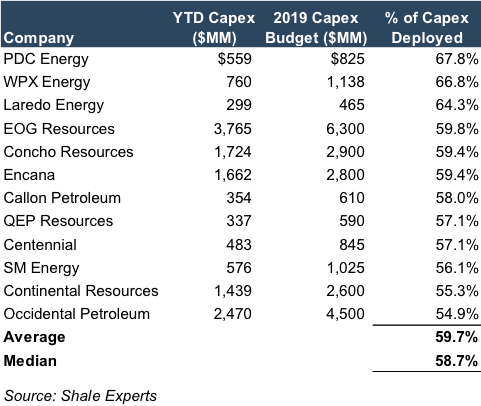 There are many factors at play in this number. Capex can and tends to be frontloaded due to seasonal factors. Still, executives will be hoping that their drilling efficiencies are achieved. Some companies may find issues hitting their production targets while decelerating drilling activities. They may be stuck between a rock and a hard place: failing to reach production targets or failing to remain within capex budgets.
Theme 4: Parent-Child Problem Continues to Plague Operators
- In the Delaware Basin, the 23 well Dominator project was designed to test logistical capabilities and well spacing that was approximately 50% tighter than our current resource assessment. While initial rates were solid, current performance data indicates that we developed the Upper Wolfcamp too densely. We're incorporating the data into our development model to adjust spacing on future projects including those projects set to spud in the second half of 2019. -Tim Leach, CEO, Concho Resources
- We've always been conservative in our spacing assumptions, and we don't really have any plans right now, especially as commodity price continues to decline, to look at any reasons to increase well spacing. This is one of those things where we've been pretty steadfast in our strategic development objectives on spacing. And we would pay attention to other spacing results that go on in the Permian Basin. And we try to learn from those as well too without exposing our shareholders to down spacing risks. -Travis Stice, CEO, Diamondback Energy
Conclusion
Commodity price will always be at the forefront of the oil and gas industry. Higher prices allow for more investment, higher profits, and lofty valuations. On the downside, operators must make it through lean times while avoiding bankruptcy. While keeping debtholders happy by making their required payments, they must also seek to please equity investors by achieving production growth on a tight capex budget. Size tends to help both of these as capital becomes cheaper and scale allows for successful drilling techniques from one basin to be applied to operations in other areas.
At Mercer Capital, we have assisted many clients with various valuation needs in the upstream oil and gas industry in North America and around the world. We can help companies navigating the bankruptcy process, considering M&A in an acquisitive market, or maintaining their operations business as usual. Contact a Mercer Capital professional to discuss your needs in confidence.

