Oil & Gas
shutterstock_115189144-1.jpg

October 2, 2020

Oil & Gas Industry Optimism Contained with Political Uncertainty Lying Ahead

Q3 2020 Macro Review

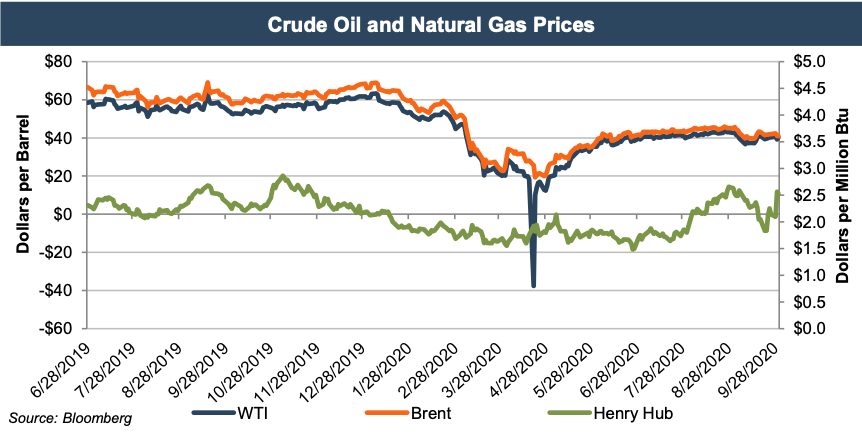
The third quarter of 2020 experienced a relatively stable price environment compared to the volatile prices seen in the first half of the year.  The WTI range narrowed, hovering around $40 per barrel, and natural gas increased from $1.70 per MMbtu to $2.50 per MMbtu.  According to the Dallas Federal Survey released on September 23, industry participants expect oil price to be nominally higher than last quarter’s expectations, but respondents continue to state that most new drilling remains uneconomic.  The concurrent overlapping impact of (i) discord created by the OPEC/Russian rift and resulting supply surge; and (ii) the drop in demand due to COVID-19 related issues was historic and continued to play a role in the third quarter.  As optimism surrounding a gradual demand recovery has increased, companies are preparing for an eventful end to 2020.  As if COVID-19 and the Russian-Saudi price rift wasn’t eventful enough, an election in November will add to the mix for what seems to be an already pressing and critical time for the industry.  The unfortunate, overlapping timing of these events has made the bankruptcy courts busy, with no indication of that trend coming to a halt.  In this post, we will examine the macroeconomic factors that have affected the industry in the third quarter and peek behind the curtain on what the remainder of the year might hold.
Global Economics

OPEC+

On June 6, OPEC+ members reached an agreement to continue cutting 9.7 million barrels a day, or about 10% of global output under normal circumstances, through July.  The extended supply cuts helped oil prices continue their recovery from their drastic drop in April due to the demand issues caused by COVID-19.  The original agreement that OPEC+ reached on April 12 stated that production was set to increase gradually after June, but members refined that plan and continued their supply cuts for another month.

On July 15, OPEC + members agreed to loosen existing production caps by roughly 1.6 million barrels a day.  The agreement was slated to begin in August as demand was showing signs of recovery amid the COVID-19 related lockdowns.  The decision created a 10% increase in Brent prices to $43.30/bbl.  OPEC expects the world’s demand for oil to increase by 7 million barrels a day next year, after a forecast 8.9 million barrel a day decline in 2020.  A primary source of overall industry decline is the lack of jet fuel demand as travel has decreased significantly throughout the year.  According to the Dallas Federal Energy Survey, 74% of industry executives believe that OPEC will play a bigger role in the determination of the price of oil going forward.

Potential Market Consequences: Trump vs. Biden Administration

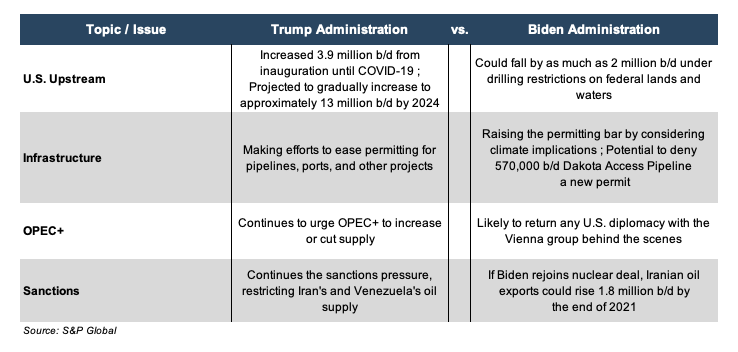
The upcoming election in November 2020 is on the industry’s mind as both administrations have expressed their energy initiatives that will be implemented during the next four years.  The election comes at a pressing time in the industry, with the next four years of U.S. oil and gas policy at stake.  The major topics at hand include domestic production, infrastructure plans, OPEC+ engagements, and international sanctions.  The following chart shows the contrasting platforms of the two potential administrations:
U.S. Production

The decline in production, 9.7 million b/d year-over-year in August, reflects voluntary production cuts by OPEC+ along with reductions in drilling activity and curtailments as of late.  The EIA estimates that U.S. crude oil production increased to 10.8 million b/d in August as operators have brought wells back online in response to rising prices after curtailing production in the second quarter.  Frac fleets have slowly grown since May, but still are down roughly 68% from the peak in 2020.  After September, however, the EIA projects U.S. crude oil production to decline slightly as new drilling activity will not generate enough production to offset declines from existing wells.  According to the Dallas Federal Energy Survey, 66% of industry executives believe that U.S. oil production has peaked.   The upcoming election poses significant uncertainties as the two administrations’ contrasting agendas will play a major role in U.S. production moving forward.

Bankruptcy

Companies are on their heels heading into the end of 2020.  Bankruptcy activity has heightened, and debt levels have increased as companies are hoping the worst is behind them.  The question is whether the worst is yet to come.  Balance sheets have become increasingly important and cash will remain king until the price environment becomes more economic.  Deal activity has been quiet as of late, though ended with a bang given Devon’s announced merger with WPX. More deals could come as buyers and sellers turn to consolidation to reduce costs in these challenging times.  That does, however, assume companies will not have to file for bankruptcy.

Interest Rates

The U.S. Federal Reserve cut interest rates twice in the month of March. On March 3, the Fed made an emergency decision to cut interest rates by 0.5% in response to the foreseeable economic slowdown due to the spread of the coronavirus. This cut was anticipated and largely shrugged off by the markets as interest rates continued their precipitous decline.  Benchmark rates were again cut on March 15 by a full percent to near zero.  The Federal Reserve’s latest forecast suggests that rates will remain close to zero for the foreseeable future until inflation increases.

Conclusion

As the industry attempts to recover from a dramatic timeline of events in the first half of 2020, many uncertainties remain ahead.  Companies are trying to survive during the challenging environment while attempting to shore up the balance sheet and hang on tight with the election on the horizon.  Potential policy changes might be the least of companies’ worries as other pressing issues are affecting them in the very short-term.  All of the pieces are stacking up against the industry, and it will be interesting to analyze the next six months, which could very well look different.

At Mercer Capital, we stay current with our analysis of the energy industry both on a region-by-region basis within the U.S. as well as around the globe. This is crucial in a global commodity environment where supply, demand, and geopolitical factors have varying impacts on prices. We have assisted clients with diverse valuation needs in the upstream oil and gas industry in North America and internationally. Contact a Mercer Capital professional to discuss your needs in confidence.

Continue Reading

Defying the Cycle: Haynesville Production Strength in a Shifting Gas Market
Haynesville shale production defied broader market softness in 2025, leading major U.S. basins with double-digit year-over-year growth despite heightened volatility and sub-cycle drilling activity. Efficiency gains, DUC drawdowns, and Gulf Coast demand dynamics allowed operators to sustain output even as natural gas prices fluctuated sharply.
Haynesville Shale M&A Update: 2025 in Review
Key TakeawaysHaynesville remains a strategic LNG-linked basin. 2025 transactions emphasized long-duration natural gas exposure and proximity to Gulf Coast export infrastructure, reinforcing the basin’s importance in meeting global LNG demand.International utilities drove much of the activity. Japanese power and gas companies pursued direct upstream ownership, signaling a shift from traditional offtake agreements toward greater control over U.S. gas supply.M&A was selective but meaningful in scale and intent. While overall deal volume was limited, announced transactions and reported negotiations reflected deliberate, long-term positioning rather than opportunistic shale consolidation.OverviewM&A activity in the Haynesville Shale during 2025 was marked by strategic, LNG-linked transactions and renewed international investor interest in U.S. natural gas assets. While investors remained selective relative to prior shale upcycles, transactions that did occur reflected a clear pattern: buyers focused on long-duration gas exposure, scale, and proximity to Gulf Coast export markets rather than short-term development upside.Producers and capital providers increasingly refocused efforts on the Haynesville basin during the year, including raising capital to acquire both operating assets and mineral positions. This renewed attention followed a period of subdued transaction activity and underscored the basin’s continued relevance within global natural gas portfolios.Although the Haynesville did not experience the breadth of consolidation seen in some oil-weighted plays, the size, counterparties, and strategic motivations behind 2025 transactions reinforced the basin’s role as a long-term supply source for LNG-linked demand.Announced Upstream TransactionsTokyo Gas (TG Natural Resources) / ChevronIn April 2025, Tokyo Gas Co., through its U.S. joint venture TG Natural Resources, entered into an agreement to acquire a 70% interest in Chevron’s East Texas natural gas assets for $525 million. The assets include significant Haynesville exposure and were acquired through a combination of cash consideration and capital commitments.The transaction was characterized as part of Tokyo Gas’s broader strategy to secure long-term U.S. natural gas supply and expand its upstream footprint. The deal reflects a growing trend among international utilities to obtain direct exposure to U.S. shale gas through ownership interests rather than relying solely on long-term offtake contracts or third-party supply arrangements.From an M&A perspective, the transaction highlights continued willingness among major operators to monetize non-core or minority positions while retaining operational involvement, and it underscores the Haynesville’s attractiveness to buyers with a long-term, strategic view of gas demand.JERA / Williams & GEP Haynesville IIIn October 2025, JERA Co., Japan’s largest power generator, announced an agreement to acquire Haynesville shale gas production assets from Williams Companies and GEP Haynesville II, a joint venture between GeoSouthern Energy and Blackstone. The transaction was valued at approximately $1.5 billion.This acquisition marked JERA’s first direct investment in U.S. shale gas production, representing a notable expansion of the company’s upstream exposure and reinforcing JERA’s interest in securing supply from regions with strong connectivity to U.S. LNG export infrastructure.This transaction further illustrates the appeal of the Haynesville to international buyers seeking stable, scalable gas assets and highlights the role of upstream M&A as a tool for portfolio diversification among global utilities and energy companies.Reported Negotiations (Not Announced)Mitsubishi / Aethon Energy ManagementIn June 2025, Reuters reported that Mitsubishi Corp. was in discussions to acquire Aethon Energy Management, a privately held operator with substantial Haynesville production and midstream assets. The potential transaction was reported to be valued at approximately $8 billion, though Reuters emphasized that talks were ongoing and that no deal had been finalized at the time.While the transaction was not announced during 2025, the reported discussions were notable for both their scale and the identity of the potential buyer. Aethon has long been viewed as one of the largest private platforms in the Haynesville, and any transaction involving the company would represent a significant consolidation event within the basin.The reported talks underscored the depth of international interest in Haynesville-oriented platforms and highlighted the potential for large-scale transactions even in an otherwise measured M&A environment.ConclusionWhile overall deal volume remained selective, the transactions and reported negotiations in 2025 reflected sustained global interest in U.S. natural gas assets with long-term relevance. Collectively, the transactions and negotiations discussed above point to a Haynesville M&A landscape driven less by opportunistic consolidation and more by deliberate, long-term positioning. As global energy portfolios continue to evolve, the Haynesville basin remains a focal point for strategic investment, particularly for buyers seeking exposure tied to U.S. natural gas supply and LNG export linkages.
Mineral Aggregator Valuation Multiples Study Released-Data as of 06-11-2025
Mineral Aggregator Valuation Multiples Study Released

With Market Data as of June 11, 2025

Mercer Capital has thoughtfully analyzed the corporate and capital structures of the publicly traded mineral aggregators to derive meaningful indications of enterprise value. We have also calculated valuation multiples based on a variety of metrics, including distributions and reserves, as well as earnings and production on both a historical and forward-looking basis.

Cart

Your cart is empty