Corporate Valuation, Oil & Gas
shutterstock_149009990.jpg

May 28, 2020

Royalties And Minerals: A New Market Is Emerging

The marketplace has delivered some jarring blows over the past few months to players in the mineral and royalty space. Although this asset class enjoys certain benefits relative to oil and gas producers, its value is still connected to commodity prices. The recent swing downward has staggered market participants and quickly changed several assumptions regarding a sense of normalcy. In analyzing the sector, we pulsed EnergyNet, one of the largest private mineral transaction platforms in the market. Chris Atherton, EnergyNet’s CEO, is about as close to the royalty and mineral market as anyone. How close? Consider the following:

  • EnergyNet has closed over 400 royalty, overriding royalty, and/or mineral transactions this year through April 2020.
  • The platform frequently handles transactions with participants ranging from individuals all the way to integrated majors such as Chevron CVX and Shell.
  • Geographically, they handle transactions across the contiguous United States.
  • They regularly broker transactions across the dollar size spectrum in this market, ranging all the way from five figures to eight figures.
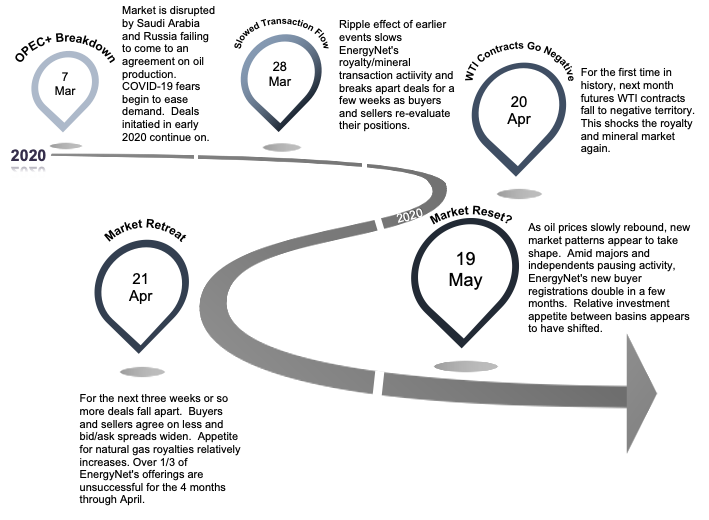
Therefore, it is reasonable to suggest EnergyNet represents an excellent glimpse into the royalty and mineral market at large (no – I did not get paid to say that). In the course of my correspondence with Chris Atherton, several interesting market movements began to emerge. After the March 7th launching point with the OPEC+ impasse, EnergyNet’s platform has taken several twists and turns. Both demand and supply shocks have squeezed the market and values have plummeted. The timeline below chronicles this: [caption id="attachment_31848" align="alignnone" width="709"]Source: EnergyNet[/caption]

Observations

The fact that valuations have decreased is not news at this point, but what is interesting is that this environment has changed a lot of things along the way:

  • Buyer Pool – Currently EnergyNet has 33,000 buyers vs. 7,000 sellers on its platform. Buyer registrations have skyrocketed in the past few months. New investors are seeking what they perceive as a potential good deal. At the same time, many of the larger participants on their platform (majors and independent producers) have paused much of their selling activity. Possibilities for this hiatus can vary. Changing economics are certainly a factor, but sellers also may be concerned about entering restructuring negotiations and do not want to be divesting assets in the time leading up to what may eventually be a bankruptcy filing.
  • Liquidity and Valuations – Although typically not falling as far as upstream producers, valuations for minerals and royalties have plummeted. Deals, even in quality basins, are trading for half of what they were a few months ago. Liquidity has been a part of this. As buyers and sellers wallow in uncertainty, more and more deals are either terminating or not happening at all.

[caption id="attachment_31849" align="alignnone" width="640"]Source: EnergyNet [/caption]
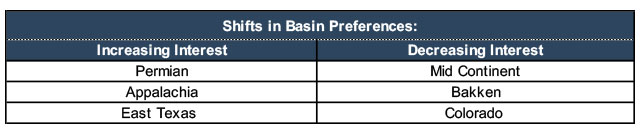
  • Basin Preferences – During this time, a previously unexpected occurrence has happened: gas assets are considered a more “tradeable” investment. Said Atherton: “With gas in the proverbial doghouse, buyers are becoming more attracted to its relative stability. Sellers have noticed this too and are more reticent to trade. The transaction volume is still thin, but interestingly, the rationale has shifted.” This has led to an uptick in Appalachian and East Texas interest. Colorado has lost favor, as much due to its changing regulatory climate as commodity prices. The Bakken has had decreasing interest as well with its higher breakeven prices and transportation issues.
[caption id="attachment_31850" align="alignnone" width="640"]Source: EnergyNet [/caption]

Takeaways

“We are going to have a different market coming out of this.” says Atherton. What exactly that market will look like is another question. Speaking of questions, what will drilling activity look like going forward? How might the relationship between the mineral owner and operator change? It is possible that litigations between royalty owners and operators will pick up?

Arguably, the most pertinent question above all is this: How will horizontal wells respond to being shut-in? This is an experiment that has never been tried before. Nobody knows how the wells may or may not respond when the spigots get re-opened at some future point. This uncertainty is part of why values are so depressed right now. The answer, whenever it comes, could be the lynchpin to what royalty and mineral valuations will look like in the future.


Originally appeared on Forbes.com.

Continue Reading

Defying the Cycle: Haynesville Production Strength in a Shifting Gas Market
Haynesville shale production defied broader market softness in 2025, leading major U.S. basins with double-digit year-over-year growth despite heightened volatility and sub-cycle drilling activity. Efficiency gains, DUC drawdowns, and Gulf Coast demand dynamics allowed operators to sustain output even as natural gas prices fluctuated sharply.
Haynesville Shale M&A Update: 2025 in Review
Key TakeawaysHaynesville remains a strategic LNG-linked basin. 2025 transactions emphasized long-duration natural gas exposure and proximity to Gulf Coast export infrastructure, reinforcing the basin’s importance in meeting global LNG demand.International utilities drove much of the activity. Japanese power and gas companies pursued direct upstream ownership, signaling a shift from traditional offtake agreements toward greater control over U.S. gas supply.M&A was selective but meaningful in scale and intent. While overall deal volume was limited, announced transactions and reported negotiations reflected deliberate, long-term positioning rather than opportunistic shale consolidation.OverviewM&A activity in the Haynesville Shale during 2025 was marked by strategic, LNG-linked transactions and renewed international investor interest in U.S. natural gas assets. While investors remained selective relative to prior shale upcycles, transactions that did occur reflected a clear pattern: buyers focused on long-duration gas exposure, scale, and proximity to Gulf Coast export markets rather than short-term development upside.Producers and capital providers increasingly refocused efforts on the Haynesville basin during the year, including raising capital to acquire both operating assets and mineral positions. This renewed attention followed a period of subdued transaction activity and underscored the basin’s continued relevance within global natural gas portfolios.Although the Haynesville did not experience the breadth of consolidation seen in some oil-weighted plays, the size, counterparties, and strategic motivations behind 2025 transactions reinforced the basin’s role as a long-term supply source for LNG-linked demand.Announced Upstream TransactionsTokyo Gas (TG Natural Resources) / ChevronIn April 2025, Tokyo Gas Co., through its U.S. joint venture TG Natural Resources, entered into an agreement to acquire a 70% interest in Chevron’s East Texas natural gas assets for $525 million. The assets include significant Haynesville exposure and were acquired through a combination of cash consideration and capital commitments.The transaction was characterized as part of Tokyo Gas’s broader strategy to secure long-term U.S. natural gas supply and expand its upstream footprint. The deal reflects a growing trend among international utilities to obtain direct exposure to U.S. shale gas through ownership interests rather than relying solely on long-term offtake contracts or third-party supply arrangements.From an M&A perspective, the transaction highlights continued willingness among major operators to monetize non-core or minority positions while retaining operational involvement, and it underscores the Haynesville’s attractiveness to buyers with a long-term, strategic view of gas demand.JERA / Williams & GEP Haynesville IIIn October 2025, JERA Co., Japan’s largest power generator, announced an agreement to acquire Haynesville shale gas production assets from Williams Companies and GEP Haynesville II, a joint venture between GeoSouthern Energy and Blackstone. The transaction was valued at approximately $1.5 billion.This acquisition marked JERA’s first direct investment in U.S. shale gas production, representing a notable expansion of the company’s upstream exposure and reinforcing JERA’s interest in securing supply from regions with strong connectivity to U.S. LNG export infrastructure.This transaction further illustrates the appeal of the Haynesville to international buyers seeking stable, scalable gas assets and highlights the role of upstream M&A as a tool for portfolio diversification among global utilities and energy companies.Reported Negotiations (Not Announced)Mitsubishi / Aethon Energy ManagementIn June 2025, Reuters reported that Mitsubishi Corp. was in discussions to acquire Aethon Energy Management, a privately held operator with substantial Haynesville production and midstream assets. The potential transaction was reported to be valued at approximately $8 billion, though Reuters emphasized that talks were ongoing and that no deal had been finalized at the time.While the transaction was not announced during 2025, the reported discussions were notable for both their scale and the identity of the potential buyer. Aethon has long been viewed as one of the largest private platforms in the Haynesville, and any transaction involving the company would represent a significant consolidation event within the basin.The reported talks underscored the depth of international interest in Haynesville-oriented platforms and highlighted the potential for large-scale transactions even in an otherwise measured M&A environment.ConclusionWhile overall deal volume remained selective, the transactions and reported negotiations in 2025 reflected sustained global interest in U.S. natural gas assets with long-term relevance. Collectively, the transactions and negotiations discussed above point to a Haynesville M&A landscape driven less by opportunistic consolidation and more by deliberate, long-term positioning. As global energy portfolios continue to evolve, the Haynesville basin remains a focal point for strategic investment, particularly for buyers seeking exposure tied to U.S. natural gas supply and LNG export linkages.
Mineral Aggregator Valuation Multiples Study Released-Data as of 06-11-2025
Mineral Aggregator Valuation Multiples Study Released

With Market Data as of June 11, 2025

Mercer Capital has thoughtfully analyzed the corporate and capital structures of the publicly traded mineral aggregators to derive meaningful indications of enterprise value. We have also calculated valuation multiples based on a variety of metrics, including distributions and reserves, as well as earnings and production on both a historical and forward-looking basis.

Cart

Your cart is empty