Oil & Gas
shutterstock_1797460684.jpg

October 29, 2020

What a Biden or Trump Presidency Might Mean for the Oil & Gas Industry

With the presidential election less than a week away, we believe it is timely to identify the potential domestic and international implications of each candidates’ agendas as they relate to the oil and gas industry.  The election comes at a pressing time in the industry, with the next four years of U.S. oil and gas policy at stake.  Uncertainty continues to build as the election awaits and as two contrasting platforms face off.  As if COVID-19 and the Saudi-Russian price rift weren’t impactful enough to the industry, an election year adds to the eventful list.  In this post, we discuss each candidate’s political platform for the oil and gas industry.  The major topics and issues at stake include domestic production, infrastructure plans, OPEC+ engagements, and international sanctions.

U.S. Upstream

Prior to the COVID-19 demand destruction, U.S. oil production increased 3.9 million b/d from Trump’s inauguration in January 2017.  President Trump’s production initiative aims to increase domestic output to pre-COVID levels, aligning with his historical policies to maximize U.S. energy production while constraining the supply of international players.  The industry has a general consensus on what the next four years may look like under a Trump administration.  The last four years have been filled with unrestricted oil production and relaxed crude export barriers.  The greatest domestic impact could come from Joe Biden’s initiative to oppose fracking on federal lands and waters.  Biden denied claims that he would ban fracking outright, instead stating that his platform would favor a ban on new fracking on federal lands and waters.  According to S&P Global Platts Analytics, eliminating the issuance of drilling permits for federal lands has the potential to shrink U.S. oil production by up to 2 million b/d by 2025, primarily from the Delaware Basin and the Gulf of Mexico.  During the final presidential debate, Joe Biden called for the U.S. to transition away from oil to address the environmental harm of climate change.  A Biden administration would look to re-enter the Paris Climate Agreement, which Trump pulled out of during his term, in order to prioritize the movement away from fossil fuel energy sources.  The push towards alternative energy sources could hinder domestic oil production compared to Trump’s vision for the industry, which supports fracking initiatives.
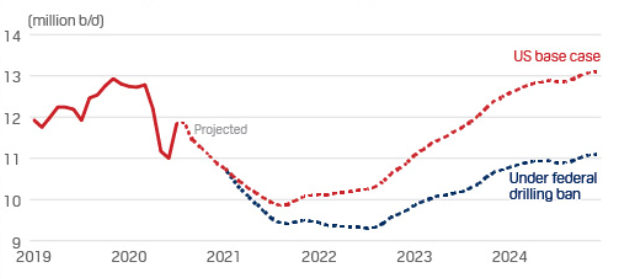
Source: S&P Global

Infrastructure

During his term, President Trump signed executive orders, making efforts to ease permitting for pipelines, ports, and other energy infrastructure projects.  His actions were challenged by many state governments and projects continue to face legal obstacles.  If Joe Biden is elected, he would likely raise the bar for infrastructure project permits by considering climate impacts.  For example, it is possible that Biden may deny the 570,000 b/d Dakota Access Pipeline a new permit, a move initiated by the Obama administration, leaving Bakken producers without capacity to transport roughly 300,000 b/d to market.  U.S. crude exports that rely on certain pipelines will be affected by these future build-out decisions.  Infrastructure orders that are initiated by either candidate will face pushback as it is common for state and local authorities to get involved.

OPEC+

According to the Dallas Federal Energy Survey, 74% of industry executives believe that OPEC will play a bigger role in the determination of the price of oil going forward.  This year has further illustrated the impact OPEC+ participants can have on the global oil and gas market, shown by the Saudi-Russian price rift.  During his term, President Trump urged OPEC+ to increase or cut supply on a number of occasions.  Most would agree that President Trump has been more engaged with OPEC+ than most of his predecessors.  Trump’s international sanctions, which we will touch on below, have weakened the influence of OPEC’s Venezuela and Iran, which in turn concentrated power with Saudi Arabia and Russia.  A Biden administration may not be as aggressive with OPEC+ compared to President Trump.  Although Biden has not detailed his approach to the OPEC+ players, some assume he will attempt to rely on quiet diplomatic channels behind the scenes.

International Sanctions

In November 2018, President Trump imposed economic sanctions on Iran and withdrew the United States from the Iran Nuclear Deal.  President Trump’s approach to international sanctions on OPEC members Iran and Venezuela have decreased international oil production by approximately 3 million b/d, slightly more than 3% of world supply.  If President Trump is re-elected, he is expected to continue the sanctions pressure on the two countries, restricting Iran and Venezuela’s oil exports.  If Biden is elected, Iranian oil exports could rise 1.8 million b/d by the end of 2021.  There is a possibility that Biden would amend the sanctions imposed on Iran, creating a partnered approach, assuming conditions are met, that would be similar to the deal struck under the Obama administration.  Global oil supply has the ability to dramatically shift, depending on each candidate’s international sanctions approach.

Conclusion

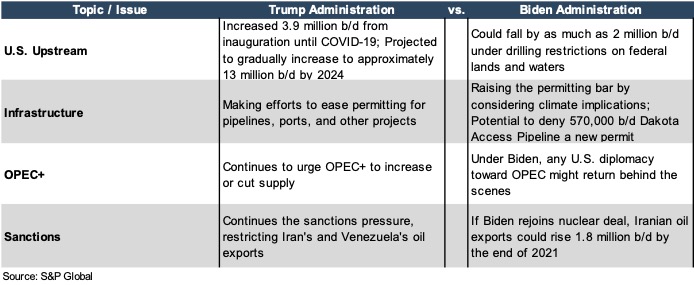
We have examined only a number of categories of each candidate’s proposed agendas and the impact each will have on the oil and gas industry.  As with all industries, the oil and gas sector is affected by many macro and micro factors that transpire over a long period of time.  The true impact of each candidate’s policies, along with the policies that are already enacted, may not be measurable for years to come.  A summary of the key differences discussed above in each candidate’s proposed agendas are as follows:
 

Continue Reading

Defying the Cycle: Haynesville Production Strength in a Shifting Gas Market
Haynesville shale production defied broader market softness in 2025, leading major U.S. basins with double-digit year-over-year growth despite heightened volatility and sub-cycle drilling activity. Efficiency gains, DUC drawdowns, and Gulf Coast demand dynamics allowed operators to sustain output even as natural gas prices fluctuated sharply.
Haynesville Shale M&A Update: 2025 in Review
Key TakeawaysHaynesville remains a strategic LNG-linked basin. 2025 transactions emphasized long-duration natural gas exposure and proximity to Gulf Coast export infrastructure, reinforcing the basin’s importance in meeting global LNG demand.International utilities drove much of the activity. Japanese power and gas companies pursued direct upstream ownership, signaling a shift from traditional offtake agreements toward greater control over U.S. gas supply.M&A was selective but meaningful in scale and intent. While overall deal volume was limited, announced transactions and reported negotiations reflected deliberate, long-term positioning rather than opportunistic shale consolidation.OverviewM&A activity in the Haynesville Shale during 2025 was marked by strategic, LNG-linked transactions and renewed international investor interest in U.S. natural gas assets. While investors remained selective relative to prior shale upcycles, transactions that did occur reflected a clear pattern: buyers focused on long-duration gas exposure, scale, and proximity to Gulf Coast export markets rather than short-term development upside.Producers and capital providers increasingly refocused efforts on the Haynesville basin during the year, including raising capital to acquire both operating assets and mineral positions. This renewed attention followed a period of subdued transaction activity and underscored the basin’s continued relevance within global natural gas portfolios.Although the Haynesville did not experience the breadth of consolidation seen in some oil-weighted plays, the size, counterparties, and strategic motivations behind 2025 transactions reinforced the basin’s role as a long-term supply source for LNG-linked demand.Announced Upstream TransactionsTokyo Gas (TG Natural Resources) / ChevronIn April 2025, Tokyo Gas Co., through its U.S. joint venture TG Natural Resources, entered into an agreement to acquire a 70% interest in Chevron’s East Texas natural gas assets for $525 million. The assets include significant Haynesville exposure and were acquired through a combination of cash consideration and capital commitments.The transaction was characterized as part of Tokyo Gas’s broader strategy to secure long-term U.S. natural gas supply and expand its upstream footprint. The deal reflects a growing trend among international utilities to obtain direct exposure to U.S. shale gas through ownership interests rather than relying solely on long-term offtake contracts or third-party supply arrangements.From an M&A perspective, the transaction highlights continued willingness among major operators to monetize non-core or minority positions while retaining operational involvement, and it underscores the Haynesville’s attractiveness to buyers with a long-term, strategic view of gas demand.JERA / Williams & GEP Haynesville IIIn October 2025, JERA Co., Japan’s largest power generator, announced an agreement to acquire Haynesville shale gas production assets from Williams Companies and GEP Haynesville II, a joint venture between GeoSouthern Energy and Blackstone. The transaction was valued at approximately $1.5 billion.This acquisition marked JERA’s first direct investment in U.S. shale gas production, representing a notable expansion of the company’s upstream exposure and reinforcing JERA’s interest in securing supply from regions with strong connectivity to U.S. LNG export infrastructure.This transaction further illustrates the appeal of the Haynesville to international buyers seeking stable, scalable gas assets and highlights the role of upstream M&A as a tool for portfolio diversification among global utilities and energy companies.Reported Negotiations (Not Announced)Mitsubishi / Aethon Energy ManagementIn June 2025, Reuters reported that Mitsubishi Corp. was in discussions to acquire Aethon Energy Management, a privately held operator with substantial Haynesville production and midstream assets. The potential transaction was reported to be valued at approximately $8 billion, though Reuters emphasized that talks were ongoing and that no deal had been finalized at the time.While the transaction was not announced during 2025, the reported discussions were notable for both their scale and the identity of the potential buyer. Aethon has long been viewed as one of the largest private platforms in the Haynesville, and any transaction involving the company would represent a significant consolidation event within the basin.The reported talks underscored the depth of international interest in Haynesville-oriented platforms and highlighted the potential for large-scale transactions even in an otherwise measured M&A environment.ConclusionWhile overall deal volume remained selective, the transactions and reported negotiations in 2025 reflected sustained global interest in U.S. natural gas assets with long-term relevance. Collectively, the transactions and negotiations discussed above point to a Haynesville M&A landscape driven less by opportunistic consolidation and more by deliberate, long-term positioning. As global energy portfolios continue to evolve, the Haynesville basin remains a focal point for strategic investment, particularly for buyers seeking exposure tied to U.S. natural gas supply and LNG export linkages.
Mineral Aggregator Valuation Multiples Study Released-Data as of 06-11-2025
Mineral Aggregator Valuation Multiples Study Released

With Market Data as of June 11, 2025

Mercer Capital has thoughtfully analyzed the corporate and capital structures of the publicly traded mineral aggregators to derive meaningful indications of enterprise value. We have also calculated valuation multiples based on a variety of metrics, including distributions and reserves, as well as earnings and production on both a historical and forward-looking basis.

Cart

Your cart is empty