Corporate Valuation, Oil & Gas
shutterstock_1892669737-copy.jpg

October 15, 2021

Chesapeake Finds Vine Ripe for the Picking

In August, Chesapeake Energy Corporation announced that it would acquire Vine Energy Inc. in a stock-and-cash transaction valued at approximately $2.2 billion.  We previously discussed Vine’s IPO, which was the first upstream (non-minerals, non-SPAC) initial public offering since Berry Petroleum’s debut in mid-2017.  Vine’s decision to be acquired in a ~0% premium transaction less than five months after its IPO speaks to the difficulty for E&P companies to manage public market dynamics even in a much-improved commodity price environment.  In this post, we dig into the transaction rationale, look at relative value measures, and analyze how this transaction seems to indicate a shift in Chesapeake’s strategy.

Transaction Rationale

Chesapeake’s acquisition generally follows the recent upstream M&A playbook: mostly stock, low-to no-premium, and a focus on cost synergies.

Cash consideration of $1.20 per share represents 8% of the $15.00 total consideration per share.  It is somewhat curious that there’s a cash component to the purchase, especially for a company that recentlyemerged from bankruptcy in a transaction that doubles the company’s leverage.  However, even with the cash outlay and assumption of Vine’s debt, Chesapeake management indicates that the pro forma entity will have a relatively modest net debt to 2022E EBITDAX ratio of 0.6x.

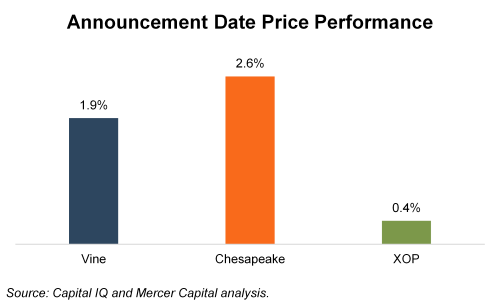
Based on market data, immediately prior to announcement, the transaction consideration represents a <1% premium to Vine’s stock price.  While that may not seem like a great deal for shareholders, the 92% stock consideration means that legacy Vine shareholders should benefit from any synergies achieved by the transaction.  On the announcement date, market reaction was generally positive, with both Vine and Chesapeake outperforming the broader upstream universe (as proxied by the SPDR S&P Oil & Gas Exploration & Production ETF, ticker XOP).
As for those synergies, management expects to save $20 million per year on general & administrative and lease operating expenses, with another $30 million per year in capital efficiencies, resulting in an annual savings of $50 million per year.

Valuation Considerations

Relative value measures for the transaction are shown in the following table:

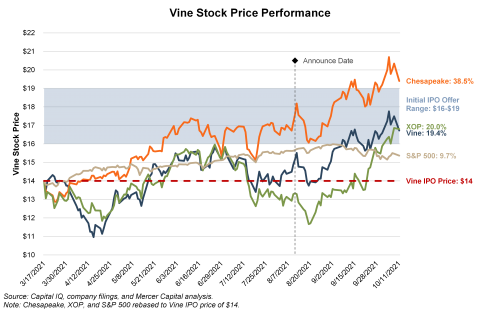
As with any transaction with a stock component, the transaction consideration is dynamic and fluctuates with the acquirer’s stock price.  The initial transaction consideration of $15 per share was only $1 higher than Vine’s IPO price.  But with the run-up in natural gas prices and continued exposure via stock consideration, Vine has recently traded at all-time highs and is now within its initial IPO offer range.
Chesapeake Shifts Back to Natural Gas Roots

Chesapeake has historically focused on natural gas production.  However, in the wake of persistently low natural gas prices from roughly 2010-2020, the company sought to diversify its production mix and become more oil focused.  In pursuit of this goal, the company was particularly active on the M&A and A&D front, with actions including the sale of itsUtica assets in Ohio and acquisition of Eagle Ford producer WildHorse Development Corporation.  Ultimately, the company overextended itself and entered bankruptcy in mid-2020.
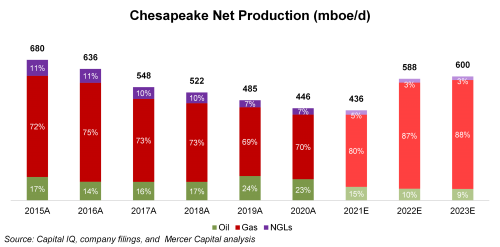
After emerging from bankruptcy earlier this year, management indicated that investment activity would be focused on natural gas assets.  The timing seems apt with the recent increase in natural gas prices.  The acquisition of Vine will stem Chesapeake’s recent trend of production declines and materially increase its natural gas mix.

Conclusion

Vine’s brief stint as a public company looks to be coming to an end.  With natural gas stealing the spotlight from crude oil, Chesapeake is seeking to return to its former glory as America’s natural gas champion.  The combination with Vine will make Chesapeake a dominate force in the Haynesville and support the company’s pivot away from oil.

We have assisted many clients with various valuation needs in the upstream oil and gas space for both conventional and unconventional plays in North America, and around the world.  Contact a Mercer Capital professional to discuss your needs in confidence and learn more about how we can help you succeed.

Continue Reading

Defying the Cycle: Haynesville Production Strength in a Shifting Gas Market
Haynesville shale production defied broader market softness in 2025, leading major U.S. basins with double-digit year-over-year growth despite heightened volatility and sub-cycle drilling activity. Efficiency gains, DUC drawdowns, and Gulf Coast demand dynamics allowed operators to sustain output even as natural gas prices fluctuated sharply.
Haynesville Shale M&A Update: 2025 in Review
Key TakeawaysHaynesville remains a strategic LNG-linked basin. 2025 transactions emphasized long-duration natural gas exposure and proximity to Gulf Coast export infrastructure, reinforcing the basin’s importance in meeting global LNG demand.International utilities drove much of the activity. Japanese power and gas companies pursued direct upstream ownership, signaling a shift from traditional offtake agreements toward greater control over U.S. gas supply.M&A was selective but meaningful in scale and intent. While overall deal volume was limited, announced transactions and reported negotiations reflected deliberate, long-term positioning rather than opportunistic shale consolidation.OverviewM&A activity in the Haynesville Shale during 2025 was marked by strategic, LNG-linked transactions and renewed international investor interest in U.S. natural gas assets. While investors remained selective relative to prior shale upcycles, transactions that did occur reflected a clear pattern: buyers focused on long-duration gas exposure, scale, and proximity to Gulf Coast export markets rather than short-term development upside.Producers and capital providers increasingly refocused efforts on the Haynesville basin during the year, including raising capital to acquire both operating assets and mineral positions. This renewed attention followed a period of subdued transaction activity and underscored the basin’s continued relevance within global natural gas portfolios.Although the Haynesville did not experience the breadth of consolidation seen in some oil-weighted plays, the size, counterparties, and strategic motivations behind 2025 transactions reinforced the basin’s role as a long-term supply source for LNG-linked demand.Announced Upstream TransactionsTokyo Gas (TG Natural Resources) / ChevronIn April 2025, Tokyo Gas Co., through its U.S. joint venture TG Natural Resources, entered into an agreement to acquire a 70% interest in Chevron’s East Texas natural gas assets for $525 million. The assets include significant Haynesville exposure and were acquired through a combination of cash consideration and capital commitments.The transaction was characterized as part of Tokyo Gas’s broader strategy to secure long-term U.S. natural gas supply and expand its upstream footprint. The deal reflects a growing trend among international utilities to obtain direct exposure to U.S. shale gas through ownership interests rather than relying solely on long-term offtake contracts or third-party supply arrangements.From an M&A perspective, the transaction highlights continued willingness among major operators to monetize non-core or minority positions while retaining operational involvement, and it underscores the Haynesville’s attractiveness to buyers with a long-term, strategic view of gas demand.JERA / Williams & GEP Haynesville IIIn October 2025, JERA Co., Japan’s largest power generator, announced an agreement to acquire Haynesville shale gas production assets from Williams Companies and GEP Haynesville II, a joint venture between GeoSouthern Energy and Blackstone. The transaction was valued at approximately $1.5 billion.This acquisition marked JERA’s first direct investment in U.S. shale gas production, representing a notable expansion of the company’s upstream exposure and reinforcing JERA’s interest in securing supply from regions with strong connectivity to U.S. LNG export infrastructure.This transaction further illustrates the appeal of the Haynesville to international buyers seeking stable, scalable gas assets and highlights the role of upstream M&A as a tool for portfolio diversification among global utilities and energy companies.Reported Negotiations (Not Announced)Mitsubishi / Aethon Energy ManagementIn June 2025, Reuters reported that Mitsubishi Corp. was in discussions to acquire Aethon Energy Management, a privately held operator with substantial Haynesville production and midstream assets. The potential transaction was reported to be valued at approximately $8 billion, though Reuters emphasized that talks were ongoing and that no deal had been finalized at the time.While the transaction was not announced during 2025, the reported discussions were notable for both their scale and the identity of the potential buyer. Aethon has long been viewed as one of the largest private platforms in the Haynesville, and any transaction involving the company would represent a significant consolidation event within the basin.The reported talks underscored the depth of international interest in Haynesville-oriented platforms and highlighted the potential for large-scale transactions even in an otherwise measured M&A environment.ConclusionWhile overall deal volume remained selective, the transactions and reported negotiations in 2025 reflected sustained global interest in U.S. natural gas assets with long-term relevance. Collectively, the transactions and negotiations discussed above point to a Haynesville M&A landscape driven less by opportunistic consolidation and more by deliberate, long-term positioning. As global energy portfolios continue to evolve, the Haynesville basin remains a focal point for strategic investment, particularly for buyers seeking exposure tied to U.S. natural gas supply and LNG export linkages.
Mineral Aggregator Valuation Multiples Study Released-Data as of 06-11-2025
Mineral Aggregator Valuation Multiples Study Released

With Market Data as of June 11, 2025

Mercer Capital has thoughtfully analyzed the corporate and capital structures of the publicly traded mineral aggregators to derive meaningful indications of enterprise value. We have also calculated valuation multiples based on a variety of metrics, including distributions and reserves, as well as earnings and production on both a historical and forward-looking basis.

Cart

Your cart is empty