December 1, 2021

Upstream Producers Are Not Gouging–They’re Tentative. Here Are Three Reasons Why

The drumbeats have been building for a couple of months now.  Finally, as commodity prices have risen and third quarter profit reports have rolled in, so have accusations of price gouging by oil and gas companies.  Senator Warren recently said as much on MSNBC.  She is wrong on this point, but certainly not alone by any means.  Politicians have made oil companies a proverbial punching bag on numerous fronts.  This is not news.  They have been rhetorical targets for decades.

However, it is true that U.S. upstream producers (both oil and gas) have yet to momentously hasten new production and aggressive drilling plans.  It would make sense if they did, as it speaks to the core incentives of commodity-based businesses like oil and gas.  Yet the U.S. industry remains tentative and reticent.  In the meantime, the market remains in backwardation marked by continuing inventory draws and increasing prices.  Why?  The answer is found somewhere among supply and demand dynamics, rising costs, and capital headwinds.

Supply & Demand Issues

“We are encouraged by the restraint shown by U.S. upstream operators. By restricting capital expenditure, we are healing historic overproduction of both oil and natural gas. We believe investors will be attracted back into the E&P space if, as an industry, we continue on this path for at least a year or two more to deleverage balance sheets and return capital to investors.”  -Fed SurveyRespondent It was a rough 2020, but producers have turned a corner on drilling discipline, and have restrained on the drill bit compared to years past.  They also deleveraged balance sheets, and where possible, returned capital to shareholders.  During 2021 traffic patterns have normalized, and apart from jet fuel, demand growth has bounced back to pre-pandemic levels.  It is also creeping into winter and natural gas will be in season.  That’s good news. Energy consumption is a bellwether for economic activity.  However, that production discipline in both the U.S. and OPEC+ nations has resulted in crude oil inventories being 6% below the five-year average (2016-2020) overall.  The Biden administration just announced a 50-million-barrel drawfrom the Strategic Petroleum Reserve.  This imbalance started in Q3 2020 and has continued since, and is helping to keep prices high, though perhaps not for too long.  The U.S. Energy Information Administration (EIA) projects this to come back into balance by Q2 2022.
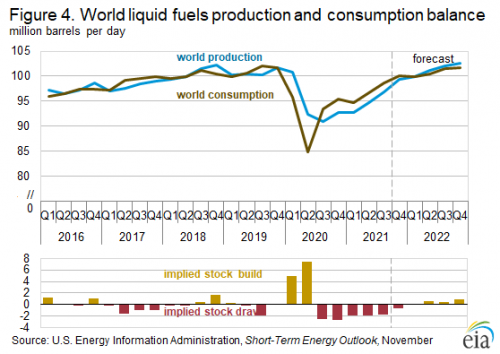
OPEC+ is slowly, but steadily adding production to the markets, while U.S. shale producers, although increasing activity, have been lagging this year.  Futures markets suggest a similar outcome and prices are expected to steady according to NYMEX and EIA.  As the futures curves tail out, the 60 month premium from a year ago is higher, but the near term spread is even wider, thus giving firms pause before diving in headlong with massive new production initiatives.
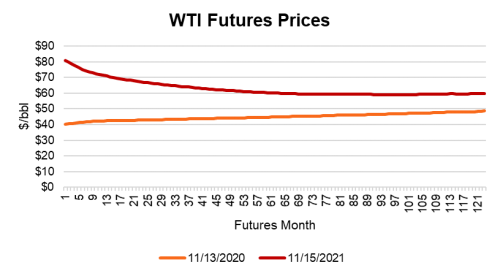
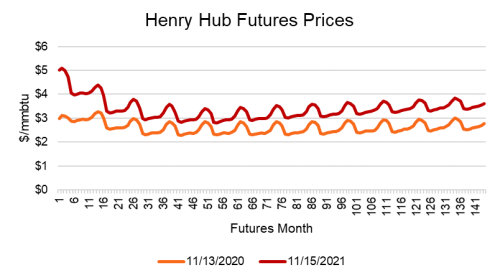
(Not all share this outlook – Bank of America sees oil at $120 by June 2022).  Still, producers went through a lot to discipline themselves, and expectations by investors have been clear for years now: less drills more bills. One other commodity that’s in demand which should impact oil and gas supply as well is the U.S. dollar.  The currency is strengthening, and this brings downward pressure on prices too.

Costs

Labor is causing major problems in staffing for the increase in activity. Wages are up 20 percent, and companies are poaching employees from competitors. We are finding it difficult to increase prices to match our increase in costs. – Fed Survey Respondent As oil and gas prices are going up, inflationary pressures are impacting the industry’s operations concurrently.  The cost of oilfield services is rising quickly.  Lease operating expenses are increasing.  Delays are a problem as well, as 70% of the respondents to the latest Dallas Fed survey said they experienced delays of some sort in the last quarter.  This is partially a result of tight labor markets and it’s dampening enthusiasm somewhat. Also, as I have mentioned before, costs on development are going up as drilled but uncompleted (DUC) well inventories shrink.  They have continued their downward march and are at the lowest levels in seven years (November 2014).
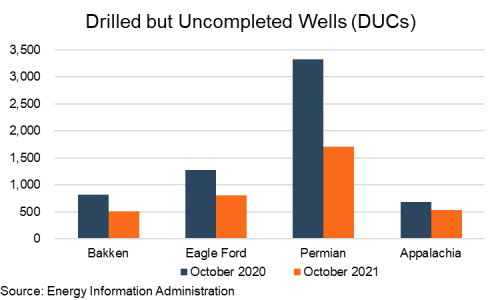
This leads to another less heralded point as well.  U.S. shale oil fields have been active for around a decade now.  Many of the best drilling locations have been developed.  Although there are a lot remaining, they haven’t been drilled yet for a reason.  Productivity per rig metrics have fallen slightly this year and it may have more to do with geology rather than technology making production growth more expensive and squeezing margins.

Investment Headwinds

“Oil, natural gas and natural gas liquids prices are greatly improved and appear to be sustainable for the coming months. The greatest headwind is skilled labor supply and access to expanding credit on our reserve base loan. Initial conversations with regional energy banks show increasing interest in advancing incremental credit. The money center banks continue to seek to reduce their commitments to oil and gas borrowers.” – Fed Survey Respondent Although economics have shifted quickly for producers this year, though investment sentiment not so much.  Capital providers are not only cautious, but fewer in number.  The multi-year souring on the oil and gas sector from several investment segments has not changed recently, leaving upstream producers with fewer options. On the debt side, some regional banks have shown a willingness to lend, but larger banks have not.  Some reasons for lending discomfort have included a wariness for shale’s ability to ramp up quickly and for margins to evaporate before loans can be paid back.  It’s worth a remind that U.S. production has a higher cost floor than OPEC+.  Larger banks appear not to be interested. Additionally, the shrinking pool of bankers has been mirrored by a shrinking pool of investors.  Firstly, returns must be carefully evaluated as many upstream producers have hedged their portfolios and some have limited their upsides to execute their strategies.  They are watching profit margins go elsewhere for the time being.  Also, as ESG concepts have gained momentum, many investors have weaned their appetite off oil and gas production.  There are simply fewer institutional and private equity investors evaluating and participating in the space.  According to a recent Wall Street Journal article, there are less than one-third of the firms and capital available in the space compared to 2018.  Simply put, it is harder for oil and gas producers to get expansion capital while they’re simultaneously paying much of it out. Talking heads and officials may be gaining political capital while talking about gouging, price controls and the like; but in a domestic industry populated with price takers and return oriented investors, prudence and temperance are driving decision making, not their ugly cousins – greed and avarice.  Thank goodness for that.


Originally appeared on Forbes.com.

Continue Reading

Mineral Aggregator Valuation Multiples Study Released-Data as of 03-10-2026
Mineral Aggregator Valuation Multiples Study Released

With Market Data as of March 10, 2026

Mercer Capital has thoughtfully analyzed the corporate and capital structures of the publicly traded mineral aggregators to derive meaningful indications of enterprise value. We have also calculated valuation multiples based on a variety of metrics, including distributions and reserves, as well as earnings and production on both a historical and forward-looking basis.
Themes from the Q4 2025 Energy Earnings Calls
Fourth quarter 2025 earnings calls suggest an industry preparing for a transitional 2026, emphasizing organic inventory expansion, structural natural gas demand growth, and tightening service market fundamentals. Management teams appear focused less on short-term volatility and more on positioning for the next upcycle.
NAPE Summit 2026: Dealmaking at the Crossroads of Molecules, Electrons, and Minerals
Mercer Capital joined industry leaders at the 2026 NAPE Summit (NAPE Expo), held February 18th to 20th, at the George R. Brown Convention Center in Houston, Texas. As with prior Expos, NAPE delivered a focused marketplace where conversations move quickly from “nice to meet you” to “what would it take to get this done?” This year, Bryce Erickson and David Smith represented Mercer Capital on the expo floor and across the conference programming, meeting with operators, minerals groups, capital providers, and advisors.If there was one defining characteristic of NAPE 2026, it was convergence. The industry’s traditional center of gravity, upstream oil and gas dealmaking, was still very much present. But the surrounding ecosystem is widening, as programming incorporated adjacent (and increasingly intertwined) sectors. The hubs for 2026, included Offshore, Data Centers, and Critical Minerals, as part of an event lineup designed to broaden the deal flow and participant mix. Below are our key takeaways from the conference, with a tour through the hub sessions and the themes that were emphasized.The Hub Sessions Told a Clear Story: Energy Is Becoming a Multi-Asset PortfolioThe 2026 NAPE hubs provided a useful lens into where capital is flowing and how industry priorities are evolving. This year’s programming demonstrated a market that still values traditional upstream opportunities, while increasingly integrating adjacent and emerging sectors into the broader deal landscape.Prospect Preview Hub: Showcasing OpportunitiesNAPE’s Prospect Preview Hub once again served as a platform for exhibitors to showcase available prospects on the expo floor, providing concise overviews of their technical merits and commercial potential. Presenters framed their investment thesis in a narrative that reflects how assets are marketed in a competitive transaction environment.Minerals & NonOp Hub: Strategies and TrendsThe Minerals & NonOp Hub discussions focused on market trends, financing strategies, and technology-driven approaches to sourcing and managing acquisition opportunities. Presentations in this hub addressed strategies, recent trends, technologies, and related developments.Offshore Hub: Long-Cycle Capital with Global ImplicationThe Offshore Hub highlighted exploration frontiers, development innovation, and the broader geopolitical context influencing offshore investment. Particular emphasis was placed on high-potential offshore regions, navigating environmental and regulatory frameworks, supply-demand trends, and the role of offshore energy in the global energy mix. Offshore projects require significant upfront investment and longer development timelines, which heighten sensitivity to regulatory stability, cost control, and commodity price outlook assumptions. In this sense, offshore dealmaking underscores how long-cycle assets must be evaluated differently from shorter-cycle onshore plays.Renewable Energy Hub: An Integrated FrameworkThe Renewable Energy Hub reflected an industry increasingly focused on integration rather than segmentation. Presentations centered on integrating renewables with traditional energy sources, hybrid project models, sustainability pathways with a focus on technology, and strategies for navigating evolving energy markets. Rather than viewing renewables as a standalone vertical, participants frequently discussed how renewable assets fit within broader portfolios that include natural gas, storage, and transmission infrastructure.Critical Minerals Hub: Supply Chain Strategy Comes to the ForefrontThe Critical Minerals Hub emphasized the strategic importance of minerals such as lithium, cobalt, rare earth elements, and graphite within evolving energy supply chains. The three sessions - Exploration/Development, Market Dynamics, and Sustainability/Innovation - featured presentations focused on resource development pathways, supply chain positioning, sourcing practices, and recycling technologies. Unlike traditional upstream projects, critical mineral investments often face unique permitting, processing, and geopolitical risks. As capital flows into the space, differentiation increasingly depends on technical credibility and downstream integration potential.Data Center Hub: Power Demand Is Now a First-Order VariableThe Data Center Hub positioned data centers as a critical component of the global economy, emphasizing the sector’s immense and growing energy needs and the resulting opportunities for collaboration between energy and technology stakeholders. Sessions addressed (i) structuring power supply, interconnection, and grid compliance, (ii) managing data center development risk, and (iii) how rising energy demands impact data center development.In practical terms, this emerged in two ways. First, site selection and power availability are increasingly central to “deal conversations.” Co-location strategies, generation capacity, transmission access, and long-term power contracting are becoming key underwriting considerations. Second, infrastructure constraints are entering valuation frameworks. Power availability, interconnection queues, permitting timelines, and fuel optionality are no longer secondary factors; they directly influence project timing, risk, and expected returns.Our Takeaways: What We Heard Repeatedly on the FloorAcross hub sessions and meetings, three themes came up again and again:Infrastructure constraints are turning into valuation drivers. Power, pipelines, processing, and permitting are not background details—they’re often the gating items that shape cash flow timing, risk, and ultimate marketability.The market is hungry for clarity. Whether the topic is policy, commodity outlook, or capital availability, counterparties are placing a premium on deals with understandable risks and executable paths.Energy dealmaking is becoming “multi-asset” by default. Even when the transaction is traditional upstream, the conversation increasingly touches power, infrastructure, data, or minerals adjacency.Final ThoughtsMercer Capital has long valued NAPE as an event where real deal conversations happen and where shifting industry priorities can be identified early on. As the lines between upstream, infrastructure, power, and emerging energy/minerals continue to blur, independent valuation and transaction advisory services become even more important, since the hardest part isn’t building a model, it’s choosing the right assumptions.We have assisted many clients with various valuation needs in the upstream oil and gas space for both conventional and unconventional plays in North America and around the world. Contact a Mercer Capital professional to discuss your needs in confidence and learn more about how we can help you succeed.

Cart

Your cart is empty