Corporate Valuation, Oil & Gas
shutterstock_2144863731.jpg

September 30, 2022

Bakken Regains Its Footing

The economics of Oil & Gas production vary by region. Mercer Capital focuses on trends in the Eagle Ford, Permian, Bakken, and Marcellus and Utica plays. The cost of producing oil and gas depends on the geological makeup of the reserve, depth of reserve, and cost to transport the raw crude to market. We can observe different costs in different regions depending on these factors. This quarter we take a closer look at the Bakken.

Production and Activity Levels

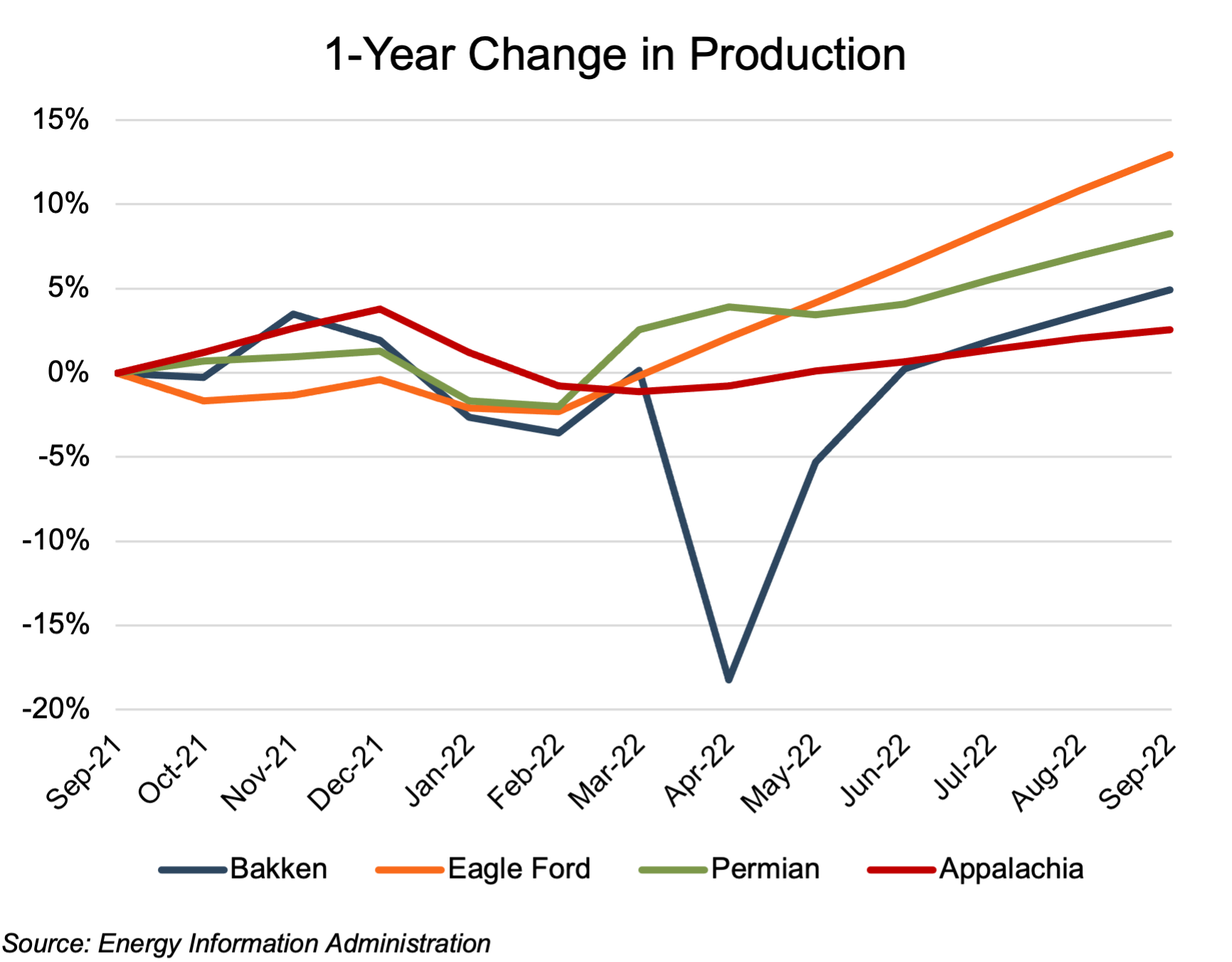
Estimated Bakken production (on a barrels of oil equivalent, or “boe” basis) increased by 5% year-over-year in September. Bakken production, relative to the September 2021 level, plunged nearly 20% in April due to the impact of back-to-back blizzards but had recovered to the September 2021 level by June 2022. Production in the Eagle Ford and Permian were 13% and 8% higher, respectively than in September 2021, without the short-lived plunge seen in the Bakken. The gas-focused Appalachia region production relative to September 2021 levels was more stable than the oil-focused regions, with relative production only varying within a band of -1% to 4%, ending at a year-over-year 3% increase in September 2022.
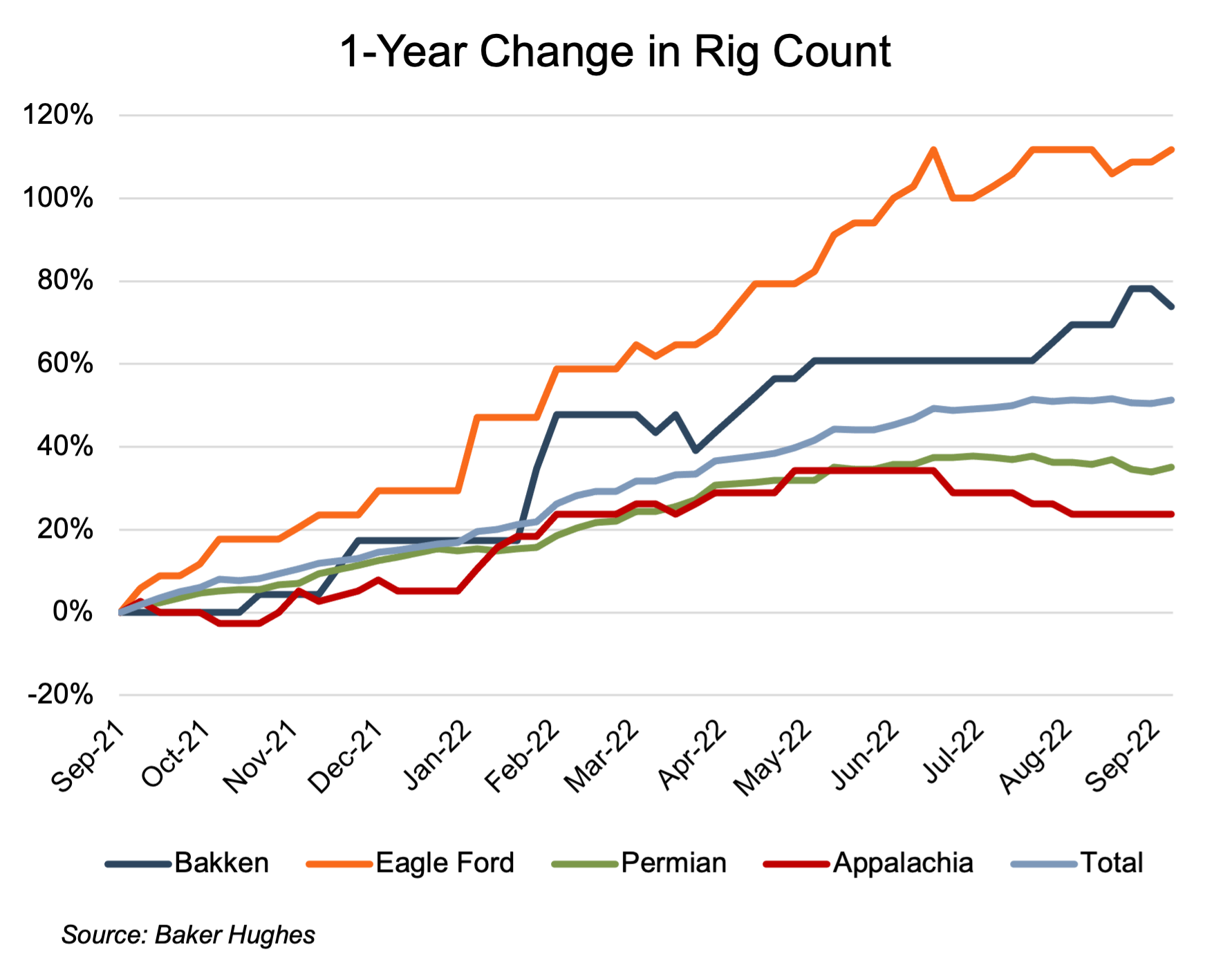
As of September 16, 2022, 40 rigs were operating in the Bakken, marking a 74% increase from September 10, 2021. Eagle Ford, Permian, and Appalachia rig counts were significantly higher than year-earlier levels at 112%, 35%, and 24% increases, respectively. The Permian continued to command the largest number of rigs at 343, with the Eagle Ford and Appalachia closer in-line with the Bakken at 72 and 47 rigs, respectively.
Oil Climbs While Gas Shows Heightened Volatility

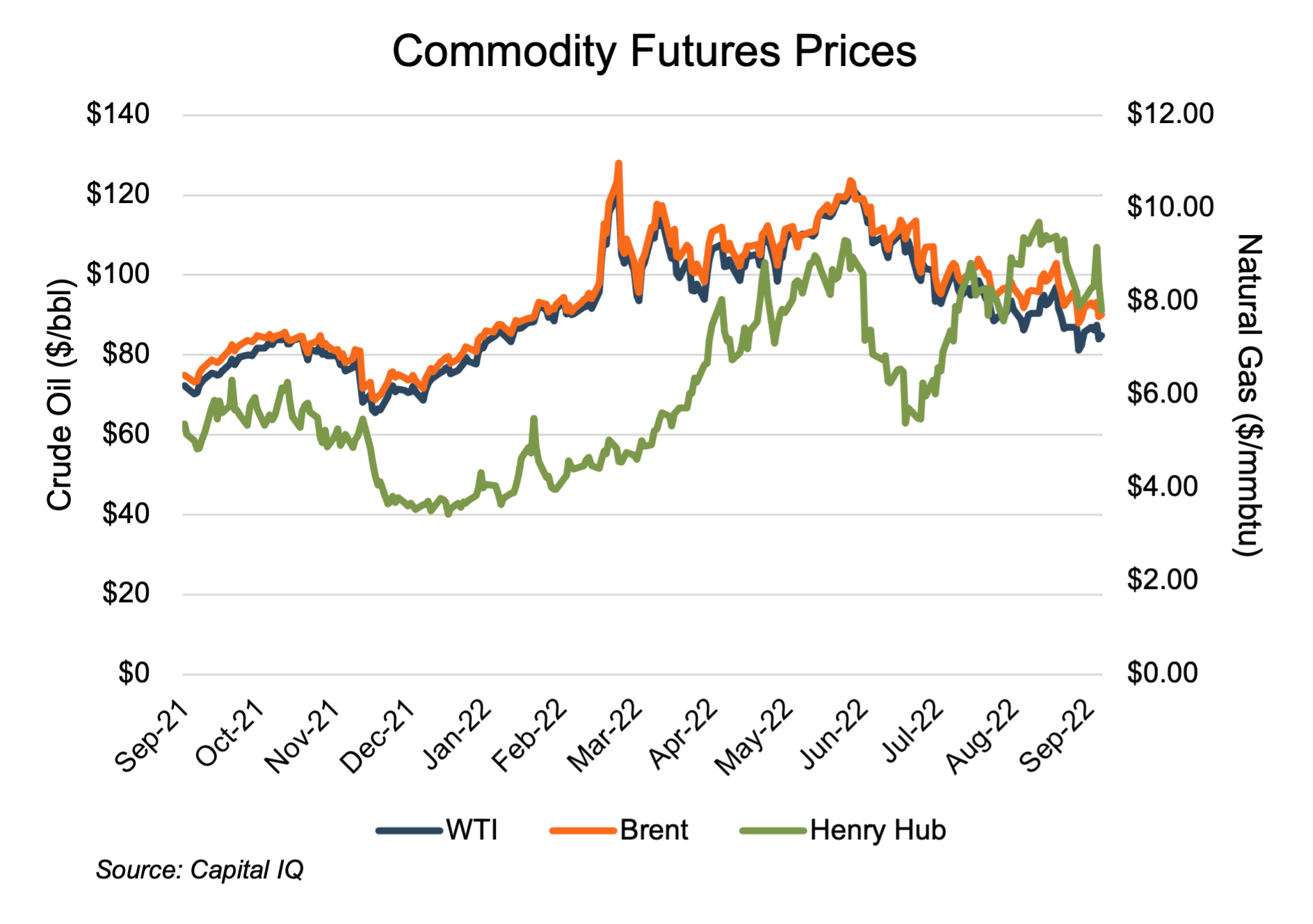
Oil prices, as benchmarked by West Texas Intermediate (WTI) and the Brent Crude (Brent), rose from $72/bbl and $75/bbl, respectively, in September 2021 to $85/bbl and $90/bbl, respectively, as of September 16, 2022. While the rise in pricing was fairly steady through mid-February 2022, the Russian invasion of Ukraine spurred a series of ups and downs, with prices spiking to a high of $120/bbl (WTI) and $128/bbl (Brent) in early March, immediately followed by a plunge to $94/bbl and $96/bbl in mid-March. Subsequent spikes and dips were somewhat more muted, but prices remained volatile through early June. A general price decline during the third quarter resulted in prices at the $85/bbl and $90/bbl level.

Henry Hub natural gas front-month futures prices dipped from a late 2021 high of $5.48/mmbtu to a low of $3.44/mmbtu near 2021 year-end as commodity markets incorporated indications of rising production levels and ebbing weather-driven demand. Pricing subsequently rose to as high as $9.29/mmbtu in June on weather-driven demand and lacking supplies due to a reduction in Russian exports. In mid-June Henry Hub pricing began a sharp decline on the announcement that prices recovered over the remaining two months of the September LTM period, albeit with some volatility, to end at $7.81/mmbtu.
Financial Performance

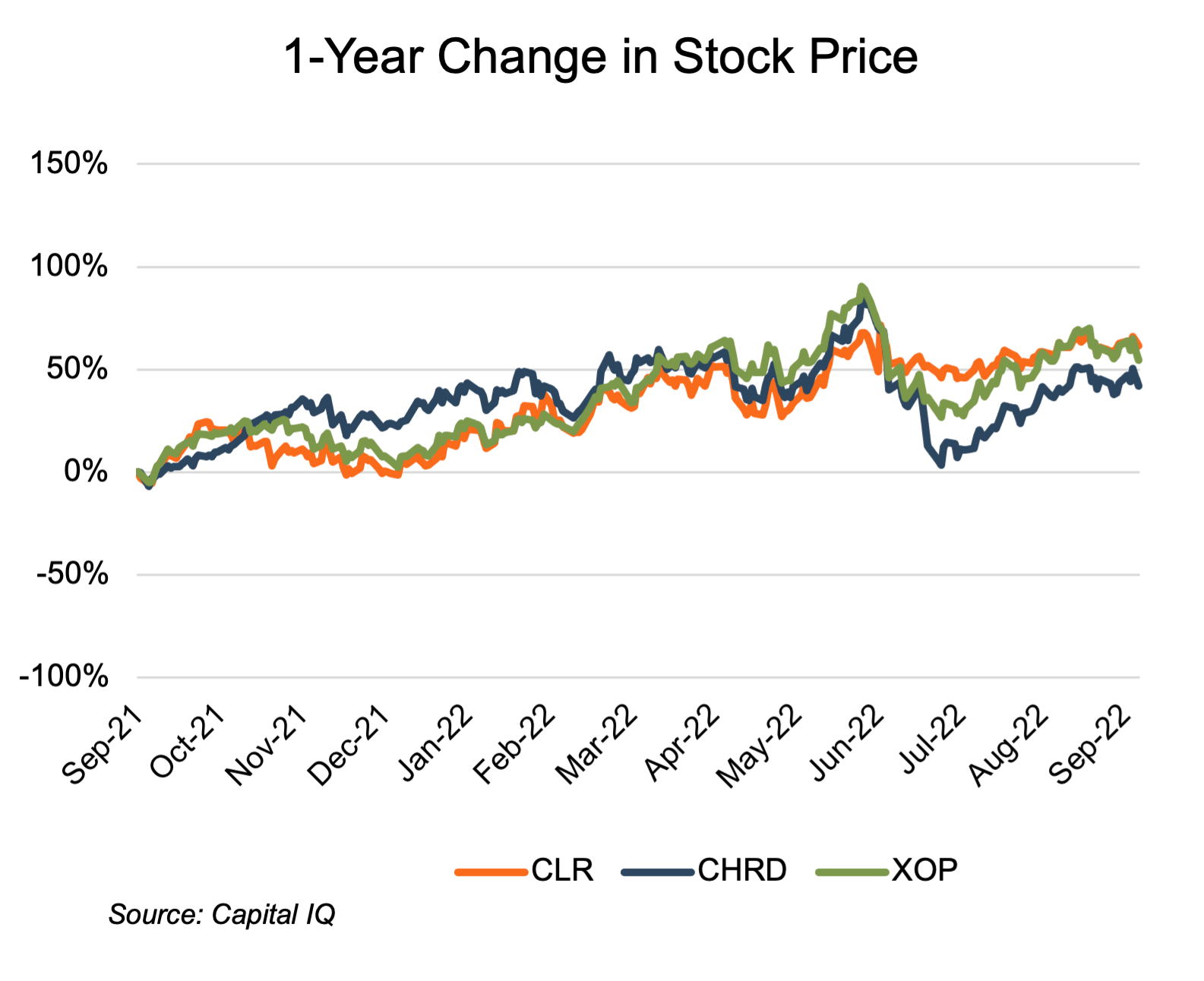
The Bakken public comp group's latest twelve-month financial performance (stock price) analysis was reduced to two subject companies and the XOP SPDR, as a result of the Whiting and Oasis merger in March 2022. The combined Whiting/Oasis company, Chord Energy, appears in our analysis as CHRD.

The Bakken comp group showed strong price performance from year-end 2021 through early June, with increases ranging from 63% to 83%, largely reflective of oil prices. The subsequent decline in commodity prices, which ran nearly un-checked for two months, slashed the analysis period performance to increases of only 3% and 46%, with Chord posting a decline that nearly wiped out its post September 2021 gains. Prices have recovered since July with one-year gains of 42% (Chord) to 61% (Continental).
Conclusion

The Bakken showed a general increase in activity over the last year, albeit with a large winter storm disruption and subsequent production recovery along the way. Rig counts have risen on strong commodity pricing, despite the oil price decline in Q3 2022. Share prices generally increased early in the latest twelve-month period, with a sharp decline in Q3 tied to oil prices slipping. Share prices recovered enough in late Q3 to show reasonably strong year-over-year growth as of September.

We have assisted many clients with various valuation needs in the upstream oil and gas space for both conventional and unconventional plays in North America and around the world. Contact a Mercer Capital professional to discuss your needs in confidence and learn more about how we can help you succeed.

Continue Reading

Defying the Cycle: Haynesville Production Strength in a Shifting Gas Market
Haynesville shale production defied broader market softness in 2025, leading major U.S. basins with double-digit year-over-year growth despite heightened volatility and sub-cycle drilling activity. Efficiency gains, DUC drawdowns, and Gulf Coast demand dynamics allowed operators to sustain output even as natural gas prices fluctuated sharply.
Haynesville Shale M&A Update: 2025 in Review
Key TakeawaysHaynesville remains a strategic LNG-linked basin. 2025 transactions emphasized long-duration natural gas exposure and proximity to Gulf Coast export infrastructure, reinforcing the basin’s importance in meeting global LNG demand.International utilities drove much of the activity. Japanese power and gas companies pursued direct upstream ownership, signaling a shift from traditional offtake agreements toward greater control over U.S. gas supply.M&A was selective but meaningful in scale and intent. While overall deal volume was limited, announced transactions and reported negotiations reflected deliberate, long-term positioning rather than opportunistic shale consolidation.OverviewM&A activity in the Haynesville Shale during 2025 was marked by strategic, LNG-linked transactions and renewed international investor interest in U.S. natural gas assets. While investors remained selective relative to prior shale upcycles, transactions that did occur reflected a clear pattern: buyers focused on long-duration gas exposure, scale, and proximity to Gulf Coast export markets rather than short-term development upside.Producers and capital providers increasingly refocused efforts on the Haynesville basin during the year, including raising capital to acquire both operating assets and mineral positions. This renewed attention followed a period of subdued transaction activity and underscored the basin’s continued relevance within global natural gas portfolios.Although the Haynesville did not experience the breadth of consolidation seen in some oil-weighted plays, the size, counterparties, and strategic motivations behind 2025 transactions reinforced the basin’s role as a long-term supply source for LNG-linked demand.Announced Upstream TransactionsTokyo Gas (TG Natural Resources) / ChevronIn April 2025, Tokyo Gas Co., through its U.S. joint venture TG Natural Resources, entered into an agreement to acquire a 70% interest in Chevron’s East Texas natural gas assets for $525 million. The assets include significant Haynesville exposure and were acquired through a combination of cash consideration and capital commitments.The transaction was characterized as part of Tokyo Gas’s broader strategy to secure long-term U.S. natural gas supply and expand its upstream footprint. The deal reflects a growing trend among international utilities to obtain direct exposure to U.S. shale gas through ownership interests rather than relying solely on long-term offtake contracts or third-party supply arrangements.From an M&A perspective, the transaction highlights continued willingness among major operators to monetize non-core or minority positions while retaining operational involvement, and it underscores the Haynesville’s attractiveness to buyers with a long-term, strategic view of gas demand.JERA / Williams & GEP Haynesville IIIn October 2025, JERA Co., Japan’s largest power generator, announced an agreement to acquire Haynesville shale gas production assets from Williams Companies and GEP Haynesville II, a joint venture between GeoSouthern Energy and Blackstone. The transaction was valued at approximately $1.5 billion.This acquisition marked JERA’s first direct investment in U.S. shale gas production, representing a notable expansion of the company’s upstream exposure and reinforcing JERA’s interest in securing supply from regions with strong connectivity to U.S. LNG export infrastructure.This transaction further illustrates the appeal of the Haynesville to international buyers seeking stable, scalable gas assets and highlights the role of upstream M&A as a tool for portfolio diversification among global utilities and energy companies.Reported Negotiations (Not Announced)Mitsubishi / Aethon Energy ManagementIn June 2025, Reuters reported that Mitsubishi Corp. was in discussions to acquire Aethon Energy Management, a privately held operator with substantial Haynesville production and midstream assets. The potential transaction was reported to be valued at approximately $8 billion, though Reuters emphasized that talks were ongoing and that no deal had been finalized at the time.While the transaction was not announced during 2025, the reported discussions were notable for both their scale and the identity of the potential buyer. Aethon has long been viewed as one of the largest private platforms in the Haynesville, and any transaction involving the company would represent a significant consolidation event within the basin.The reported talks underscored the depth of international interest in Haynesville-oriented platforms and highlighted the potential for large-scale transactions even in an otherwise measured M&A environment.ConclusionWhile overall deal volume remained selective, the transactions and reported negotiations in 2025 reflected sustained global interest in U.S. natural gas assets with long-term relevance. Collectively, the transactions and negotiations discussed above point to a Haynesville M&A landscape driven less by opportunistic consolidation and more by deliberate, long-term positioning. As global energy portfolios continue to evolve, the Haynesville basin remains a focal point for strategic investment, particularly for buyers seeking exposure tied to U.S. natural gas supply and LNG export linkages.
Mineral Aggregator Valuation Multiples Study Released-Data as of 06-11-2025
Mineral Aggregator Valuation Multiples Study Released

With Market Data as of June 11, 2025

Mercer Capital has thoughtfully analyzed the corporate and capital structures of the publicly traded mineral aggregators to derive meaningful indications of enterprise value. We have also calculated valuation multiples based on a variety of metrics, including distributions and reserves, as well as earnings and production on both a historical and forward-looking basis.

Cart

Your cart is empty