Have Reserve Reports Been Relegated To Investor Footnotes?
In the early part of my career, I vividly recall first learning about what was then arguably the most important document that an upstream company produced – the reserve report. Full of pertinent information, the reserve report struck at the heart of an oil and gas company’s economic relevance.
The now discontinued Oil and Gas Financial Journal once described reserves as “a measurable value of a company’s worth and a basic measure of its life span.” Thus, understanding the fair market value of a company’s Proven Developed Producing (PDP), Proven Developed Non-Producing (PDNP), and Proven Undeveloped (PUD) reserves was key to understanding the fair market value of the company. Investors and analysts looked to the reserve report before reviewing the financials sometimes.
Not these days.
Consigned to back pages, footnotes, and appendices, the reserve report’s relevance has waned. Current investor presentations of four Permian-focused oil and gas companies (Pioneer, Centennial, Laredo, and Callon) exemplify this. What I found pertaining to reserve reports continues a years-long trend and was a far cry from what I saw for most of my career. Only one, Laredo, spent any meaningful discourse on their reserve report over the course of a few pages in their investor presentation. They were the smallest company of the group. As for the others: Centennial and Callon spent one whopping page each on their reserves; and the most valuable of them all, Pioneer, showed a single curt reserve figure just in front of their footnotes.
Investor presentations are notable in that they represent a company’s current communication to investors, aspiring to highlight some of the most important information investors want to know. Under that argument, management believes investors don’t care to know much about reserve reports.
For decades, an oil and gas company (all else being equal) often expected to have an enterprise value somewhat close to their PV-10 calculations in their annual reserve report.
Not these days.
The table below shows that current Permian valuations don’t track very close to their PV-10 figures at all. Remember, SEC pricing utilized in these PV-10 calculations below were $66.56 per barrel and $3.60 per Mcf. The enterprise values below reflect today’s prices of over $105 per barrel and over $7.50 per Mcf so price volatility is also a big factor considering that reserve reports reflect a snapshot in time, just like values. We also looked at the enterprise value relative to developed and oil reserve mixes. No clear pattern emerged there either. It begs the question: if Pioneer is lapping the others regarding this time-tested metric, why are they currently burying it next to the fine print?
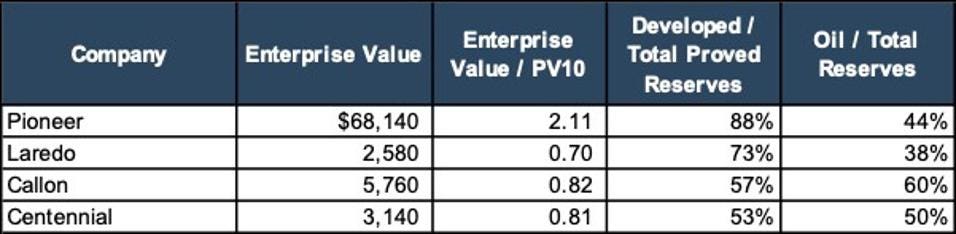
As of May 11, 2022 Source: S&P CAPIQ
The answer is because investors are focused on other things – namely the types of themes that show up in the big bold print of these investor presentations: returns to shareholders, free cash flow and deleveraging. Looking through that lens, we noticed a clearer picture of why Pioneer is valued so highly. Let’s quickly analyze these other metrics in the table below:
As of May 11, 2022 Source: S&P CAPIQ
Immediately Pioneer’s dividend yield and Debt/EBITDA ratio stand out on this table. Pioneer is also the only company on this list with an investment grade credit rating. This appears to be what investors notice. It can’t be understated that the return of capital theme is emphasized for the first ten pages of Pioneer’s investor presentation. Laredo, Callon and Centennial all centered their presentations on these themes too, sans the dividend yield that they don’t have. Valuations appear to be driven by: (i) near term cash flows, (ii) returns on capital, (iii) well margins, and (iv) deleveraging.
There are other ancillary things that analysts and management teams additionally reference frequently such as: held by production (margin related metric), cost per lateral foot drilled (margin related metric), and inventory (near term cash flow related metric). Reserve reports speak into some of those things, but certainly not all and not comprehensively. Stock prices suggest that investors are less concerned about having 15 years of reserves life, or what a company’s probable and possible reserves could be, but more about how profitable next years’ worth of wells will be. It’s also clear that investors do not want management teams beholden to their bankers for capital but prize the ability to operate more self-sufficiently going forward.
It is not that reserve reports are obsolete. They have valuable information, and the core components of value are still found within the walls of a detailed reserve analysis. Reserve reports give investors an idea of the possible production management can reasonably be sure of getting. That’s critically important. It also shows investors what production profiles look like for a company’s current (and perhaps future) wells. It also endeavors to measure near term well drilling and production costs. Bankers still utilize reserve reports as an input to lending decisions (although there has not been much reserve lending happening lately with the deleveraging trend).
Most of the elements I touched on above (near term cash flows, returns on capital, well margins) can be dug out of the details of a reserve report. What’s different now is that how production, costs, risk, and growth are analyzed have gotten more nuanced, detailed, and challenging. More layered analytical work needs be done in an increasingly complex, regulated, and integrated global oil and gas market. So, can an investor reliably breeze through a reserve report, look at proven reserves, an SEC pricing deck, and a 10% standardized discount rate to come up with the fair market value of an oil and gas company?
Not these days.
Originally appeared on Forbes.com.
Defying the Cycle: Haynesville Production Strength in a Shifting Gas Market
Haynesville shale production defied broader market softness in 2025, leading major U.S. basins with double-digit year-over-year growth despite heightened volatility and sub-cycle drilling activity. Efficiency gains, DUC drawdowns, and Gulf Coast demand dynamics allowed operators to sustain output even as natural gas prices fluctuated sharply.
Key TakeawaysHaynesville remains a strategic LNG-linked basin. 2025 transactions emphasized long-duration natural gas exposure and proximity to Gulf Coast export infrastructure, reinforcing the basin’s importance in meeting global LNG demand.International utilities drove much of the activity. Japanese power and gas companies pursued direct upstream ownership, signaling a shift from traditional offtake agreements toward greater control over U.S. gas supply.M&A was selective but meaningful in scale and intent. While overall deal volume was limited, announced transactions and reported negotiations reflected deliberate, long-term positioning rather than opportunistic shale consolidation.OverviewM&A activity in the Haynesville Shale during 2025 was marked by strategic, LNG-linked transactions and renewed international investor interest in U.S. natural gas assets. While investors remained selective relative to prior shale upcycles, transactions that did occur reflected a clear pattern: buyers focused on long-duration gas exposure, scale, and proximity to Gulf Coast export markets rather than short-term development upside.Producers and capital providers increasingly refocused efforts on the Haynesville basin during the year, including raising capital to acquire both operating assets and mineral positions. This renewed attention followed a period of subdued transaction activity and underscored the basin’s continued relevance within global natural gas portfolios.Although the Haynesville did not experience the breadth of consolidation seen in some oil-weighted plays, the size, counterparties, and strategic motivations behind 2025 transactions reinforced the basin’s role as a long-term supply source for LNG-linked demand.Announced Upstream TransactionsTokyo Gas (TG Natural Resources) / ChevronIn April 2025, Tokyo Gas Co., through its U.S. joint venture TG Natural Resources, entered into an agreement to acquire a 70% interest in Chevron’s East Texas natural gas assets for $525 million. The assets include significant Haynesville exposure and were acquired through a combination of cash consideration and capital commitments.The transaction was characterized as part of Tokyo Gas’s broader strategy to secure long-term U.S. natural gas supply and expand its upstream footprint. The deal reflects a growing trend among international utilities to obtain direct exposure to U.S. shale gas through ownership interests rather than relying solely on long-term offtake contracts or third-party supply arrangements.From an M&A perspective, the transaction highlights continued willingness among major operators to monetize non-core or minority positions while retaining operational involvement, and it underscores the Haynesville’s attractiveness to buyers with a long-term, strategic view of gas demand.JERA / Williams & GEP Haynesville IIIn October 2025, JERA Co., Japan’s largest power generator, announced an agreement to acquire Haynesville shale gas production assets from Williams Companies and GEP Haynesville II, a joint venture between GeoSouthern Energy and Blackstone. The transaction was valued at approximately $1.5 billion.This acquisition marked JERA’s first direct investment in U.S. shale gas production, representing a notable expansion of the company’s upstream exposure and reinforcing JERA’s interest in securing supply from regions with strong connectivity to U.S. LNG export infrastructure.This transaction further illustrates the appeal of the Haynesville to international buyers seeking stable, scalable gas assets and highlights the role of upstream M&A as a tool for portfolio diversification among global utilities and energy companies.Reported Negotiations (Not Announced)Mitsubishi / Aethon Energy ManagementIn June 2025, Reuters reported that Mitsubishi Corp. was in discussions to acquire Aethon Energy Management, a privately held operator with substantial Haynesville production and midstream assets. The potential transaction was reported to be valued at approximately $8 billion, though Reuters emphasized that talks were ongoing and that no deal had been finalized at the time.While the transaction was not announced during 2025, the reported discussions were notable for both their scale and the identity of the potential buyer. Aethon has long been viewed as one of the largest private platforms in the Haynesville, and any transaction involving the company would represent a significant consolidation event within the basin.The reported talks underscored the depth of international interest in Haynesville-oriented platforms and highlighted the potential for large-scale transactions even in an otherwise measured M&A environment.ConclusionWhile overall deal volume remained selective, the transactions and reported negotiations in 2025 reflected sustained global interest in U.S. natural gas assets with long-term relevance. Collectively, the transactions and negotiations discussed above point to a Haynesville M&A landscape driven less by opportunistic consolidation and more by deliberate, long-term positioning. As global energy portfolios continue to evolve, the Haynesville basin remains a focal point for strategic investment, particularly for buyers seeking exposure tied to U.S. natural gas supply and LNG export linkages.
Mineral Aggregator Valuation Multiples Study Released
With Market Data as of June 11, 2025
Mercer Capital has thoughtfully analyzed the corporate and capital structures of the publicly traded mineral aggregators to derive meaningful indications of enterprise value. We have also calculated valuation multiples based on a variety of metrics, including distributions and reserves, as well as earnings and production on both a historical and forward-looking basis.