Corporate Valuation, Oil & Gas
Energy-Cat_permian.jpg

April 1, 2022

Modest Production Growth for Eagle Ford

With More on the Way

The economics of Oil & Gas production vary by region. Mercer Capital focuses on trends in the Eagle Ford, Permian, Bakken, and Marcellus and Utica plays. In this post, we take a closer look at the Eagle Ford.

Production and Activity Levels

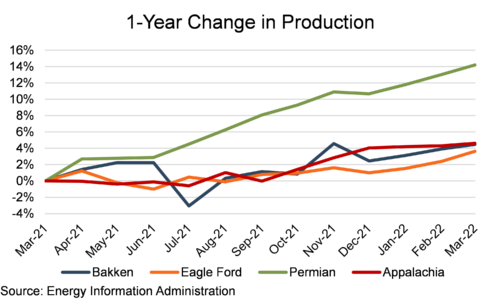
Estimated Eagle Ford production (on a barrels of oil equivalent, or “boe,” basis) increased approximately 4% year-over-year through March. This is in line with the production increases seen in the Bakken and Appalachia (4% and 5%, respectively) but lags behind the Permian, where production increased 14% year-over-year.
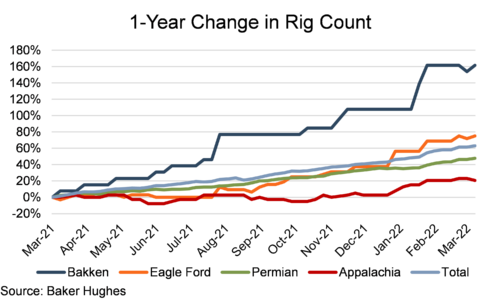
There were 56 rigs in the Eagle Ford as of March 25, up 75% from March 19, 2021. Bakken, Permian, and Appalachia rig counts were up 162%, 48%, and 21%, respectively, over the same period. One may wonder why the Eagle Ford has lagged the Permian in production growth despite a larger increase in rigs. The answer has to do with legacy production declines and new well production per rig. Based on data from the U.S. Energy Information Administration (“EIA”), the Eagle Ford needs ~40-45 rigs running to offset existing production declines, and only recently (starting in January) had more rigs running than this maintenance level. The Permian has generally been operating with more than the maintenance level of rigs, so it has seen a higher level of production growth despite a smaller increase in rigs. However, with 56 rigs now running in the Eagle Ford, more production growth should be on the way.
Commodity Prices Rise Amid Geopolitical Tension

Oil prices generally rose through the first two months of the quarter as increased demand was met with continued producer restraint. While the shale revolution had largely put geopolitics in the back seat as a key driver of commodity prices, geopolitics once again became front and center as Russia launched its invasion of Ukraine. In response, Western nations launched a series of economic sanctions against Russia. While the sanctions generally included carve-outs for energy exports, issues with financing and insurance, as well as the exit of Western oil companies and oilfield service providers from Russia, have resulted in a substantial decline in oil exports from the country. Russia was the third-largest producer of petroleum and other liquids in 2020, according to data from the U.S. Energy Information Administration, behind the U.S. and just shy of Saudi Arabia. The potential for that much oil to no longer be available for global markets has led to a high degree of volatility in oil prices. West Texas Intermediate (WTI) front-month futures prices began the quarter at ~$75/bbl and reached $120/bbl in March. Prices have swung dramatically based on actions in Ukraine and the progress of peace talks.
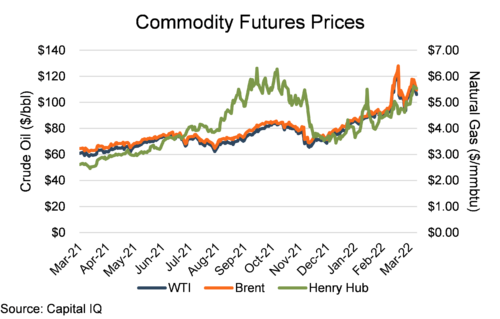
Natural gas prices did not exhibit the same level of volatility as oil prices, given the more localized nature of the commodity. However, natural gas is becoming more globalized as Europe grapples with how to replace Russian imports. One obvious source is the United States, as President Biden pledged to boost LNG exports to Europe, despite these same exports being demonized by Democratic Senator Elizabeth Warren just a few short months ago. Administration officials aim to increase European LNG exports to 50 billion cubic meters annually, up from 22 billion cubic meters exported to the E.U. last year.

Financial Performance

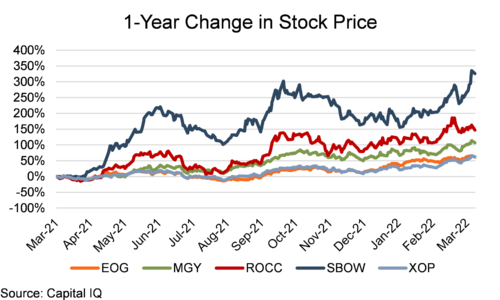
The Eagle Ford public comp group saw relatively strong stock price performance over the past year (through March 28). The beneficial commodity price environment was a significant tailwind to smaller, more leveraged producers like SilverBow and Ranger, whose stock prices increased 326% and 147%, respectively, during the past year, outperforming the broader E&P sector (as proxied by XOP, which rose 62% during the same period). Larger, less leveraged EOG was a laggard, with its stock price rising 61%, slightly behind the broader E&P sector.
Survey Says Eagle Ford Wells Among Most Economic

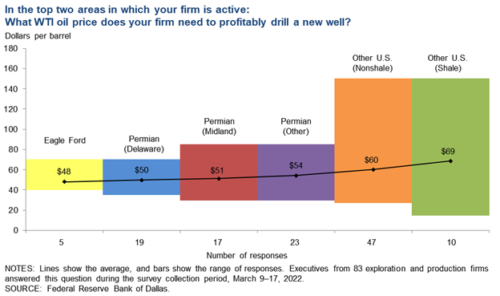
According to participants of the First Quarter 2022 Dallas Fed Energy Survey, Eagle Ford wells are among the most economic in the nation.
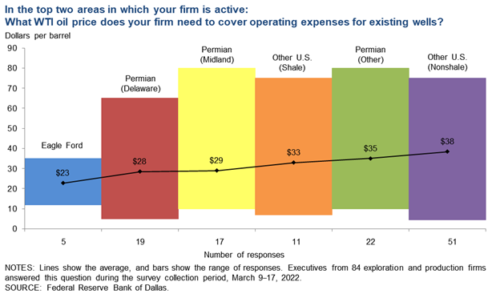
Survey respondents indicated that the average WTI price needed to break even on existing Eagle Ford wells was $23/bbl. This is below the average breakeven in the Permian ($28-$29) and other parts of the U.S. ($30+). While the economic advantage diminishes somewhat for drilling new wells, the Eagle Ford also had the lowest average breakeven for new development, with producers needing WTI at $48/bbl to profitably drill new wells, besting the Permian ($50-51) and other parts of the country ($54-$69). The Eagle Ford’s economic advantage comes from both its geology and geography. The basin’s proximity to Gulf Coast refining and export markets gives it a leg up relative to more inland basins.
Conclusion

Eagle Ford production growth was relatively muted over the past year as capital discipline led to producers running rigs largely at maintenance level. However, with the recent surge in commodity prices, producers are finally starting to bring more rigs online, which should lead to more production growth. However, this growth can’t fill the void left by Russian exports, so commodity prices will likely remain volatile until there is some sort of resolution in Ukraine.

We have assisted many clients with various valuation needs in the upstream oil and gas space for both conventional and unconventional plays in North America and around the world. Contact a Mercer Capital professional to discuss your needs in confidence and learn more about how we can help you succeed.

Continue Reading

Defying the Cycle: Haynesville Production Strength in a Shifting Gas Market
Haynesville shale production defied broader market softness in 2025, leading major U.S. basins with double-digit year-over-year growth despite heightened volatility and sub-cycle drilling activity. Efficiency gains, DUC drawdowns, and Gulf Coast demand dynamics allowed operators to sustain output even as natural gas prices fluctuated sharply.
Haynesville Shale M&A Update: 2025 in Review
Key TakeawaysHaynesville remains a strategic LNG-linked basin. 2025 transactions emphasized long-duration natural gas exposure and proximity to Gulf Coast export infrastructure, reinforcing the basin’s importance in meeting global LNG demand.International utilities drove much of the activity. Japanese power and gas companies pursued direct upstream ownership, signaling a shift from traditional offtake agreements toward greater control over U.S. gas supply.M&A was selective but meaningful in scale and intent. While overall deal volume was limited, announced transactions and reported negotiations reflected deliberate, long-term positioning rather than opportunistic shale consolidation.OverviewM&A activity in the Haynesville Shale during 2025 was marked by strategic, LNG-linked transactions and renewed international investor interest in U.S. natural gas assets. While investors remained selective relative to prior shale upcycles, transactions that did occur reflected a clear pattern: buyers focused on long-duration gas exposure, scale, and proximity to Gulf Coast export markets rather than short-term development upside.Producers and capital providers increasingly refocused efforts on the Haynesville basin during the year, including raising capital to acquire both operating assets and mineral positions. This renewed attention followed a period of subdued transaction activity and underscored the basin’s continued relevance within global natural gas portfolios.Although the Haynesville did not experience the breadth of consolidation seen in some oil-weighted plays, the size, counterparties, and strategic motivations behind 2025 transactions reinforced the basin’s role as a long-term supply source for LNG-linked demand.Announced Upstream TransactionsTokyo Gas (TG Natural Resources) / ChevronIn April 2025, Tokyo Gas Co., through its U.S. joint venture TG Natural Resources, entered into an agreement to acquire a 70% interest in Chevron’s East Texas natural gas assets for $525 million. The assets include significant Haynesville exposure and were acquired through a combination of cash consideration and capital commitments.The transaction was characterized as part of Tokyo Gas’s broader strategy to secure long-term U.S. natural gas supply and expand its upstream footprint. The deal reflects a growing trend among international utilities to obtain direct exposure to U.S. shale gas through ownership interests rather than relying solely on long-term offtake contracts or third-party supply arrangements.From an M&A perspective, the transaction highlights continued willingness among major operators to monetize non-core or minority positions while retaining operational involvement, and it underscores the Haynesville’s attractiveness to buyers with a long-term, strategic view of gas demand.JERA / Williams & GEP Haynesville IIIn October 2025, JERA Co., Japan’s largest power generator, announced an agreement to acquire Haynesville shale gas production assets from Williams Companies and GEP Haynesville II, a joint venture between GeoSouthern Energy and Blackstone. The transaction was valued at approximately $1.5 billion.This acquisition marked JERA’s first direct investment in U.S. shale gas production, representing a notable expansion of the company’s upstream exposure and reinforcing JERA’s interest in securing supply from regions with strong connectivity to U.S. LNG export infrastructure.This transaction further illustrates the appeal of the Haynesville to international buyers seeking stable, scalable gas assets and highlights the role of upstream M&A as a tool for portfolio diversification among global utilities and energy companies.Reported Negotiations (Not Announced)Mitsubishi / Aethon Energy ManagementIn June 2025, Reuters reported that Mitsubishi Corp. was in discussions to acquire Aethon Energy Management, a privately held operator with substantial Haynesville production and midstream assets. The potential transaction was reported to be valued at approximately $8 billion, though Reuters emphasized that talks were ongoing and that no deal had been finalized at the time.While the transaction was not announced during 2025, the reported discussions were notable for both their scale and the identity of the potential buyer. Aethon has long been viewed as one of the largest private platforms in the Haynesville, and any transaction involving the company would represent a significant consolidation event within the basin.The reported talks underscored the depth of international interest in Haynesville-oriented platforms and highlighted the potential for large-scale transactions even in an otherwise measured M&A environment.ConclusionWhile overall deal volume remained selective, the transactions and reported negotiations in 2025 reflected sustained global interest in U.S. natural gas assets with long-term relevance. Collectively, the transactions and negotiations discussed above point to a Haynesville M&A landscape driven less by opportunistic consolidation and more by deliberate, long-term positioning. As global energy portfolios continue to evolve, the Haynesville basin remains a focal point for strategic investment, particularly for buyers seeking exposure tied to U.S. natural gas supply and LNG export linkages.
Mineral Aggregator Valuation Multiples Study Released-Data as of 06-11-2025
Mineral Aggregator Valuation Multiples Study Released

With Market Data as of June 11, 2025

Mercer Capital has thoughtfully analyzed the corporate and capital structures of the publicly traded mineral aggregators to derive meaningful indications of enterprise value. We have also calculated valuation multiples based on a variety of metrics, including distributions and reserves, as well as earnings and production on both a historical and forward-looking basis.

Cart

Your cart is empty