
Key Takeaways
Eagle Ford production remained stable with modest 2.2% year-over-year growth, reflecting basin maturity and consistent output despite declining rig counts.
Commodity price volatility, especially oil, significantly influenced market dynamics, with geopolitical events driving sharp price swings and equity performance in early 2026.
Diverging regional trends, particularly in natural gas basins like Haynesville and Appalachia, highlight the impact of infrastructure, demand exposure, and LNG market connectivity on production activity.
The economics of oil and gas production vary by region. Mercer Capital focuses on trends in the Eagle Ford, Permian, Haynesville, and Marcellus and Utica plays. The cost of producing oil and gas depends on factors such as the geological characteristics of the reserve, the depth of the formation, and the cost of transporting production to market. These variables drive differences in cost structures across regions. In this post, we take a closer look at the Eagle Ford and developments over the latest twelve-months.
Production & Activity Levels
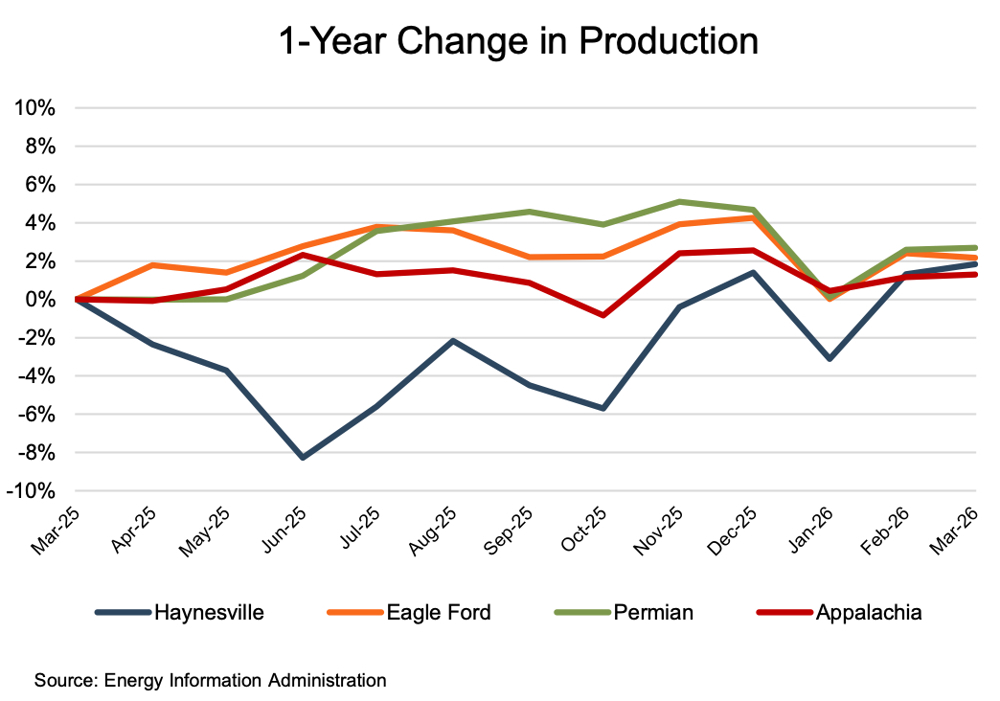
Eagle Ford production increased 2.2% year-over-year (YoY) on a barrels of oil equivalent (boe) basis for the twelve-month period ending March 2026. The basin’s growth was closely aligned with the other major basins, with YoY production increases ranging from 1.3% to 2.7% across the Eagle Ford, Permian, Haynesville and Appalachia. Eagle Ford production remained within a relatively narrow range over the review period, varying between 2.36 and 2.46 million barrels of oil equivalent per day (mboe/d).
The Haynesville exhibited a markedly different pattern, with production changes from March 2025 declining into negative territory (as low as -8.3%) through mid-2025 before recovering through the second half of the year and turning modestly positive in December 2025 and in February and March of 2026. Eagle Ford production generally increased through November 2025 before dipping to its review period starting point in January 2026. Production partially recovered over the following two months to reach its period-end 2.2% YoY change.
The divergence between the Haynesville and Appalachia production growth patterns, despite both being natural gas weighted basins, was driven in part by differences in regional demand exposure and infrastructure dynamics. The Haynesville is more directly tied to Gulf Coast LNG export markets, where timing of facility demand and delays in LNG project development, including the Golden Pass LNG project, have contributed to more pronounced short-term fluctuations in production activity. In contrast, Appalachia production tends to be more stable due to its access to a broader mix of end markets, including domestic consumption and storage, as well as more constrained takeaway capacity that moderates rapid changes in output.
Rig count trends in the Eagle Ford reflect a sustained reduction in drilling activity over the past year. The basin’s rig count declined 13% YoY, falling from 48 rigs in March 2025 to 42 rigs in March 2026. The 48 rigs in March 2025 was the review period high point with the lows at 38 rigs reached in both August and December. The basin posted a brief recovery to 45 rigs in late September and early October, but the count slid back to 38 rigs over the next two months. By early 2026, the rig count stabilized at 40 to 42 rigs.
The Eagle Ford’s decline in rig count was consistent with the Permian which also experienced a bit higher YoY reduction in rig count at 20%. In contrast, the Haynesville and Appalachia gas weighted basins posted rig count increases reflecting improved natural gas economics. Appalachia posted a modest 6% increase while the Haynesville rig count surged 90% to rig count levels it has not seen since 2022. The Haynesville surge was largely attributable to its proximity to Gulf Coast LNG export markets, where growing and anticipated demand provided a more immediate incentive for drilling.
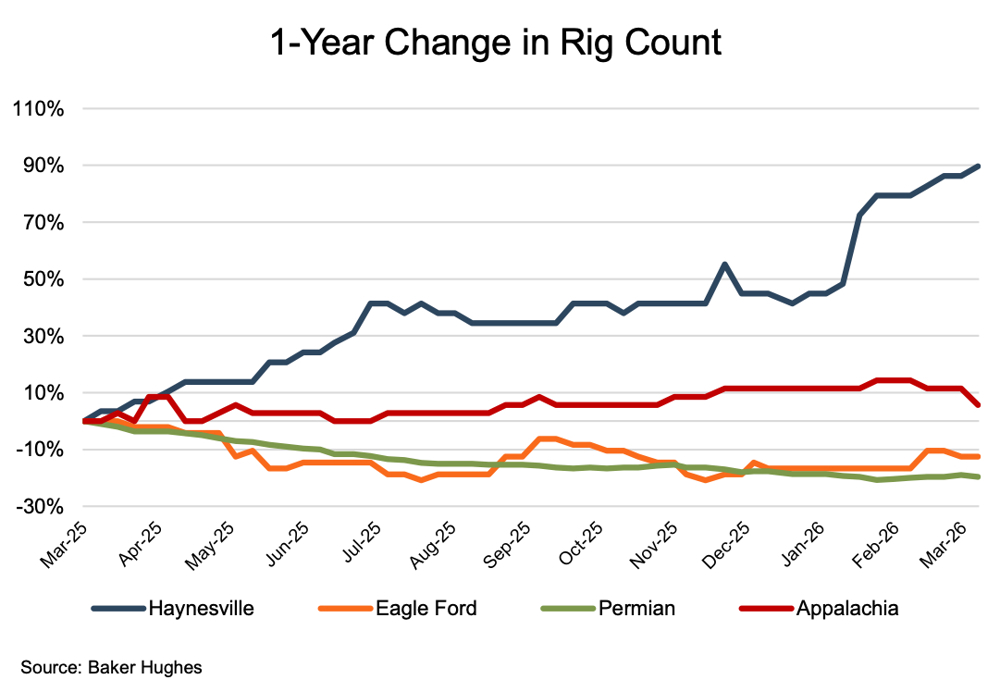
Overall, the combination of modest production growth and declining rig counts highlights the capital discipline and maturity of the Eagle Ford basin. While production levels have remained relatively resilient, the reduction in drilling activity suggests limited near-term growth absent a sustained improvement in oil prices and corresponding increase in operator investment.
Commodity Price Volatility
Oil prices, as benchmarked by West Texas Intermediate and Brent crude front-month futures contracts, experienced greater than usual volatility over the review period – in particular in early 2026. Prices began the period at $71.48 (WTI) and $74.77 (Brent) in late March 2025 before declining into early May, reaching lows of $57.13 and $60.23, respectively. The early period decline was driven by a combination of increasing global supply, including higher OPEC+ output, and softer demand expectations tied to macroeconomic uncertainty and weaker international consumption trends. Prices rebounded through June, supported in part by improving macroeconomic sentiment and geopolitical developments, including coordinated U.S. and Israeli military attacks targeting Iranian nuclear facilities, which introduced a temporary supply risk premium.
For the remainder of 2025, oil prices generally trended downward, reaching lows of $55.13 (WTI) and $58.67 (Brent) in mid-December. However, a reversal in prices began in January and accelerated markedly in March, as the U.S. and Israel launched large-scale military action against Iran to cripple its military and prevent its development of long-range nuclear weapons. The U.S./Israeli attacks heightened concerns around potential supply disruptions and led to Iran’s threatening transportation through the Strait of Hormuz. From March 1 to month-end, WTI jumped 51% from $67.02 to $101.38 while Brent jumped 43% from $72.87 to $103.97.
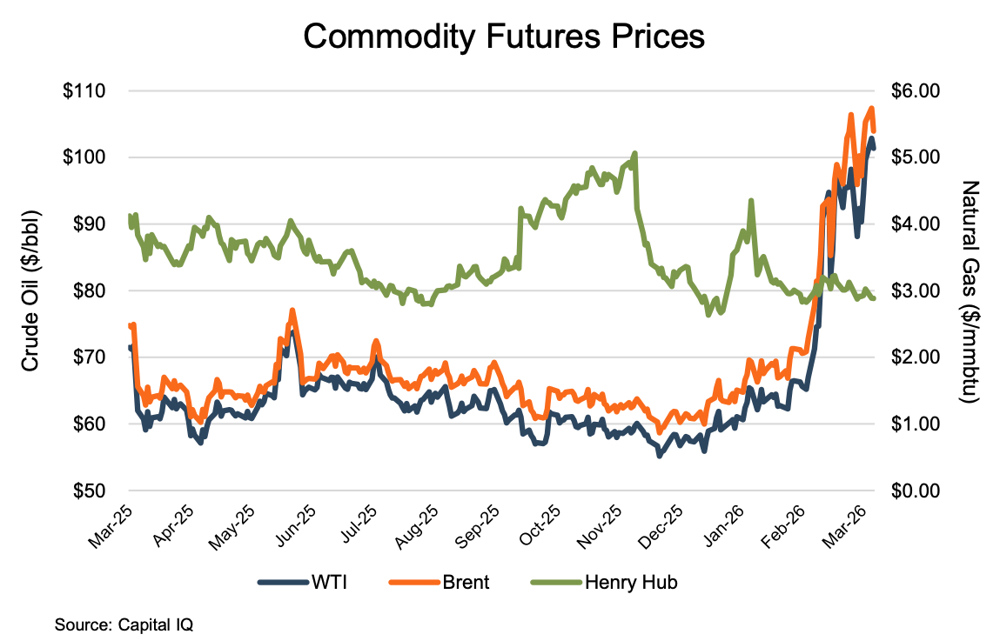
Natural gas prices, as benchmarked by Henry Hub natural gas front-month futures prices, exhibited a period of price stability during the first half of the review period, but marked volatility over the latter part of the period. Prices began the review period at $4.12 per mmbtu at the end of March 2025 and declined through the spring and summer months, reaching a low of $2.80 in August 2025. As seasonal demand strengthened and storage levels tightened, prices rebounded into the winter months, peaking at $5.06 in early December.
Following this peak, natural gas prices declined through mid-January reaching $2.72 as milder weather reduced heating demand and storage concerns eased after the winter peak. Prices then experienced a sharp but short-lived spike in late January driven by extreme winter weather associated with Winter Storm Fern, which temporarily disrupted production and accelerated storage withdrawals.
Financial Performance
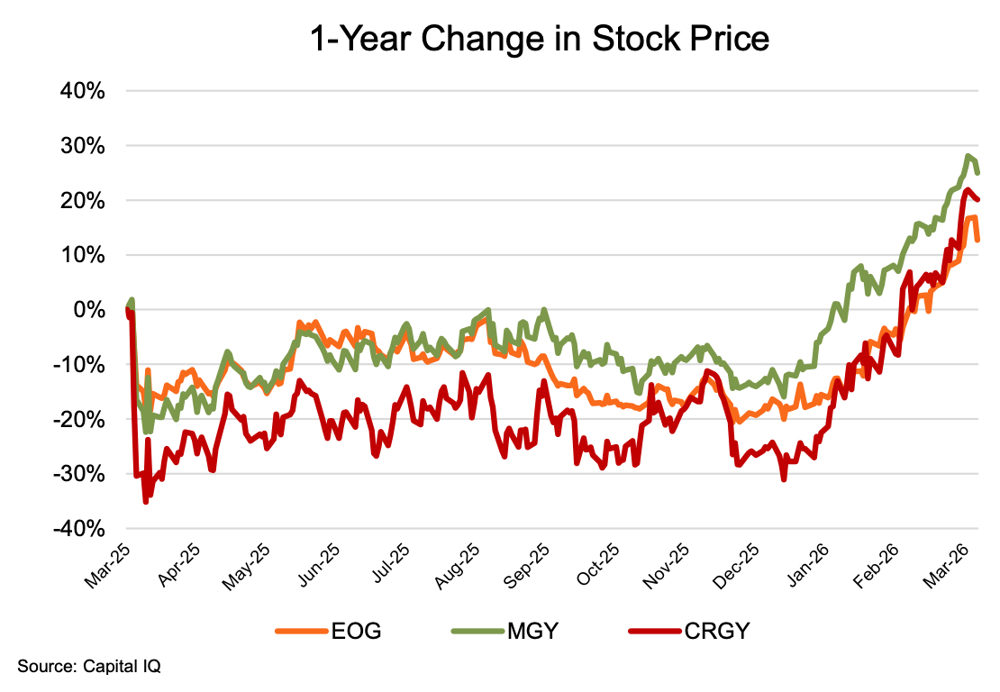
Eagle Ford public comp group companies, including EOG Resources, Magnolia Oil & Gas, and Crescent Energy, posted positive YoY stock price performance through March 31, 2026. EOG increased 13%, Crescent advanced 20%, and Magnolia rose 25%.
Stock prices declined sharply at the outset of the period, with share prices falling 16% to 31% during the first two weeks of April 2025, reflecting a rapid deterioration in oil prices driven by increased global supply expectations and weakening demand outlooks. Over the following nine months, stock prices varied within a broad range without a sustained directional trend, mirroring fluctuations in crude prices. That pattern shifted entering 2026, when all three companies rallied sharply alongside the rebound in oil prices, driven in part by the March U.S./Israel attacks on Iran. From December 31, 2025 to March 31, 2026, EOG rose 38%, Magnolia gained 44%, and Crescent advanced 61%, underscoring improved market sentiment toward Eagle Ford-exposed names.
Crescent Energy’s stock price underperformance during much of 2025, particularly through October, reflects its higher leverage profile and greater sensitivity to commodity price volatility relative to its peers. As a smaller and more acquisition-driven operator, Crescent’s equity performance exhibited greater downside during periods of oil price weakness, though it also participated more strongly in the early 2026 rebound.
Conclusion
The Eagle Ford exhibited modest production growth over the past year, broadly in line with other major basins, as output remained within a relatively narrow range. This stability reflects the basin’s maturity, with limited variability in production despite declining rig counts and continued capital discipline among operators.
Commodity price movements provided a more constructive backdrop entering 2026, with crude prices rebounding sharply during the first quarter and driving a corresponding increase in the stock prices of the Eagle Ford public comp group. While this rally, supported in part by geopolitical developments involving the U.S., Israel, and Iran, contributed to strong equity performance, it may prove transitory when Middle East supply concerns ease. Overall, the basin enters 2Q 2026 with stable production despite reduced rig count levels, with future growth dependent in part on the durability of recent oil price strength.