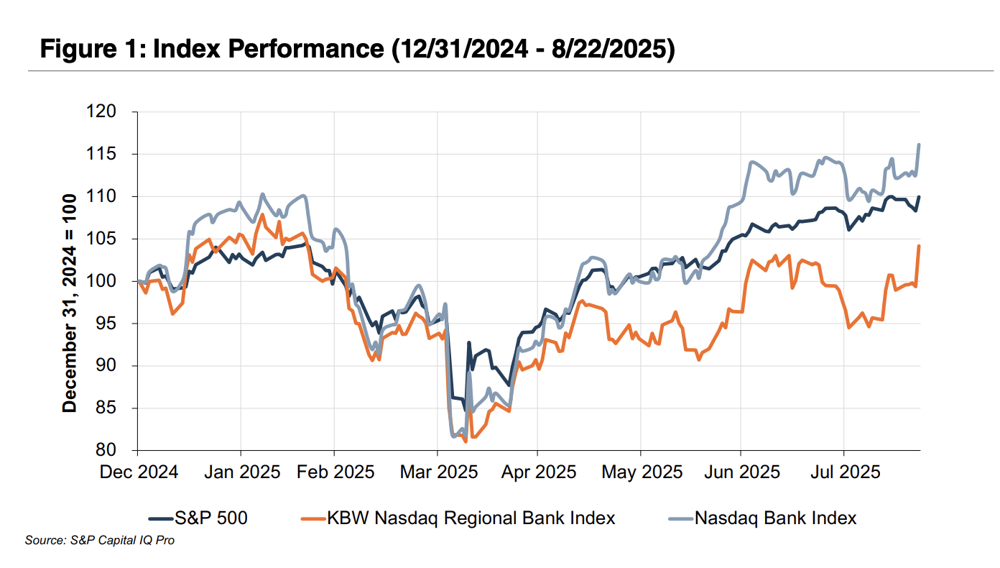
Year-to-date through August 22nd, the Nasdaq Bank Index and KBW Nasdaq Regional Bank Index appreciated by 16.2% and 4.2%, respectively, compared to 10.0% appreciation in the S&P 500 over the same span (see Fig. 1). Bank stocks were down through March/April 2025, tracking the wider market, and fell below the market at the outset of Liberation Day tariff implementation. The Nasdaq Bank Index rebounded strongly throughout the summer, outpacing wider market growth from late May through August. The Regional Bank Index recovered at a slower rate, underperforming the wider market and mirroring wider sluggish growth in small cap stocks related to greater volatility in the market.
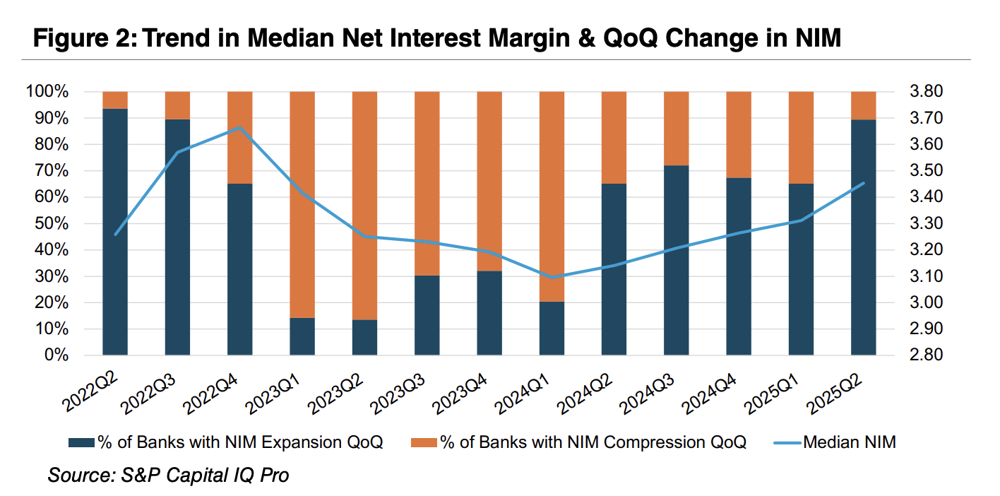
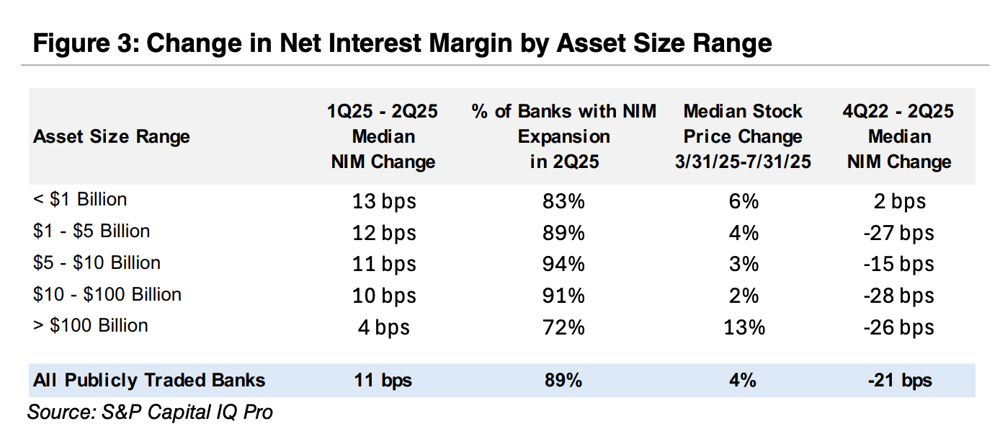
The median net interest margin for all banks traded on the NYSE and NASDAQ widened by 14 basis points in Q2 2025 compared to Q1 2025, continuing a trend of expansion after NIMs bottomed in Q1 2024. Interest rates stabilized in 2025 following a series of cuts throughout the second half of 2024, and bank NIMs have expanded each of the last four quarters. As shown in Figure 2, 89% of banks reported NIM expansion in Q2 2025, up from 65% in the previous quarter. Margin improvement continues to lag for the largest banks (assets > $100 billion), with 72% reporting NIM expansion for Q2 2025 and a median of four basis point of margin expansion.
However, the largest banks had the greatest stock appreciation from the end of March 2025 to July 2025, reflecting the stronger performance from large capitalization companies in light of April tariff volatility. The larger asset bases, economic moats, and greater resilience to volatility of large companies relative to smaller companies has allowed them to weather market volatility and enjoy a “flight to quality” effect as investors allocate to assets perceived as safer.
As shown in Figure 3, the largest banks materially outperformed the wider banking sector from March 31, 2025 through July 31, 2025. Additionally, the smallest banks (assets < $1 billion) have fully recovered above the Q4 2022 peak in NIM, while the rest of the group is still approximately 15-30 basis points below those levels.
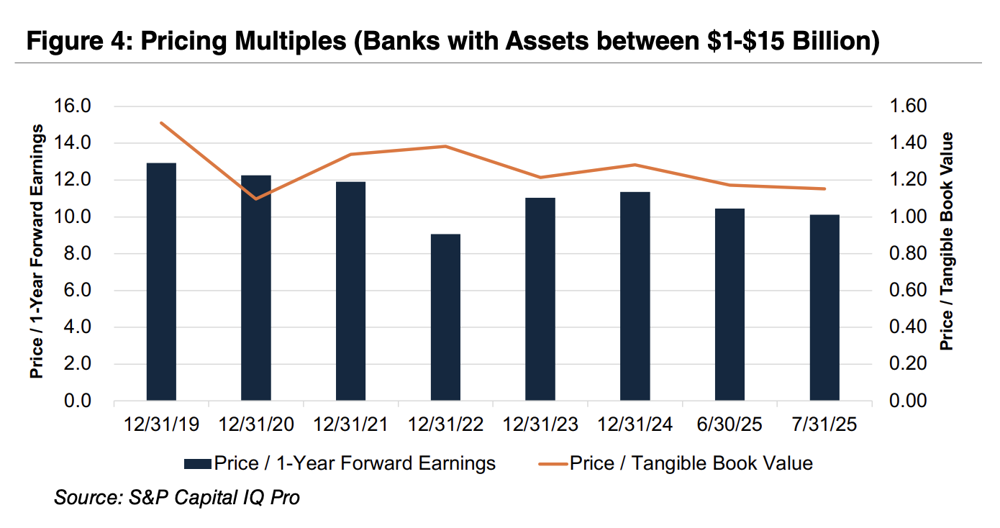
As illustrated in Figure 4, valuation multiples fell slightly across the first half of 2025. Publicly traded banks with assets between $1 and $15 billion reported a median price/one year forward earnings multiple of 10.1x and a price/tangible book value multiple of 1.15x as of July 31, 2025, down from 11.4x and 1.28x as of December 31, 2024. According to data provided by S&P Capital IQ Pro, there were 113 announced M&A transactions through August 25, compared to 133 announced transactions for the entirety of 2024.
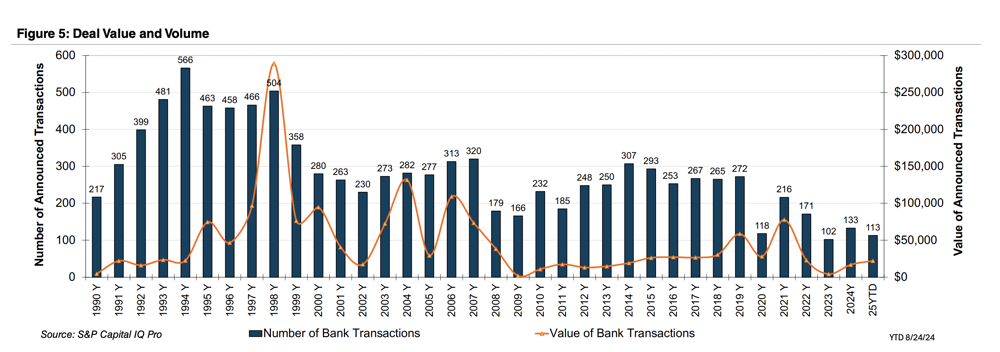
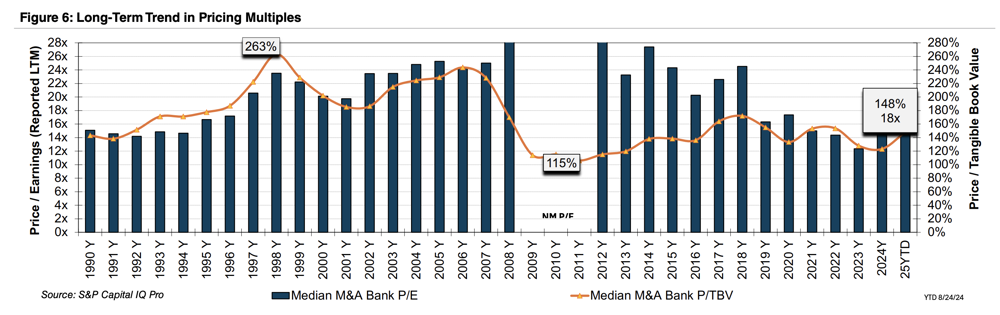
Notably, aggregate deal volume reached $22.1 billion, which exceeds the $16.9 billion in announced deals in all of 2024 as shown in Figure 5, on the next page. The bank M&A market continues to recover after a down 2023, reflecting a more stable interest rate environment and expectations for further rate cuts. Four deals valued at over $1 billion have been announced in 2025 compared to six in 2024 and just one in 2022 and 2023, and the median P/E multiple on announced deals increased from 16.4x in 2024 to 18.1x in 2025.
The market is currently pricing in a cut in the Federal Reserve target rate at the September and October meetings, with 30-day Fed Funds Futures prices implying approximately an 87% chance of a 25 basis point cut at the September meeting. During prior interest rate cut cycles (August 2024 through December 2024 and June 2019 through January 2020), NIMs either rose or stayed constant. While 30-year yields fell during the 2019 cutting cycle, they rose during the most recent 2024 cycle. This could reflect concerns about longer-term inflation risks in the event of short term rates falling, as well as the potential impact on banks with longer-duration balance sheet exposures in the event of interest rate cuts in September and October.
Overall, the banking industry has continued to recover in the first half of 2025, following recovery throughout 2024 following a period of uncertainty and heightened industry volatility in 2023. Larger institutions have seen greater stock price appreciation given strong recovery from April 2025 lows, while smaller institutions have benefitted with stronger NIMs in an operating environment with a more stable, lower interest rate outlook. A further drop in rates as anticipated could serve to continue bolstering profitability, offset by possible long-term inflation risks. M&A activity has continued to accelerate with deal size and volume both ahead of mid-year 2024 levels.