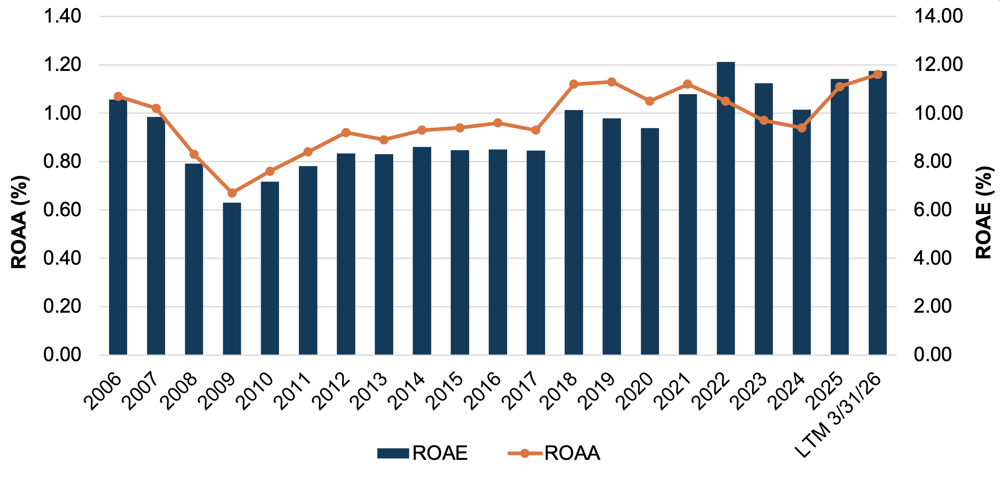
Community bank earnings have improved the past two years. For banks with assets between $100 million and $5 billion, the median ROAA was 1.16% for the trailing twelve months ended March 31, 2026, up from 0.94% in 2024. Median ROAE improved from 10.15% to 11.75% over the same period. The improvement reflects three key factors: wider NIMs, earning asset growth that has been driven via loans rather than securities growth, and modest credit costs.
Figure 1: Median ROAA and ROAE
Source: S&P Capital IQ Pro. Data set includes commercial banks, savings banks, and savings and loan associates with assets between $100 million and $5 billion. Excludes those with unusual loan portfolio and revenue composition.
Margin Recovery Has Run Its Course
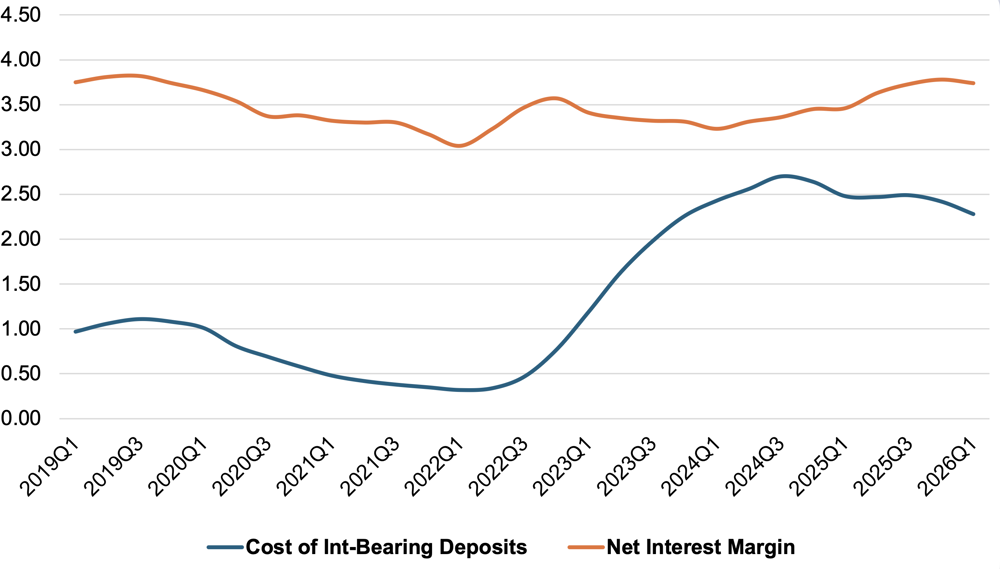
The median net interest margin for community banks in the data set increased from 3.23% in the first quarter of 2024 to 3.78% in the fourth quarter of 2025, before easing to 3.74% in the first quarter of 2026. Loan yields benefited from new production in a higher-rate environment and from the repricing of credits booked during lower-rate periods. Securities cash flows provided a similar tailwind as proceeds were reinvested at yields above those available in 2020 and 2021. At the same time, the rapid increase in funding costs that occurred after SVB failed eased as the Fed cut its short-term policy rates in the fall of 2024 and again in the fall of 2025, which resulted in the cost of deposits declining to 2.28% in the first quarter of 2026 from 2.70% in the third quarter of 2024.
Absent a material change in rates, the rebound in NIMs likely has run its course as deposit competition remains intense while the repricing of the back books of loan portfolios will mostly run its course by early next year. Security portfolio yields will grind higher as cash flows are reinvested at higher yields, but probably not sufficiently fast to materially improve NIMs and drive EPS above expectations.
Figure 2: Trend in Net Interest Margin & Cost of Interest-Bearing Deposits
Source: S&P Capital IQ Pro.
The Deposit Mix Has Changed
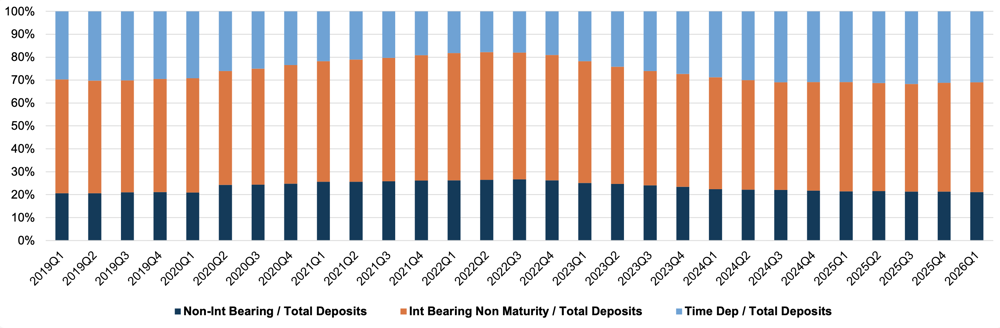
Deposit composition changed meaningfully over the cycle. Noninterest-bearing deposits peaked at 26% of total deposits in the third quarter of 2022. By the first quarter of 2026, they represented 21% of deposits. Interest-bearing non-maturity deposits also declined, falling from 54% of deposits in the second quarter of 2022 to 47% in the first quarter of 2026. Time deposits moved in the opposite direction, increasing from 17% of total deposits in the second quarter of 2022 to 30% in the first quarter of 2026. While the time deposit share has declined from its recent peak of 32% in the third quarter of 2025, it remains a much larger portion of the funding base than it was earlier in the cycle.
If the Fed reverses its 2025 rate cuts, then funding costs may move higher with less lag (or a higher deposit beta) than occurred pre-SVB because NIB deposits are lower and many banks aggressively reduced money market rates last year to drive NIMs higher. Nonetheless, the data do not suggest a broad deposit problem for community banks. Deposits are still growing, funding conditions are better than they were at the peak of the cycle, and the shift toward time deposits has moderated.
Figure 3: Deposit Base Composition
Source: S&P Capital IQ Pro.
Loan Growth Is Available, But Funding Matters
Loan growth remained positive across community bank size cohorts in the first quarter of 2026, with the pace generally increasing with asset size. Banks under $500 million reported year-over-year loan growth of 5.0%, while banks between $3 billion and $10 billion reported growth of 6.2%. Deposit growth was positive as well, but generally trailed loan growth, at 3.7% for banks under $500 million and 5.1% for banks between $3 billion and $10 billion. Banks under $500 million reported a median loan-to-deposit ratio of 76.1%, compared with 88.7% for banks between $3 billion and $10 billion. Larger community banks also reported greater use of brokered deposits and borrowings.
This does not suggest unusual funding stress, but it indicates that funding loan growth at the margin is more expensive. Loan pricing should reflect this, but it may not. A non-owner occupied CRE loan and a C&I relationship can produce the same balance-sheet growth, but not the same funding or franchise value. The C&I relationship should bring operating deposits and other customer touchpoints. The CRE credit may provide earning asset growth but fewer ancillary benefits. As liquidity has normalized, the source and composition of growth matter more.
Credit Metrics Are Normalizing from Low Levels
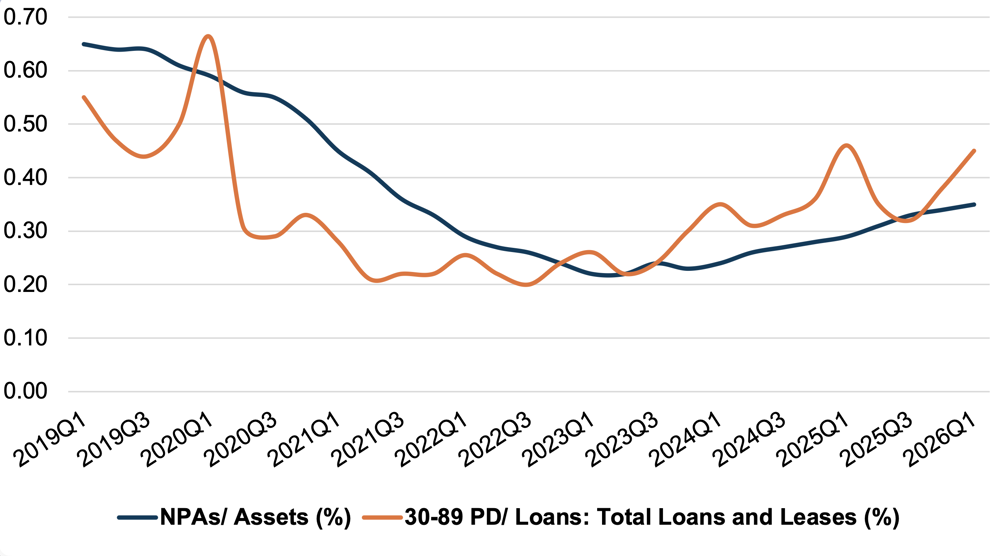
Credit quality metrics reflect an increase in NPAs and net charge-offs from the post-COVID lows, but not high enough to meaningfully dent profitability. NPAs as a percentage of assets declined from 0.65% in the first quarter of 2019 to 0.22% in 2023. Since then, the ratio has increased to 0.35% in the first quarter of 2026. Early-stage delinquencies have also moved higher, with loans 30 to 89 days past due representing 0.45% of loans in the first quarter of 2026.
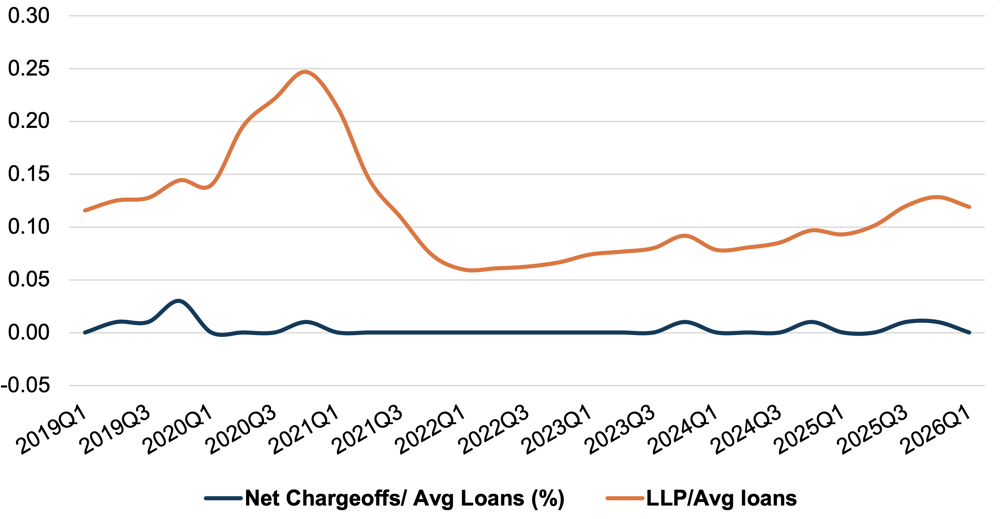
Net charge-offs remain low, while provision expense has moved up modestly from trough levels. Loan loss provision expense to average loans increased from 0.07% in the fourth quarter of 2021 to 0.12% in the first quarter of 2026.
From 2021 through much of 2023, unusually low credit costs were a tailwind to reported profitability. As provision expense moves toward more normal levels, that tailwind becomes less meaningful.
Figure 4

Source: S&P Capital IQ Pro. Data set includes commercial banks, savings banks, and savings and loan associates with assets less than $10 billion. Excludes those with unusual loan portfolio and revenue composition.
Figure 5: Trend in NPAs & Delinquencies
Source: S&P Capital IQ Pro.
Figure 6: Trend in NCOs & LLP
Source: S&P Capital IQ Pro.
Operating Leverage Remains Part of the Earnings Story
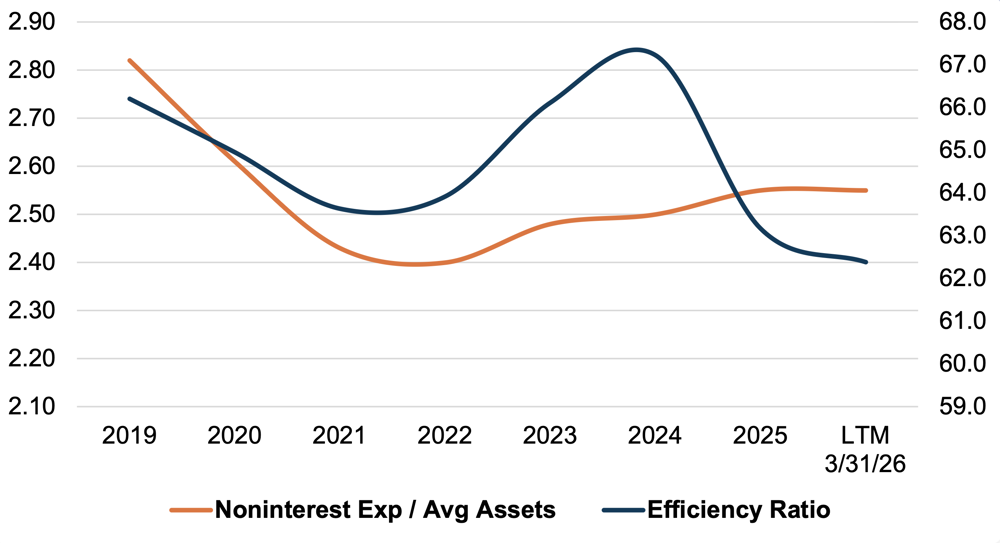
The expense data add another layer to the durability question. The median efficiency ratio improved to 63.2% in 2025 from 67.2% in 2024 and 66.1% in 2023, and improved further to 62.4% for the twelve months ended March 31, 2026. While that’s an encouraging trend, noninterest expense as a percentage of average assets tells a slightly different story. Noninterest expense as a percentage of average assets declined from 2.82% in 2019 to 2.40% in 2022, but then moved higher to 2.50% in 2024 and 2.55% in 2025. It remained 2.55% for the twelve months ended March 31, 2026.
Figure 7 provides a useful cross-check on the improvement in the efficiency ratio. Revenue has recovered, which helps the efficiency ratio, but the underlying expense burden has not moved back to its 2022 low. That is not surprising, as community banks continue to invest in technology, cybersecurity, fraud prevention, compliance, data processing, treasury management, lenders, and credit infrastructure. Some of these costs are defensive, while others are intended to support growth or improve productivity. Either way, margin relief alone does not answer the operating leverage question.
Better, But Built to Last?
The data and recent conversations with bank management teams point to a stronger earnings backdrop for community banks, but also a more nuanced one. Loan demand is generally healthy, margin pressure has eased, and credit quality remains manageable. At the same time, funding remains central to the growth discussion, deposit mix is less favorable than it was earlier in the cycle, and credit costs are moving off unusually low levels. The credit issues that are surfacing, however, appear more borrower-specific or segment-specific than systemic.
For community banks, 2026 may be less about whether earnings are better and more about whether the improvement is supported by relationship deposits, fundable loan growth, manageable credit costs, and operating leverage. Community bank earnings are better. Whether they are built to last depends on the composition of that improvement.
Figure 7: Trend in Noninterest Expenses & Efficiency Ratio
Source: S&P Capital IQ Pro.