When Circle Internet Group (CRCL) began trading on the New York Stock Exchange in June 2025, it opened at $69 per share, more than double its IPO price of $31 per share, and reached an intraday high of $103.75 per share on its first day. In our July 2025 Bank Watch, we used that IPO as a lens for examining what the rise of stablecoins might mean for traditional bank deposit franchises. The GENIUS Act had just been signed into law and one of the central questions as regulatory frameworks began crystallizing was: How will stablecoins threaten bank deposit funding? Ten months later, we have a clearer picture of the strategic divide opening up between large banks and community institutions.
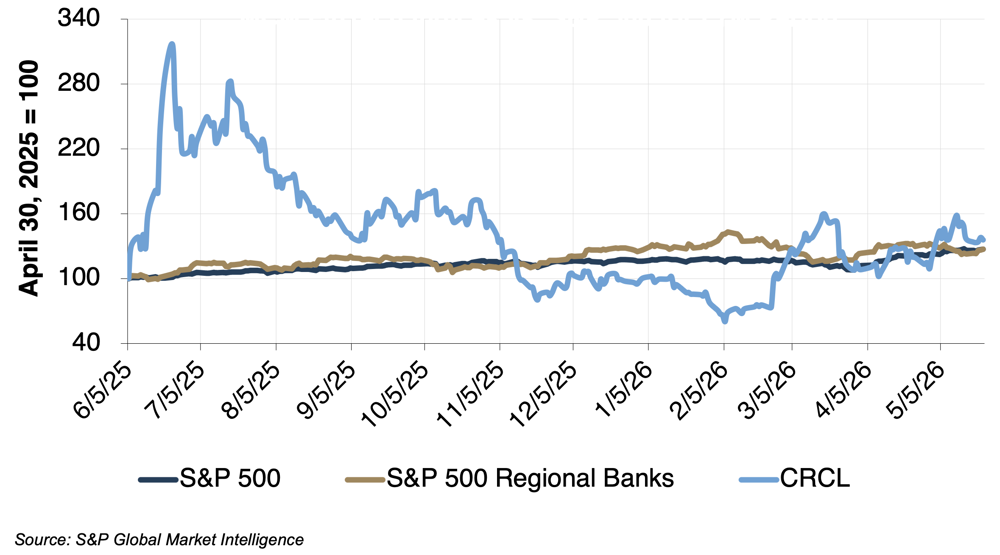
CRCL’s post-IPO arc is itself instructive. After reaching a record high of $300 per share in late June 2025, the stock has pulled back sharply, with a closing price of $113 per share as of May 22, 2026- a 62% decline from its peak, though still roughly 3.65x its original IPO price. The Company’s Q1 2026 earnings report provided a backdrop for this trading volatility. Circle posted EPS of $0.47, beating estimates of $0.27 by a wide margin, but revenue of $694 million missed consensus forecasts by approximately 3%. The revenue miss highlights Circle’s fundamental business model vulnerability in that the company earns the vast majority of its revenue from the interest generated by investing USDC reserves in short-term U.S. Treasury securities, opening the company to interest rate volatility.
As Visa’s Economic Empowerment Institute observed in a detailed study of Circle’s S-1, fully 95–99% of Circle’s revenue from 2022 to 2024 was derived from reserve interest income. This means that Circle’s revenue model, and the model of any similar companies built on stablecoin custodianship, is dependent on short term interest notes in a way that bank deposit franchises are not. Traditional banks can reprice loans, manage mix, and lean on multiple levers to manage duration and spread, whereas the GENIUS Act restricts the type of assets that companies like Circle can hold.
What the market re-rating tells us is less about Circle specifically and more about how investors are recalibrating the stablecoin opportunity. The initial euphoria priced in a world where stablecoins swept quickly into everyday consumer payments. The reality of the past year’s more sober follow-through reflects a more nuanced reality: stablecoins are growing fast, but their near-term dominance is concentrated in specific use cases (institutional settlement, DeFi, international remittances, and cross-border corporate treasury).
Circle Total Return vs. Market and Regional Banks Post-IPO
Stablecoin Market Growth
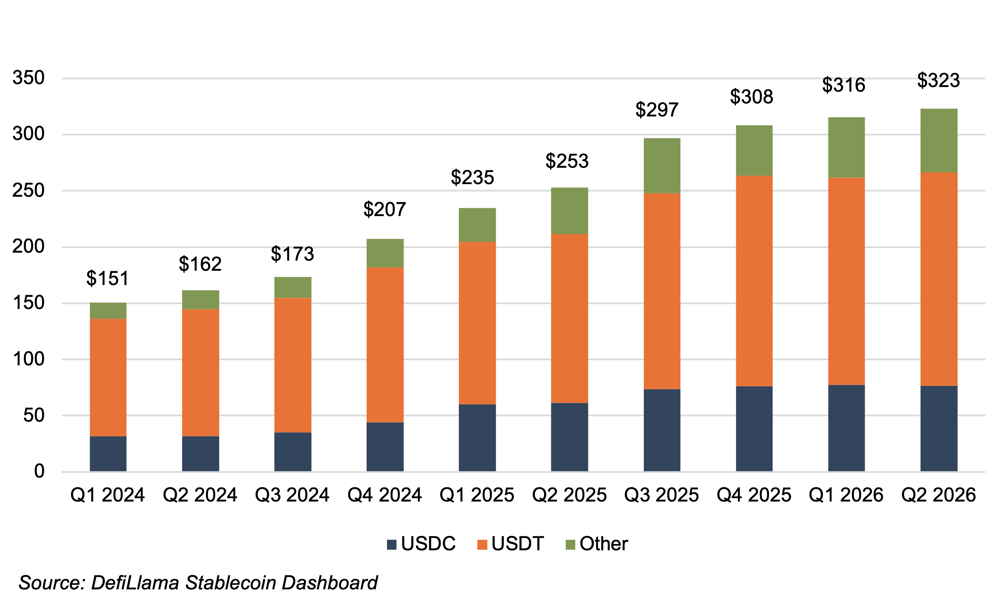
Despite Circle’s valuation rerating over the last year and a less euphoric market outlook, the stablecoin market itself has remained strong and continued to expand. The total stablecoin market capitalization surpassed $320 billion in April 2026, up from approximately $205 billion at the start of 2025- a more than a 50% increase in roughly sixteen months.
Transaction volumes told an even more striking story: aggregate stablecoin transaction volume reached $33 trillion in 2025, a 72% year-over-year increase, with USDC leading with $18.3 trillion and USDT recording $13.3 trillion. For context, Visa processed $15.7 trillion in fiscal year payment volume over a comparable period. USDC specifically has continued to gain ground. Circulating supply reached $78.1 billion as of May 2026, up from $61 billion at the time of Circle’s IPO, a 28% increase in less than a year. Bloomberg Intelligence projects stablecoin payment flows could reach $56.6 trillion annually by 2030, implying roughly 80% compound annual growth from 2025 levels.
Stablecoin Market Capitalization (billions of USD)
The competitive landscape within stablecoins has also intensified in ways that matter for banks. Tether launched USA in January 2026, a federally regulated stablecoin issued through Anchorage Digital Bank and designed for GENIUS Act compliance. The launch put Tether back in direct competition with USDC for the U.S. institutional market, which USDC had largely owned by virtue of its early regulatory posture. PayPal’s PYUSD and Ripple’s RLUSD are also expanding their footprints. The institutional stablecoin market is no longer a two-company race, and the pace of new entrants is accelerating, not slowing.
From Observers to Participants: What Are Big Banks Doing?
In the ten months since we wrote about Circle’s IPO, major U.S. banks have begun actively positioning themselves to participate in stablecoin industry activity. JPMorgan, Bank of America, Citigroup, and Wells Fargo began exploring a joint stablecoin initiative routed through Early Warning Services (the operator of Zelle) and The Clearing House, which powers real-time payment networks. Additionally, Wells Fargo filed a trademark application for WFUSD in March of 2026 with the U.S. Patent and Trademark Office. The filing covers cryptocurrency payment processing, digital asset trading, and software for tokenizing assets, language that points squarely toward a deposit token or stablecoin. The move mirrors JPMorgan’s earlier trademark filing for “JPMD,” which preceded the launch of a permissioned USD deposit token on Base, the Ethereum layer-2 network. SoFi Bank went further still, launching SoFiUSD — a fully reserved dollar-pegged stablecoin built on BitGo’s stablecoin-as-a-service infrastructure.
The GENIUS Act created legal architecture for traditional banks to add stablecoin activity and services to their suite of product offerings, allowing them to establish roles for themselves in the ecosystem across the three distinct roles for banks in the stablecoin ecosystem: issuance, custody, and distribution. The fact that numerous digital asset and cryptocurrency-centric companies like Circle including Ripple, Paxos, Fidelity Digital Assets, Crypto.com, and more have applied for banking charters serves to illustrate the blurring of lines between the areas in which traditional financial institutions and digital asset companies operate. While it is unlikely every bank needs to issue its own stablecoin, institutions involved in payments and depository institutions face a strategic choice about which role, if any, it intends to play and how it will address potential competition for deposits.
Effect on Community Banks
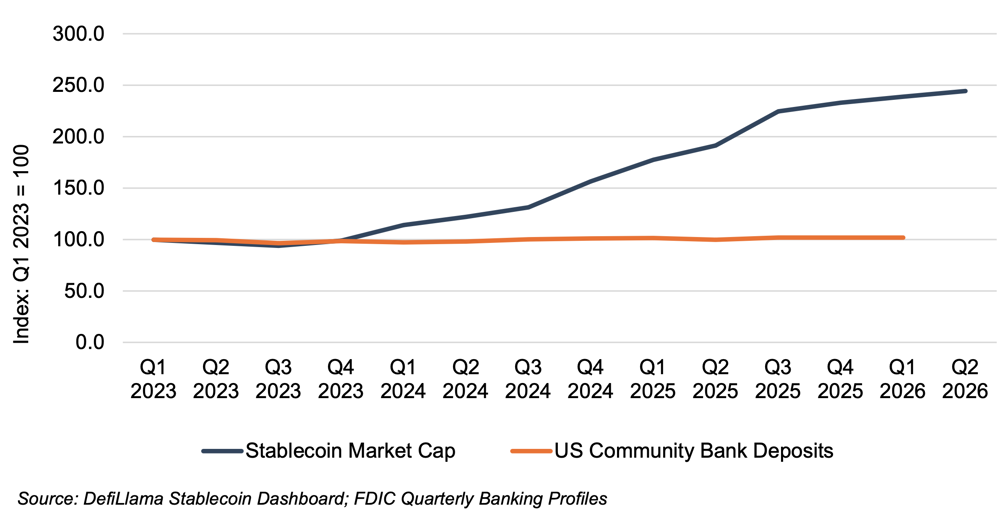
Our discussion above has primarily focused on large institutions with the balance sheets, technology infrastructure, and regulatory relationships to engage the stablecoin market as active participants. For community banks, the situation is more complex. Standard Chartered’s global head of digital assets research estimated in January 2026 that stablecoins could drain roughly $100 billion from U.S. bank deposits, calculated as approximately one-third of the stablecoin market’s then-current capitalization of $301 billion.
Citigroup’s earlier analysis put the range considerably wider, projecting $182 to $908 billion in deposit displacement by 2030 (this reflects 2.5% of projected 2030 U.S. bank deposits). Citi released a September 2025 update which adjusted stablecoin issuance forecasts upwards from $0.5T-$3.7T to $1.9T-$4.0T (while this report did not also update displacement numbers, it would stand to reason that displacement would increase as well).
The wide range reflects genuine uncertainty about adoption curves, but even the low end is a number that warrants board-level attention. Because stablecoin issuers primarily hold Treasury bills and other assets outside the banking system on their balance sheets, money moved into stablecoins by customers is effectively removed from the banking system. This is why widespread stablecoin adoption could have an outsize effect on deposits, especially at institutions with limited ability to participate in the stablecoin ecosystem.
Furthermore, the structural mechanism of deposit displacement does not affect all banks equally. The concern is not simply that consumers will move deposits into stablecoins held in crypto wallets. The more plausible and proximate risk is structural: stablecoin issuers need to custody their reserves somewhere, and that somewhere will almost certainly be a large regulated bank rather than a community institution.
As Circle’s reserve composition illustrates, USDC reserves are held in a mix of cash at regulated U.S. banks and short-term U.S. Treasury bills held in a BlackRock-managed government money market fund. The cash portion flows to large custodians, not local community banks. Our previous Bank Watch article noted this concern. What has become clearer since then is the compounding effect: as stablecoins grow, deposits migrate not just out of the banking system in aggregate but specifically toward the largest institutions with the infrastructure to serve as reserve custodians. Community banks bear a disproportionate share of the deposit risk while having the fewest tools to respond.
There is also a second-order effect worth tracking. Circle’s chief commercial officer advised enterprises in February 2026 against building their own stablecoins, noting that of more than 300 attempted stablecoin launches, roughly 95% have failed to achieve sustainable global scale. That counsel applies with even more force to community banks: the capital investment, regulatory overhead, reserve management infrastructure, and 24/7 compliance requirements make independent stablecoin issuance impractical for any institution below a certain size.
Deposit Franchise Premium in Light of Stablecoin Adoption
For Mercer Capital, the stablecoin conversation ultimately connects to something very specific: the value of core deposit franchises, which has long been one of the most important drivers of bank acquisition premiums and independent bank valuations.
Core deposit intangibles (CDIs) and the premium an acquirer pays for stable, low-cost deposit relationships are higher if the deposit relationships are sticky, relationship-based, and durable over time. In our September 2025 Bank Watch, we updated our annual analysis of deposit premiums paid in bank M&A and branch transactions, and stablecoins introduces an important question: What impact will deposit competition from non-bank alternatives at scale have on deposit premiums and CDIs?
Stablecoins introduce a plausible scenario in which it becomes less true over time. A depositor who uses USDC for bill pay, cross-border transfers, or as an operating account substitute is a depositor whose relationship with their bank is more transactional and less embedded than it used to be. Over a five- to ten-year horizon, that behavioral shift could have real implications for CDIs and how deposit premiums should be underwritten in M&A transactions.
Against this backdroup, bank boards should be proactive in addressing the composition of their deposit base, the age and engagement of their depositor relationships, and whether their transaction accounts are genuinely sticky or simply convenient. Those distinctions matter in any rate environment, and matter more when a well-capitalized, GENIUS Act-compliant stablecoin issuer is offering an alternative that did not exist five years ago.
Growth in Stablecoin Market Cap vs. Community Bank Deposits
Deposit Franchise Premium in Light of Stablecoin Adoption
The stablecoin story is not an existential threat to community banking, at least not on any near-term horizon. But the growth of the market does present a strategic question that boards cannot responsibly defer indefinitely. We would suggest three conversations worth having now, before the market forces the issue.
What is our distribution strategy, even if we never issue a stablecoin? The GENIUS Act creates roles for banks as distributors of stablecoins issued by others. That may be the most natural entry point for community institutions, as issuance requires infrastructure and capital that most smaller banks do not have, but participation in the distribution infrastructure that their customers will increasingly demand is a possibility, especially given the strong relationships community institutions already have with many of their depositors. Partnerships with FinTechs and larger stablecoin issuers deserve examination.
Which deposit categories are most exposed? While not all deposits face equal displacement risk, transactional accounts used primarily for bill pay and transfers or commercial customers with a high number of international transfers are more vulnerable to stablecoin substitution than relationship-based commercial operating accounts or time deposits. Boards should understand the composition of their deposit base with this risk lens applied to better know where the deposit franchise is defensible and where it may need reinforcement.
How does this change how we think about our own valuation? Deposit franchise value, measured through core deposit intangibles and the deposit premium embedded in any acquisition discussion, rests on assumptions about depositor behavior that are slowly but potentially meaningfully shifting. Banks with high concentrations of young, digitally-engaged transactional depositors or commercial customers with a high number of international transfers may be more exposed than their current financials suggest. Banks with deep commercial relationships and diversified funding bases may be better positioned than the headline stablecoin threat implies.