In this month’s edition of Bank Watch, we look to the business development company (“BDC”) sector to make a few observations about transactions and fair value marks.
BDCs are private or publicly traded investment companies authorized by the Small Business Investment Incentive Act of 1980, which amended the Investment Company Act of 1940 to create the BDC framework. In effect, BDCs are moderately levered investment funds that invest in small and middle market companies that theoretically have (or used to have) limited access to capital. The majority of BDC investments consist of debt financing that may be supplemented with equity exposure via warrants, convertible preferred stock and common equity.
BDCs have been at the heart of the private credit debate in markets this year because their investments must be marked to fair value, unlike bank loans that are “held for investment,” which are carried at amortized cost less an allowance for credit losses. Like banks, BDC stock valuations vary with fundamentals and, at times, technical factors. BDCs that elect regulated investment company tax treatment generally must distribute at least 90% of their investment company taxable income. The combination of a high payout ratio and cumulative credit losses over time can be detrimental to NAV per share (i.e., BVPS).
While media coverage has become less sensational than was the case last year, significant repurchase requests continue at nontraded BDCs that provide limited liquidity through periodic share repurchases at NAV (i.e., the fair value of assets less liabilities). Many limit repurchases to 5% of shares outstanding per quarter, subject to board discretion. These vehicles grew tremendously earlier this decade as investors and their wealth advisors allocated significant capital to private credit in a near-zero interest rate environment.
Nontraded BDCs stand in contrast to their publicly traded counterparts, whose shareholders can sell during market hours at whatever price the market will bear.
One credit manager that has drawn considerable attention is Blue Owl Capital Inc. (NYSE:OWL), which called off a merger of privately held Blue Owl Capital Corporation II (“OBDC II”) with publicly traded Blue Owl Capital Corporation (NYSE:OBDC) in November 2025.
The aborted transaction highlighted multiple issues:
The desire for liquidity by investors, once the news flow turned negative, who knowingly invested in an illiquid security;
A growing gap between private asset marks and public market pricing for comparable securities;
Whether the sizable discounts at which BDCs trade to NAV signal an emerging credit cycle that is not fully reflected in private asset marks; and
What constitutes a fair exchange ratio in a stock swap merger.
Blue Owl became a focal point of questions about private asset marks when it proposed the affiliated merger to create liquidity for OBDC II shareholders, many of whom invested through financial advisors that promoted private BDCs as high yielding investments with low NAV volatility. Some have called the smoothing of reported returns through private asset marks “volatility laundering.”
The exchange ratio would have been based on each company’s NAV if OBDC traded at or below NAV. On its face, this was reasonable because the two BDCs held substantially overlapping portfolios. However, OBDC was trading at a roughly 20% discount to NAV when the deal was terminated. Had the merger closed at that discount, OBDC II shareholders could liquidate NYSE-traded shares easily, but at a 20% discount to fair value as determined by the manager who offered limited quarterly redemptions at NAV. Not surprisingly, OBDC II shareholders balked at the disparate economics and forced Blue Owl to terminate the deal.
Figure 1 provides a perspective on how BDC pricing has evolved since year-end 2024, when the group was trading around NAV and at a premium when the 39 publicly traded BDCs were weighted by market cap. Since then, P/NAV has declined even though the underlying investments (i.e., mostly loans) are subject to fair value adjustments each quarter. In effect, investors have considerable doubts about the marks and the earnings those assets will produce. A discount to NAV can also reflect management fees, leverage and the liquidity investors demand; it is not a direct measure of unrecognized loan losses.
Figure 1:: P/NAV Multiples for Selected BDCs
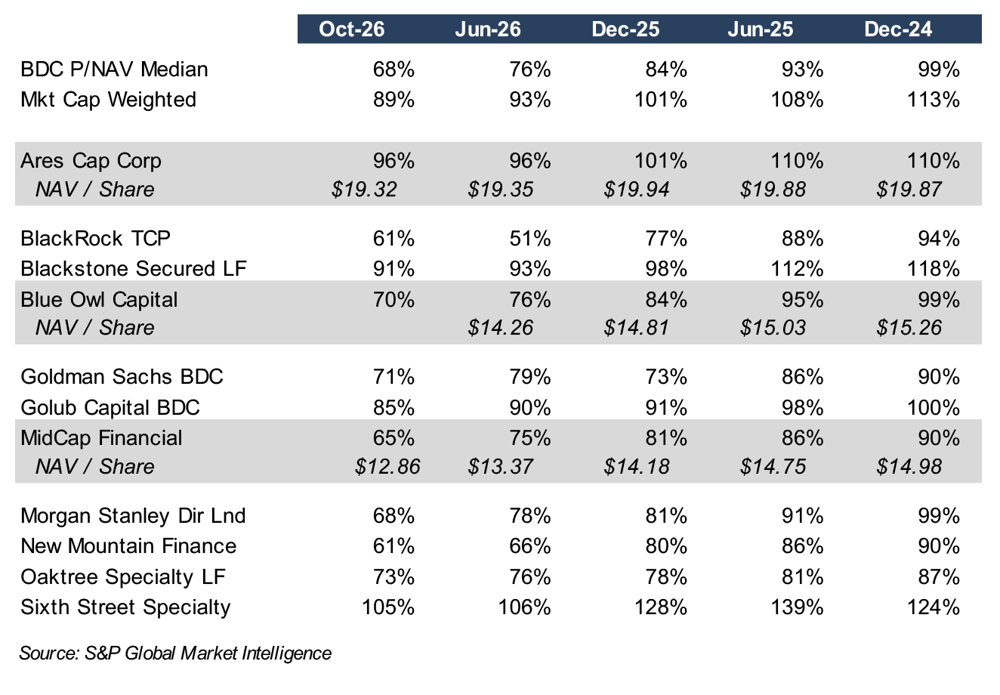
Markets can overshoot to the downside as they can to the high side. Ares Capital Corp.’s (NASDAQ:ARCC) October 27, 2026 agreement to acquire Apollo-sponsored MidCap Financial Investment Corp. (NASDAQ:MFIC) appears to illustrate this. The announced $10.88 per share consideration represents a 30% premium to MidCap’s prior day closing price yet remains below NAV. Figure 1 and Figure 2 use MidCap’s preliminary September 30 NAV of $12.86 per share; NAV as of June 30 was $13.37.
Figure 2:: ARCC - MFIC Deal Overview
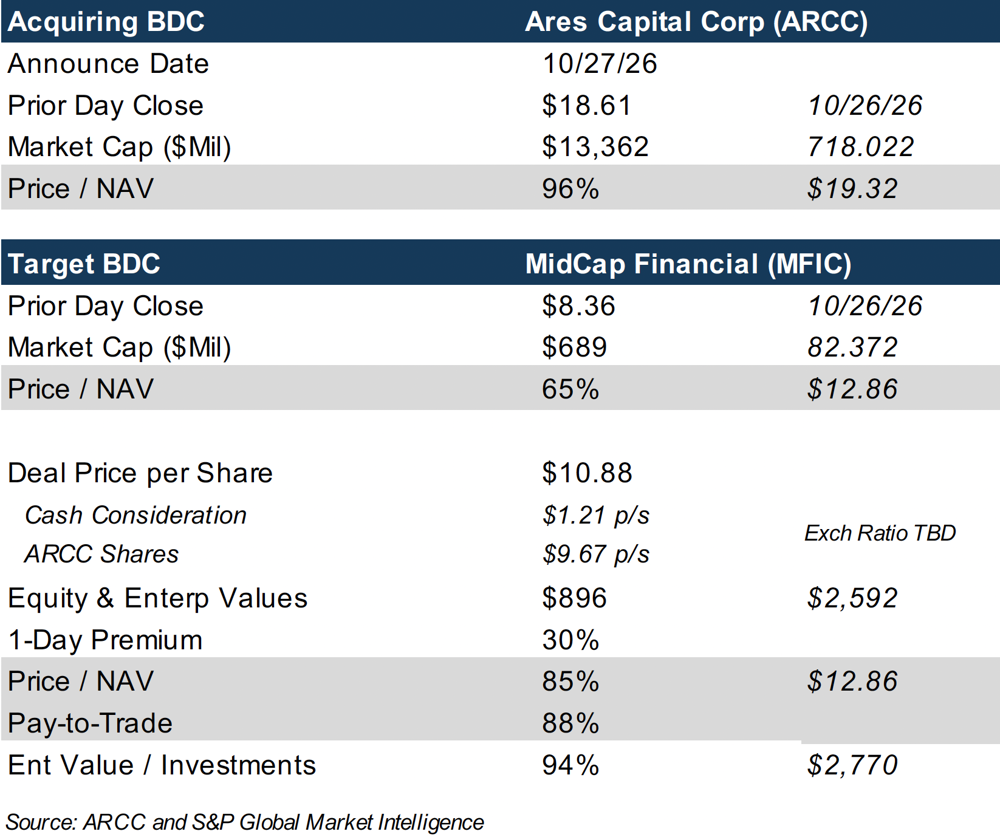
The announced price equates to 81% of June NAV, or approximately 85% of estimated September NAV. It includes $1.21 per share in cash from an Ares Management subsidiary and $9.67 in ARCC stock under a closing exchange formula tied to the greater of ARCC’s NAV or share price, with limited premium sharing. A preclosing MidCap special dividend will reduce the stock consideration dollar-for-dollar. The stock’s eventual market value can therefore differ from its stated value. Ares expects modest core EPS accretion and support for future dividends.
Ares is using its stronger currency to acquire MidCap at a substantial premium while keeping the indicative pay-to-trade ratio below 1.0. The cash contribution from its manager also helps bridge the valuation gap. Figure 2’s enterprise-value-to-investments ratio of 94% illustrates how leverage narrows an equity discount when expressed against gross assets. It does not establish the fair value of individual loans. Nor does the equity purchase price, by itself, establish Ares’s acquisition marks or provide insight into any funding or expense synergies.
For banks considering acquisitions or a sale, we offer a few takeaways:
Credit marks are obviously critical. A low price-to-book multiple offers little protection if the buyer materially underestimates losses;
Fair value marks have been part of M&A pricing for 25 years, but in recent years, an intense focus on earning back day-one dilution to tangible BVPS within 2-3 years and on growth in stand-alone TBVPS has limited pricing flexibility, all else equal;
A stronger buyer currency creates negotiating room. It can support a meaningful premium for the seller while preserving value for the buyer, but directors should separate the benefit of the exchange ratio from the earnings and cost savings needed to justify the deal; and
Judge the consideration by what shareholders can realize. A large premium to a depressed share price and a NAV-based exchange ratio can each obscure the economics. For sellers receiving stock, the buyer’s valuation, earning power and prospective returns matter as much as the headline price.