Impairment Testing

October 26, 2018

Financial Reporting Fallacy: The Whole May Appear Healthier Than the Parts

A logical fallacy occurs when one makes an error in reasoning.Causal fallacies occur when a conclusion about a cause is reached without enough evidence to do so.The cum hoc (“with this”) fallacy is committed when a causal relationship is assumed because two events occur together.

When it comes to financial reporting, an example of this fallacy would be assuming that goodwill cannot be impaired unless the company’s shares are trading below book value.This is a tempting fallacy–especially as the U.S. economy is continuing a long expansion, companies are posting solid earnings, and valuations are reaching new highs.The S&P 500 increased 19% in 2017 and the Nasdaq was up 28%.In these market conditions, goodwill impairment probably does not seem like a pressing concern.After all, goodwill is considered impaired only when fair value drops below carrying value, right?While this is true, accounting standards require that goodwill be tested for impairment at the reporting unit level.Impairment relates to a reporting unit’s ability to generate cash flows.This means that a company’s goodwill can be impaired at the reporting unit level, even as its stock trades above book value.

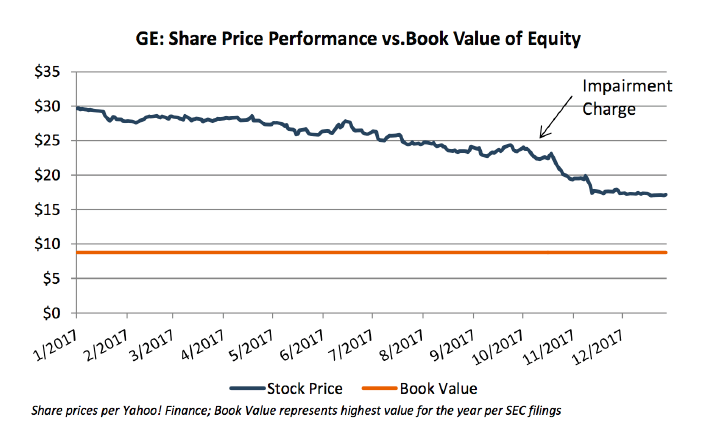
This was the case for multinational conglomerate General Electric last year.GE had a tumultuous 2017 as the company’s CEO and CFO departed, the dividend was cut, and a corporate restructuring was announced.The salient event for the purposes of this article is a $947 million impairment loss recorded in its Power Conversion Unit during the third quarter of 2017.This unit is what became of GE’s 2011 $3.2 billion acquisition of Converteam, an electrical engineering company.According to the company’s 2017 annual report, the causes for this impairment included downturns in marine and oil and gas markets, pricing and cost pressures, and increased competition.GE’s stock felt the turmoil, falling 42% in 2017.Shares traded at $17.25 at their lowest point, implying a market capitalization of $150.5 billion.But even at this point, GE’s stock was not trading below book value ($64.3 billion at the end of 2017).GE’s market value exceeded book value of equity by $86.2 billion.So while impairment and market value/share price are related, it is not safe to assume that there is no impairment if the stock trades above book value.
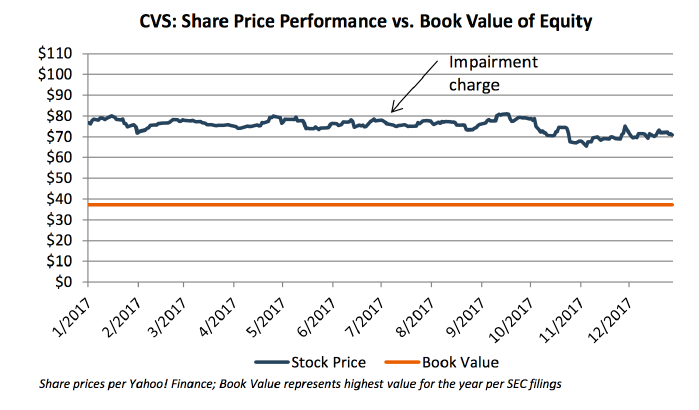
Another notable example is CVS Health.The company made headlines with one of the largest mergers of the year when it announced the acquisition of insurer Aetna, Inc. for $69 billion in December 2017.A smaller, less widely reported transaction transpired in November when the company announced the sale of its RxCrossroads reporting unit to McKesson Corp. for $735 million.This unit was part of CVS’s 2015 acquisition of nursing home pharmacy Omnicare, Inc. and provided reimbursement assistance and sales operation support, among other services.In the second quarter of 2017, CVS recognized a $135 million impairmentcharge related to this reporting unit.As with GE, CVS never traded below book value.CVS stock declined approximately 8% in 2017 and hit a low of $66.45 on November 6.The market capitalization at this point was approximately $67.7 billion.The book value of CVS equity was $34.9 billion at September 30, 2017 and $37.7 billion at year-end.
The above examples expose the fallacious idea that a company can avoid impairment charges simply because its stock trades above book value.That is not to say that there is no relationship between the two; an impairment charge can certainly signal the market and affect share price, or a decline in share price may foreshadow an impending impairment charge.Because goodwill must be tested for impairment at the reporting unit level, impairment may occur even when the company’s market cap exceeds book value.


Originally appeared in Mercer Capital's Financial Reporting Update: Goodwill Impairment

Continue Reading

A Decade in Motion: How COVID Reshaped Valuations in the Transportation Industry
The last several years have been nothing short of transformative for the transportation and logistics industry. Shifts in global trade patterns, consumer behavior, capital markets, and cost structures have left an indelible mark on both the operating performance and valuation metrics of transportation companies. A review of enterprise value to EBITDA (EV/ EBITDA) multiples across key subsectors, truckload, less-than-truckload (LTL), air, marine, rail, and logistics, reveals three distinct eras: the calm before the storm (pre-COVID), the whiplash of the pandemic years, and the normalization that followed.
2025 MedTech Year in Review
2025 Year in Review: Across MedTech, Discipline Is a Recurring Theme
Last month, the medtech team at Mercer Capital attended the 2025 Musculoskeletal New Ventures Conference, where discussions among founders, venture investors, strategic acquirers, and advisors converged on a consistent message: activity in the industry is increasingly shaped by discipline around clinical differentiation, capital efficiency, and strategic coherence. Innovation continues across the ecosystem, though expectations around execution, funding, and exit visibility have tightened. For early-stage companies, investors described an environment that supports new ventures, albeit with a greater emphasis on efficient capital deployment. Successful companies are pursuing leaner development strategies with earlier clinical or regulatory wins, rather than broad, capital-intensive pipelines. Incremental innovation, particularly in mature segments such as orthopedics, has been attractive when paired with platform scalability or data-enabled (AI) differentiation. Management quality and adaptability remain critical at this stage. In contrast, as other observers have also noted, venture capital has favored select growth-stage and later-stage deals. Investments flowed into companies able to articulate coherent clinical and commercial strategies aligned with the priorities of large, strategic buyers. Clear narratives around end-market adoption, strategic fit, and integration potential have tended to lead to higher valuations across observed transactions. Among large, established medtech companies, portfolio optimization was an ongoing effort. For public companies, exposure to higher-growth segments has increasingly supported better valuation multiples and relative equity performance. In response, strategic acquirers such as Stryker, Boston Scientific, Medtronic, and Johnson & Johnson have tuned their portfolios through targeted acquisitions, divestitures, and capital redeployment. For example, Stryker’s acquisition of Inari Medical reflects the appeal of the high-growth interventional markets with strong clinical differentiation, while its divestment of the spine business demonstrates an effort to exit slower-growth or less strategically differentiated segments. Similarly, Johnson & Johnson’s acquisitions of Shockwave Medical and V-Wave in 2024 augmented a cardiovascular platform focused on markets with long-term growth potential, while the announced separation of its DePuy Synthes orthopedics business signals a broader effort to simplify and sharpen strategic focus within its portfolio. Overall healthcare IPO activity in 2025 was broadly in line with 2024 levels, with issuance concentrated among higher-quality medtech and life sciences companies rather than reflecting a broad-based market reopening. Offerings such as Caris Life Sciences, which combined scale, revenue growth, and a differentiated data-driven platform, were relatively well received, suggesting that the IPO window remains available but is selective. Across various company stages and transactions, 2025 activity in medtech reflected a consistent emphasis on disciplined, capital-efficient growth. Whether among early-stage investments prioritizing focused development, later-stage companies articulating clear strategic fit, or large strategics actively reshaping portfolios, the common thread has been the pursuit of durable clinical differentiation and well-defined paths to scale or exit.
The 2025 Tariff Surge: Timeline and Industry Impact - Part I
The 2025 Tariff Surge: Timeline and Industry Impact
In the Q1 newsletter, we discussed the impact of the newly levied tariffs on the transportation sector. We focused on the main targets of the original tariffs (Canada, China, and Mexico) and the proposed removal of the De Minimis exemptions. These actions led to an increase in imports due to companies rushing to acquire inventory prior to the start of the tariffs, and speculation that inflation would be on the rise shortly after. Since Q1, the ever-evolving tariff landscape has created new implications for importers and exporters alike.

Cart

Your cart is empty