Impairment Testing
global-thumbnail-square.png

October 29, 2018

Industry Considerations for Step Zero: Qualitative Assessments

What is Step Zero?

A qualitative approach to test goodwill for impairment was introduced by the Financial Accounting Standards Board (“FASB”) when it released Accounting Standards Update 2011-08 (“ASU 2011-08”) in September 2011 as an update to goodwill impairment testing standards under Topic 350, Intangibles—Goodwill and Other.ASU 2011-08 set forth guidance for an optional qualitative assessment to be performed before the traditional quantitative two step goodwill impairment testing process.This preliminary qualitative assessment is known as “Step Zero.”The goal of Step Zero is to simplify and reduce costs of performing the traditional quantitative goodwill impairment test process.

According to ASU 2011-08, Step Zero allows entities “the option to first assess qualitative factors to determine whether the existence of events or circumstances leads to a determination that it is more likely than not that the fair value of a reporting unit is less than its carrying amount.”

Step One is required only if the qualitative assessment supports the conclusion that it is more likely than not (i.e., likelihood greater than 50%) that the fair value is less than the carrying value.Otherwise, Step One of the goodwill impairment testing process is not required.Alternatively, Step Zero can be skipped altogether, and the traditional quantitative goodwill impairment test can be performed beginning with Step One.

Industry Considerations

The standards update release by FASB outlines the individual qualitative categories of the assessment.Specific qualitative events and circumstances to be evaluated include the economy, industry, cost factors, financial performance, firm-specific events, reporting unit events, and changes in share price.

ASU 2011-08 defines industry events and circumstances as follows:

“Industry and market conditions such as a deterioration in the environment in which an entity operates, an increased competitive environment, a decline in market-dependent multiples or metrics (consider in both absolute terms and relative to peers), a change in the market for an entity’s products or services, or a regulatory or political development.”

The process of evaluating an industry involves assessing each of these stated events and circumstances since the previous reporting period and determining how they affect the comparison of fair value to carrying value.By comparing current conditions to the prior period, an analysis of relative improvement or deterioration can be made concerning each industry factor and the industry as a whole.

Increasing multiples, share prices, financial metrics, and M&A activity indicate that an industry is improving and suggests that it is more likely than not that the reporting unit’s fair value is greater than its carrying value. Decreasing multiples, share prices, financial metrics, and M&A activity indicate the industry is weakening and suggests that fair value may be less than the reporting unit’s carrying value.

Industry Analysis

An analysis of the S&P 1500, an index that includes approximately 90% of the market capitalization of U.S. stocks, reveals the prevalence of impairment in different industries. For example, of the companies reporting goodwill on their balance sheets, 25% of telecommunication, 17% of consumer staples, and 14% of consumer discretionary companies recorded goodwill impairment charges in 2017.

On the other hand, the more robust performance of financial, information technology, and real estate companies is manifest in that only 4% of companies reporting goodwill in each industry recorded a goodwill impairment charge in 2017.
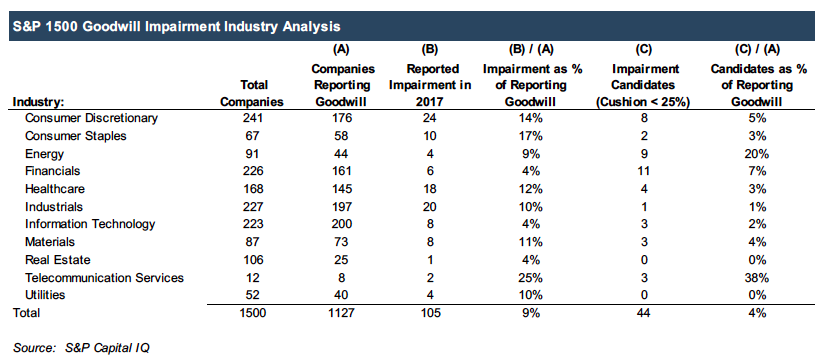
Further analysis indicates that companies in the energy and telecommunication industries are currently more likely to be potential impairment candidates as 20% and 38%, respectively, of companies reporting goodwill have cushions (the amount by which market value of equity exceeds book value of equity) of less than 25%. Deterioration in the operating environment of these industries may result in an increase in goodwill impairment charges.Industries with fewer impairment candidates at the moment include real estate, utilities, and industrials.

Industry considerations are particularly important to the qualitative assessment and provide valuable insight on the potential for impairment. The qualitative assessment is especially valuable in industries that are performing well as it is less likely that goodwill is impaired.

Step Zero provides the opportunity to perform a preliminary qualitative analysis to determine the necessity of performing the traditional two step goodwill impairment test and can lead to a simpler, more efficient impairment testing process.

The analysts at Mercer Capital have experience in, and follow, a diverse set of industries.We help clients assemble, evaluate, and document relevant evidence for the Step Zero impairment test. Call us today so we can help you.


Originally appeared in Mercer Capital's Financial Reporting Update: Goodwill Impairment

Continue Reading

Medical Device Industry Outlook – Five Long-Term Trends to Watch
Demographic shifts underlie the long-term market opportunity for medical device manufacturers. While efforts to control costs on the part of the government insurer in the U.S. (and elsewhere) may limit future pricing growth for incumbent products, a growing global market provides domestic device manufacturers with an opportunity to broaden and diversify their geographic revenue base. Developing new products and procedures is risky and usually more resource intensive compared to some other growth sectors of the economy. However, barriers to entry in the form of existing regulations provide a measure of relief from competition, especially for newly developed products.
Does Your Bank Need an Interim Impairment Test Due to the Economic Impact of COVID-19?
Analysts and pundits are debating whether the economic recovery will be shaped like a U, V, W, swoosh, or check mark and how long it may take to fully recover. To find clues, many are following the lead of the healthcare professionals and looking to Asia for economic and market data since these economies experienced the earliest hits and recoveries from the COVID-19 pandemic.Taking a similar approach led me to take a closer look at the Japanese megabanks for clues about how U.S. banks may navigate the COVID-19 crisis. In Japan, the banking industry is grappling with similar issues as U.S. banks, including the need to further cut costs; expanding branch closures; enhancing digital efforts; bracing for a tough year as bankruptcies rise; and looking for acquisitions in faster growing markets.Another similarity is impairment charges. Two of the three Japanese megabanks recently reported impairment charges. Mitsubishi UFJ Financial Group (MUFG) reported a ¥343 billion impairment charge related to two Indonesian and Thai lenders that MUFG owned controlling interests in and whose share price had dropped ~50% since acquisition. Mizuho Financial Group incurred a ¥39 billion impairment charge.In the years since the Global Financial Crisis, there have not been many goodwill impairment charges recognized by U.S. banks. A handful of banks including PacWest (NASDAQ-PACW) and Great Western Bancorp (NYSE-GWB) announced impairment charges with the release of 1Q20 results. Both announced dividend reductions, too.Absent a rebound in bank stocks, more goodwill impairment charges likely will be recognized this year. Bank stocks remain depressed relative to year-end pricing levels despite some improvements in May and early June. For perspective, the S&P 500 Index was down ~5% from year-end 2019 through May 31, 2020 compared to a decline of ~32% for the SNL Small Cap Bank Index and ~34% for the SNL Bank Index.This sharper decline for banks reflects concerns around net interest margin compression, future credit losses, and loan growth potential. The declines in the public markets mirrored similar declines in M&A activity and several bank transactions that had previously been announced were terminated before closing with COVID-19 impacts often cited as a key factor.Price discovery from the public markets tends to be a leading indicator that impairment charges and/or more robust impairment testing is warranted. The declines in the markets led to multiple compression for most public banks and the majority have been priced at discounts to book value since late March. At May 31, 2020, ~77% of publicly traded community banks (i.e., having assets below $5B) were trading at a discount to their book value with a median of ~83%. Within the cohort of banks trading below book value at May 31, 2020, ~74% were trading below tangible book value.Do I Need an Impairment Test?Goodwill impairment testing is typically performed annually. But the unprecedented events precipitated by the COVID-19 pandemic now raise questions whether an interim goodwill impairment test is warranted.The accounting guidance in ASC 350 prescribes that interim goodwill impairment tests may be necessary in the case of certain “triggering” events. For public companies, perhaps the most easily observable triggering event is a decline in stock price, but other factors may constitute a triggering event. Further, these factors apply to both public and private companies, even those private companies that have previously elected to amortize goodwill under ASU 2017-04.For interim goodwill impairment tests, ASC 350 notes that management should assess relevant events and circumstances that might make it more likely than not that an impairment condition exists. The guidance provides several examples, several of which are relevant for the bank industry including the following:Industry and market considerations such as a deterioration in the environment in which an entity operates or an increased competitive environmentDeclines in market-dependent multiples or metrics (consider in both absolute terms and relative to peers)Overall financial performance such as negative or declining cash flows or a decline in actual or planned revenue or earnings compared with actual and projected results of relevant prior periodsChanges in the carrying amount of assets at the reporting unit including the expectation of selling or disposing certain assetsIf applicable, a sustained decrease in share price (considered both in absolute terms and relative to peers) The guidance notes that an entity should also consider positive and mitigating events and circumstances that may affect its conclusion. If a recent impairment test has been performed, the headroom between the recent fair value measurement and carrying amount could also be a factor to consider.How Does an Impairment Test Work?Once an entity determines that an interim impairment test is appropriate, a quantitative “Step 1” impairment test is required. Under Step 1, the entity must measure the fair value of the relevant reporting units (or the entire company if the business is defined as a single reporting unit). The fair value of a reporting unit refers to “the price that would be received to sell the unit as a whole in an orderly transaction between market participants at the measurement date.”For companies that have already adopted ASU 2017-04, the legacy “Step 2” analysis has been eliminated, and the impairment charge is calculated as simply the difference between fair value and carrying amount.ASC 820 provides a framework for measuring fair value which recognizes the three traditional valuation approaches: the income approach, the market approach, and the cost approach. As with most valuation assignments, judgment is required to determine which approach or approaches are most appropriate given the facts and circumstances. In our experience, the income and market approaches are most used in goodwill impairment testing. However, the market approach is somewhat limited in the current environment given the lack of transaction activity in the banking sector post-COVID-19.In the current environment, we offer the following thoughts on some areas that are likely to draw additional scrutiny from auditors and regulators.Are the financial projections used in a discounted cash flow analysis reflective of recent market conditions? What are the model’s sensitivities to changes in key inputs?Given developments in the market, do measures of risk (discount rates) need to be updated?If market multiples from comparable companies are used to support the valuation, are those multiples still applicable and meaningful in the current environment?If precedent M&A transactions are used to support the valuation, are those multiples still relevant in the current environment?If the subject company is public, how does its current market capitalization compare to the indicated fair value of the entity (or sum of the reporting units)? What is the implied control premium and is it reasonable in light of current market conditions? At a minimum, we anticipate that additional analyses and support will be necessary to address these questions. The documentation from an impairment test at December 31, 2019 might provide a starting point, but the reality is that the economic and market landscape has changed significantly in the first half of 2020.Concluding ThoughtsWhile not all industries have been impacted in the same way from the COVID-19 pandemic and economic shutdown, the banking industry will not escape unscathed given the depressed valuations observed in the public markets. For public and private banks, it can be difficult to ignore the sustained and significant drop in publicly traded bank stock prices and the implications that this might have on fair value and the potential for goodwill impairment.At Mercer Capital, we have experience in implementing both the qualitative and quantitative aspects of interim goodwill impairment testing. To discuss the implications and timing of triggering events, please contact a professional in Mercer Capital’s Financial Institutions Group.Originally published in Bank Watch, June 2020.Request for ProposalMercer Capital is pleased to prepare a proposal for impairment testing services for your bank or bank holding company. Follow the link below to complete a submission.Bank Impairment Testing Proposal Request »
August 2023 | 2023 Core Deposit Intangibles Update
Bank Watch: August 2023
In this issue: 2023 Core Deposit Intangibles Update

Cart

Your cart is empty