Corporate Valuation, Financial Services

July 6, 2018

Takeaways from FinXTech 2018: The Rise of Bank and FinTech Partnerships

I recently attended FinXTech, an industry event where the hosts at Bank Director bring together FinTech founders and bank directors and executives for productive conversations about the road ahead as partners (and competitors).

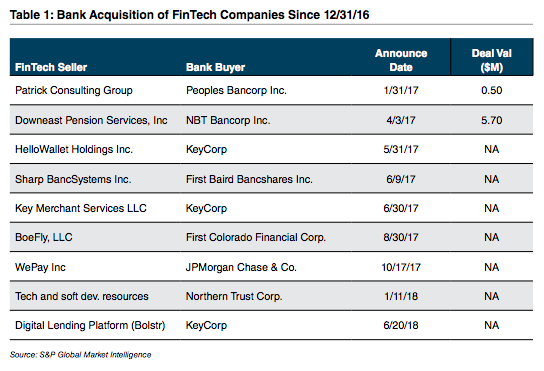
Those discussions occurred against a backdrop in which FinTech, as a concept to enhance the customer experience and to drive operating efficiencies, is widely accepted by bank management, shareholders, and regulators. How “FinTech” is implemented varies depending upon resources. As shown in the Table 1, there has been no surge of M&A in which banks buy FinTech companies. Only nine of 276 transactions announced since year-end 2016 entailed a bank or bank holding company acquirer. KeyCorp, which has been one of the nine active FinTech acquirers, announced in June 2018 that it would acquire digital lending technology for small businesses built by Chicago based FinTech company Bolstr. At best, activity can be described as episodic as it relates to bank acquisitions, which appears to be designed to supplement internal development.
The very largest banks such as JPMorgan Chase & Co. are spending billions of dollars annually to upgrade technology—a level of spending that even super regional banks cannot match. In contrast, community and regional banks have been left scratching their heads about how to address FinTech-related issues when money is a constraining factor.

During the FinXTech 2018, the focus shifted from the potential disruption of a bank’s franchise by FinTech to the potential to partner with FinTech companies, which stood out to me as a marked change from prior years.

Both banks and FinTech companies realize that they need each other to some degree. For banks, FinTech offers the potential to leverage innovation and new technologies to meet customer expectations, enhance efficiency, and compete more effectively against the biggest banks. For FinTech companies, the benefits from bank partnerships can include the potential to leverage the bank’s customer relationships to scale more quickly, access to funding, and regulatory/compliance expertise. Several examples of successful partnerships between banks and FinTech companies were highlighted at the FinXTech event. (You can read more about some of them here.)

The FinTech/Bank partnership theme also was evident in GreenSky’s recent IPO, a FinTech company based in Atlanta. GreenSky arranges loans primarily for home improvement projects. Bank partners pay GreenSky to generate and service the loans while the bank funds and holds the loans on their balance sheet. As more partnerships emerge, it will be interesting to see if FinTech impacts the valuation of banks that effectively leverage technology to achieve strategic objectives such as growing low-cost core deposits, opening new lending venues, and improving efficiency. One would think the answer will be “yes” if the impact can be measured and is meaningful.

Another trend to look for will be whether smaller banks become more active as investors in FinTech companies. For the most part, investments by community and regional banks in FinTech companies remains sporadic at best even though FinTech companies raised nearly $16 billion of equity capital between year-end 2016 and June 2018 in both private and public offerings. An interesting transaction we observed was a $16 million Series A financing by Greenlight Financial Technology, Inc., a creator of smart debit cards, in which the investors included SunTrust Bank, Amazon Alexa Fund, and $619 million asset NBKC Bank, among others.

FinXTech 2018 included several sessions related to due diligence for FinTech partnerships; however, with limited M&A and investing activity by banks there was little discussion about valuation issues, which can be challenging for FinTech companies and differs markedly from methods employed to value a bank.

Not surprisingly, we have lots of thoughts on the subject.

With the emerging partnership theme from FinXTech 2018 in mind, view our complimentary webinar “How to Value an Early-Stage FinTech Company.” Additionally, if you have questions, reach out to one of our professionals to discuss your needs in confidence.

Originally published in Bank Watch, June 2018.

Continue Reading

A Decade in Motion: How COVID Reshaped Valuations in the Transportation Industry
The last several years have been nothing short of transformative for the transportation and logistics industry. Shifts in global trade patterns, consumer behavior, capital markets, and cost structures have left an indelible mark on both the operating performance and valuation metrics of transportation companies. A review of enterprise value to EBITDA (EV/ EBITDA) multiples across key subsectors, truckload, less-than-truckload (LTL), air, marine, rail, and logistics, reveals three distinct eras: the calm before the storm (pre-COVID), the whiplash of the pandemic years, and the normalization that followed.
2025 MedTech Year in Review
2025 Year in Review: Across MedTech, Discipline Is a Recurring Theme
Last month, the medtech team at Mercer Capital attended the 2025 Musculoskeletal New Ventures Conference, where discussions among founders, venture investors, strategic acquirers, and advisors converged on a consistent message: activity in the industry is increasingly shaped by discipline around clinical differentiation, capital efficiency, and strategic coherence. Innovation continues across the ecosystem, though expectations around execution, funding, and exit visibility have tightened. For early-stage companies, investors described an environment that supports new ventures, albeit with a greater emphasis on efficient capital deployment. Successful companies are pursuing leaner development strategies with earlier clinical or regulatory wins, rather than broad, capital-intensive pipelines. Incremental innovation, particularly in mature segments such as orthopedics, has been attractive when paired with platform scalability or data-enabled (AI) differentiation. Management quality and adaptability remain critical at this stage. In contrast, as other observers have also noted, venture capital has favored select growth-stage and later-stage deals. Investments flowed into companies able to articulate coherent clinical and commercial strategies aligned with the priorities of large, strategic buyers. Clear narratives around end-market adoption, strategic fit, and integration potential have tended to lead to higher valuations across observed transactions. Among large, established medtech companies, portfolio optimization was an ongoing effort. For public companies, exposure to higher-growth segments has increasingly supported better valuation multiples and relative equity performance. In response, strategic acquirers such as Stryker, Boston Scientific, Medtronic, and Johnson & Johnson have tuned their portfolios through targeted acquisitions, divestitures, and capital redeployment. For example, Stryker’s acquisition of Inari Medical reflects the appeal of the high-growth interventional markets with strong clinical differentiation, while its divestment of the spine business demonstrates an effort to exit slower-growth or less strategically differentiated segments. Similarly, Johnson & Johnson’s acquisitions of Shockwave Medical and V-Wave in 2024 augmented a cardiovascular platform focused on markets with long-term growth potential, while the announced separation of its DePuy Synthes orthopedics business signals a broader effort to simplify and sharpen strategic focus within its portfolio. Overall healthcare IPO activity in 2025 was broadly in line with 2024 levels, with issuance concentrated among higher-quality medtech and life sciences companies rather than reflecting a broad-based market reopening. Offerings such as Caris Life Sciences, which combined scale, revenue growth, and a differentiated data-driven platform, were relatively well received, suggesting that the IPO window remains available but is selective. Across various company stages and transactions, 2025 activity in medtech reflected a consistent emphasis on disciplined, capital-efficient growth. Whether among early-stage investments prioritizing focused development, later-stage companies articulating clear strategic fit, or large strategics actively reshaping portfolios, the common thread has been the pursuit of durable clinical differentiation and well-defined paths to scale or exit.
The 2025 Tariff Surge: Timeline and Industry Impact - Part I
The 2025 Tariff Surge: Timeline and Industry Impact
In the Q1 newsletter, we discussed the impact of the newly levied tariffs on the transportation sector. We focused on the main targets of the original tariffs (Canada, China, and Mexico) and the proposed removal of the De Minimis exemptions. These actions led to an increase in imports due to companies rushing to acquire inventory prior to the start of the tariffs, and speculation that inflation would be on the rise shortly after. Since Q1, the ever-evolving tariff landscape has created new implications for importers and exporters alike.

Cart

Your cart is empty