Corporate Valuation

June 25, 2021

Estate of Michael J. Jackson v. Commissioner - Key Takeaways

It is imperative for estate planners to engage valuation analysts that perform the proper procedures and follow best practices when performing valuations for gift and estate planning purposes. It is necessary to have a well-supported valuation because these reports are scrutinized by the IRS and may end up going to court. The recent decision by the U.S. Tax Court in Estate of Michael J. Jackson v. Commissioner provides several lessons and reminders for valuation analysts, and those that engage valuation analysts, to keep in mind when performing valuations for gift and estate planning purposes. Michael Jackson, the “King of Pop,” passed away on June 25, 2009. His Estate (the “Estate”) filed its 2009 Form 706, United States Estate (and Generation-Skipping Transfer) Tax Return, listing the value of Jackson’s assets. After auditing the Estate’s tax return, the Commissioner of the Internal Revenue Service (the “Commissioner”) issued a notice of deficiency that concluded that the Estate had underpaid Jackson’s estate tax by a little more than $500 million. Because the valuation of some assets were considered to be so far off, the Commissioner also levied penalties totaling nearly $200 million on the Estate. The IRS and the Estate settled the values of several assets outside of court. The case involved three contested assets of Michael Jackson’s estate:
  1.  Jackson’s Image and Likeness
  2. Jackson’s interest in New Horizon Trust II (“NHT II”) which held Jackson’s interest in Sony/ATV Music Publishing, LLC, a music-publishing company
  3. Jackson’s interest in New Horizon Trust III (“NHT III”) which contained Majic Music, a music-publishing catalog
We discuss the key topics that the Tax Court ruled on and addressed that inform valuation analysts in the preparation of quality valuation reports.

Known or Knowable

It is important that valuation analysts only rely on information that was known or knowable at the valuation date.

In the decision, the Tax Court rejects the analysis of experts on several occasions for using information that was “unforeseeable at the time of Jackson’s death.The Tax Court goes on to state that “foreseeability can’t be subject to hindsight.”

It can be difficult to distinguish and depend on only the information known or knowable at the valuation date especially when a significant amount of time has passed between the current date and the valuation date.Therefore, a careful examination of all sources of information is necessary to be sure that it can be relied upon in the analysis.

As can be seen from the Tax Court’s opinion, valuation analysts and experts can undermine their credibility by relying on information that was not known or knowable at the valuation date.

Tax Affecting S Corporations

The Tax Court, in this specific case, did not accept the tax affecting of S Corporations: “The Estate’s own experts used inconsistent tax rates.They failed to explain persuasively the assumption that a C corporation would be the buyer of the assets at issue.They failed to persuasively explain why many of the new pass-through entities that have arisen recently wouldn’t be suitable purchasers.And they were met with expert testimony from the Commissioner’s side that was, at least on this very particular point, persuasive in light of our precedent.This all leads us to find that tax affecting is inappropriate on the specific facts of this case.”The Tax Court did, however, leave room for the possibility of tax affecting being appropriate by stating, “we do not hold that tax affecting is never called for.”

At Mercer Capital, we tax affect the earnings of S corporations and other pass-through entities.Given that this issue continues to be a point of contention, it is imperative that valuation analysts provide a thorough analysis and clear explanation for why tax affecting is appropriate for S corporations and other tax pass-through entities.

Developing Projected Cash Flows

In the valuation of NHT II, the Court found it more reasonable to use the projections of Sony/ATV in the development of a forecast used in the income approach rather than relying on historical financial performance to inform the projection.The Tax Court based its decision on the fact that “the music-publishing industry was (and has remained) in a state of considerable uncertainty created by a long series of seismic technological changes. We think that projections of future cashflow, if made by businessmen with an incentive to get it right, are more likely to reflect reasonable estimates of the short-to-medium-term effects of these wild changes in the industry that even experts, much less judges, are unlikely to intuit correctly.”

This decision makes it clear that valuation analysts need to fully understand the industry in which the company operates and develop a forecast that is most reasonable given the information available as of the valuation date.

In cases where analysts have access to a projection developed by management, valuation analysts should have a clear, well-reasoned rationale for not relying on the forecast should they decide not to use it in the analysis.However, valuation analysts should not blindly accept management’s forecasts as truth but should perform proper due diligence to assess the reasonability of the forecast and clearly articulate any deviations from management’s forecast.

Other Topics Addressed

A few other topics of note are addressed throughout the decision that can help valuation analysts provide reliable valuation analyses.

On more than one occasion, the Tax Court sided with the expert that provided a compelling explanation for the use of a certain assumption rather than arbitrarily using an assumption without explanation.The Tax Court also sided with one expert simply because they provided a clear citation for their source when another expert did not.The Tax Court also called out the inconsistency of an expert in their report and testimony.These topics addressed by the Tax Court demonstrate that consistently explaining and citing the sources of assumptions and key elements of the valuation analysis help to produce a supportable valuation analysis.

Finally, the expert for the Commissioner seriously damaged their credibility in the eyes of the Tax Court when the expert was caught in a couple lies during the trial.The Tax Court found that the expert “did undermine his own credibility in being so parsimonious with the truth about these things he didn’t even benefit from being untruthful about, as well as not answering questions directly throughout his testimony.This affects our fact finding throughout.”

Takeaways & Conclusion

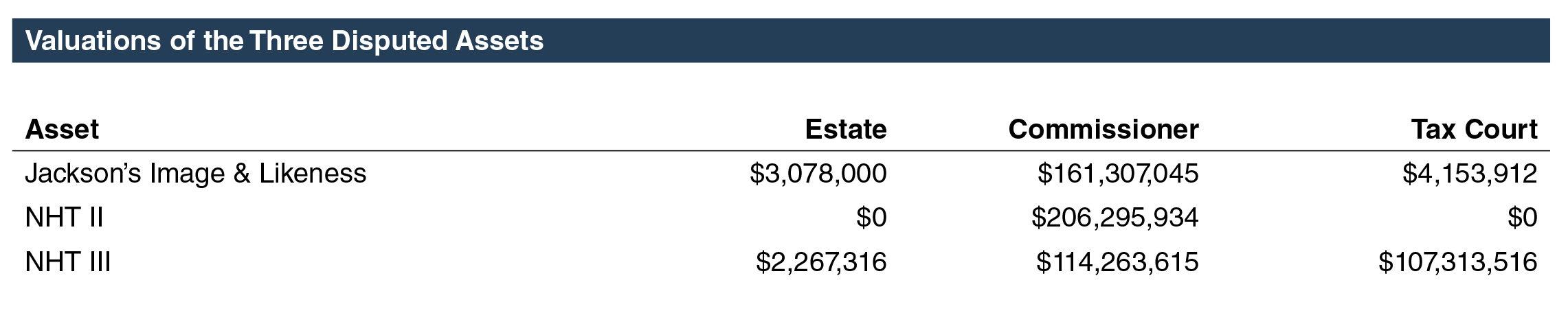
The table below presents the valuation conclusions of the Estate, Commissioner, and the Tax Court at trial. This decision has shown that it is critical for valuation analysts to present quality valuation reports that are clear, supported, and follow accepted best practices.
At Mercer Capital, estate planners can be confident that we follow the proper procedures, standards, and best practices when performing our valuations for gift and estate planning.Mercer Capital has substantial experience providing valuations for gift and estate planning as well as expert witness testimony in support of our reports.Please do not hesitate to contact one of our professionals to discuss how Mercer Capital may be able to help your estate planning needs.


Continue Reading

Mercer Capital to Sponsor TexasBarCLE’s 50th Annual Advanced Estate Planning & Probate Course
Mercer Capital is pleased to sponsor TexasBarCLE’s 50th Annual Advanced Estate Planning & Probate course, taking place June 3 -5, 2026, at the Hyatt Regency Frisco-Dallas. J. David Smith, CFA, ASA, and Andrew B. Frew, ASA, ABV, will attend on behalf of the firm.Hosted by TexasBarCLE and cosponsored by the Real Estate, Probate & Trust Law Section of the State Bar of Texas, the annual course brings together estate planning and probate professionals for three days of focused education and discussion. This year’s agenda includes sessions on case law updates, fiduciary issues, grantor trusts, retirement benefits, will contests, and current developments in estate planning tax law.David Smith is a Senior Vice President at Mercer Capital and a senior member of the firm’s tax practice. He provides valuation services for tax planning, transactional purposes, and financial reporting, with particular experience in industries including financial services, oil and gas, and biotechnology. David is also a regular contributor to Mercer Capital’s Value Matters Newsletter.Andrew Frew is a Vice President at Mercer Capital and has nearly 25 years of business valuation experience. He has been involved with hundreds of valuation and related engagements across numerous industries and values businesses and business interests for gift and estate tax, charitable giving, buy-sell agreements, mergers and acquisitions, business succession and exit planning, and litigation support purposes.Mercer Capital regularly assists attorneys, fiduciaries, and advisors with valuation matters that arise in estate planning, probate, tax planning, and related disputes. The firm is pleased to support programs that help professionals address the financial issues that often accompany trusts, estates, and closely held business interests.Mercer Capital looks forward to connecting with attendees in Frisco. Additional information about the course is available through TexasBarCLE: https://www.texasbarcle.com/.
Getting Into the Spirit of Valuation
When people talk about the “value” of a company, it is easy to assume there is one correct “answer.” In practice, there are many possible answers, and which one is the best answer depends on the purposes of the valuation, the user, and the facts and circumstances at hand. The Internal Revenue Service’s Revenue Ruling 59-60, defines fair market value “as the price at which the property would change hands between a willing buyer and a willing seller when the former is not under any compulsion to buy and the latter is not under any compulsion to sell, both parties having reasonable knowledge of the relevant facts.” This is a great place to begin, but it is only the start.
Mercer Capital to Attend and Speak at the 38th Annual ABA RPTE National CLE Conference
Mercer Capital will attend and participate in the 38th Annual American Bar Association Real Property, Trust and Estate (RPTE) National CLE Conference, held April 29–May 1, 2026, in Chicago, IL, at the Loews Hotel. Travis Harms and Tim Bronza will represent the firm, with Harms also participating as a speaker.The RPTE National CLE Conference is one of the ABA’s flagship gatherings for real property and estate planning professionals, bringing together attorneys and advisors for several days of in-person education and discussion. Topics this year range from estate and gift tax planning and charitable strategies involving closely held businesses to real estate transactions and fiduciary considerations, with an emphasis on practical takeaways for day-to-day practice.Harms will serve as a panelist on the session “Fair (Market) Warning: This is Not a Final Determination – Practical Advice from Tax Litigators."Travis Harms is President of Mercer Capital and leads the firm’s Family Business Advisory Services Group. He works with multi-generation family businesses on valuation, financial education, and strategic planning, helping families align ownership structures and long-term objectives.Tim Bronza is Managing Director of Mercer Capital’s Florida office. He has extensive experience valuing business interests for federal gift, estate, and income tax purposes and works with clients and their advisors on complex valuation matters across a range of contexts.Mercer Capital regularly supports attorneys and fiduciaries in these areas through independent valuation and financial advisory services. The firm’s work includes analyses prepared for gift and estate tax planning, succession planning, and dispute resolution, with an emphasis on producing clear, well-supported conclusions that can be used in both planning and adversarial settings.Mercer Capital looks forward to participating in this year’s conference. To learn more about the RPTE conference, visit the event’s website: https://rptecleconference.com/.

Cart

Your cart is empty