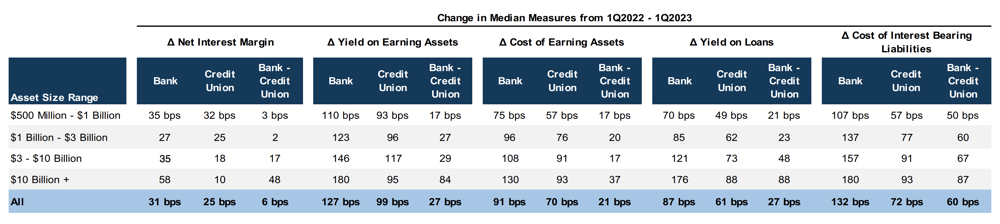
The change in the median NIM from 1Q22-1Q23 is greater for banks versus credit unions (31 basis point expansion vs. 25 basis point expansion).
Yields on earning assets expanded to a greater degree for banks versus credit unions from 1Q22-1Q23, which likely reflects a greater proportion of fixed rate loans for credit unions versus banks.
The median yield on loans increased 87 bps for banks from 1Q22-1Q23 in comparison to 61 bps for credit unions.
Credit unions appear to be less sensitive (at least so far) to funding cost pressure.
The median cost of earning assets for banks increased by 91 bps from 1Q22- 1Q23 in comparison to 70 bps for credit unions.
The 1Q22-1Q23 change in the NIM components varies by asset size (that is larger banks/CUs generally have experienced larger upward adjustments to both asset yields and the cost of funds, relative to smaller banks/CUs).
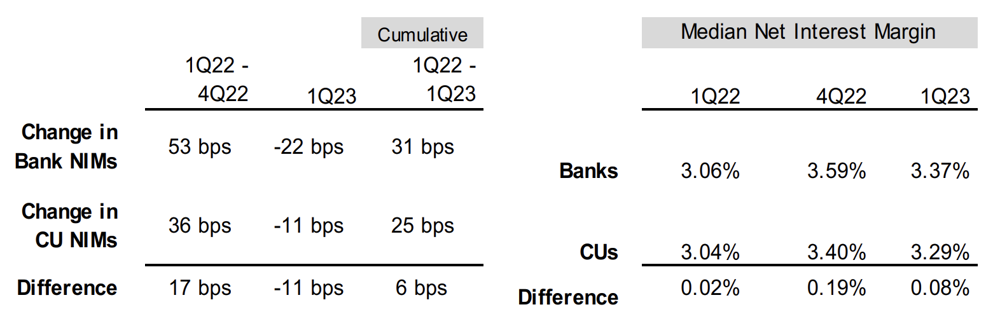
Over the course of 2022, the median NIM for banks expanded from 3.06% in 1Q22 to 3.59% in 4Q22, while the median NIM for credit unions expanded from 3.04% to 3.40%.
The NIM advantage reported by banks began to dissipate in 1Q23 as banks faced more cost of funds pressure than CUs.
Bank NIMs widened by 17 bps more than CU NIMs between 1Q22 and 4Q22. However, funding cost pressures in 1Q23 caused bank NIMs to tighten by 22 bps in 1Q23, while CU NIMs compressed by only 11 bps.
The change in NIMs between 1Q22 and 1Q23 can be decomposed as follows:
Source of data for tables: S&P Capital IQ Pro, Mercer Capital research. Includes credit unions and banks with assets > $500 Million as of 12/31/21
Originally appeared in the June 2023 issue of Bank Watch.