Recent Healthcare Technology Stock Market Trends
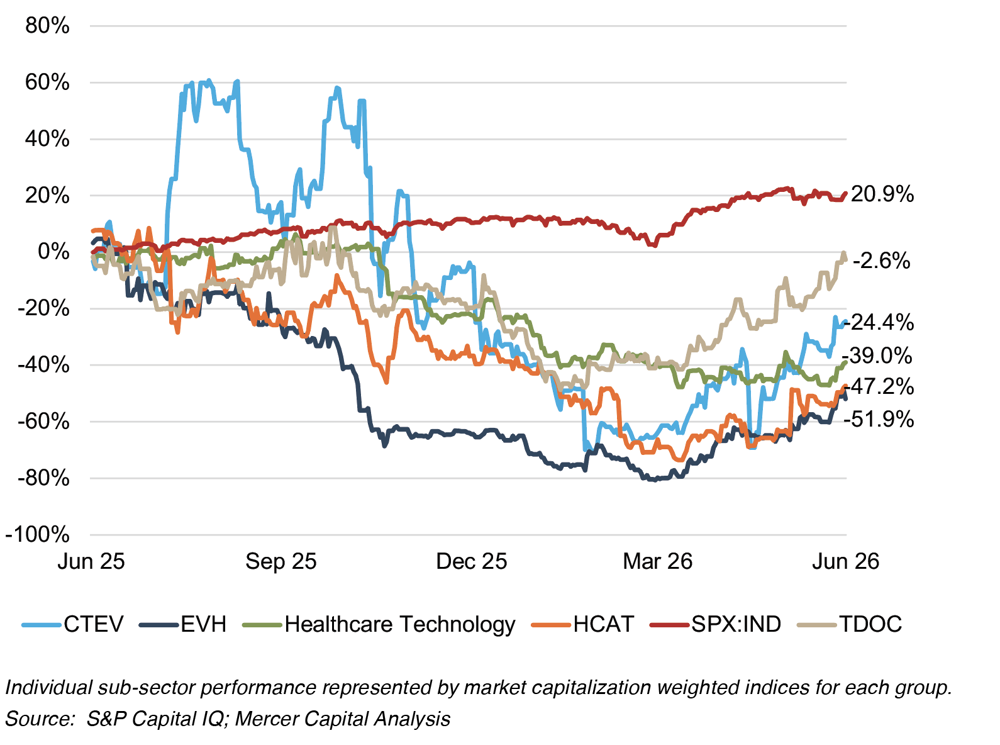
For several months leading up to 2Q26, the healthcare technology sector appeared to face significant market headwinds. Using June 30, 2025 as the baseline, the healthcare technology sector peaked in October 2025, showing a return of 6.4%. Since that mark, the sector has faced rapid declines in market returns. By the end of the year, the healthcare technology sector had declined 22.3%. By March 31, 2026, the sector was down by 39.6%. The sector’s low point since October 2025 occurred during 2Q26 (-47.7% in April compared to the baseline). Compared to other sectors tracked by Mercer Capital (biotech & life sciences, medical device, and large, diversified companies), the healthcare technology sector has had the most adverse market returns over the last twelve months by a significant margin.
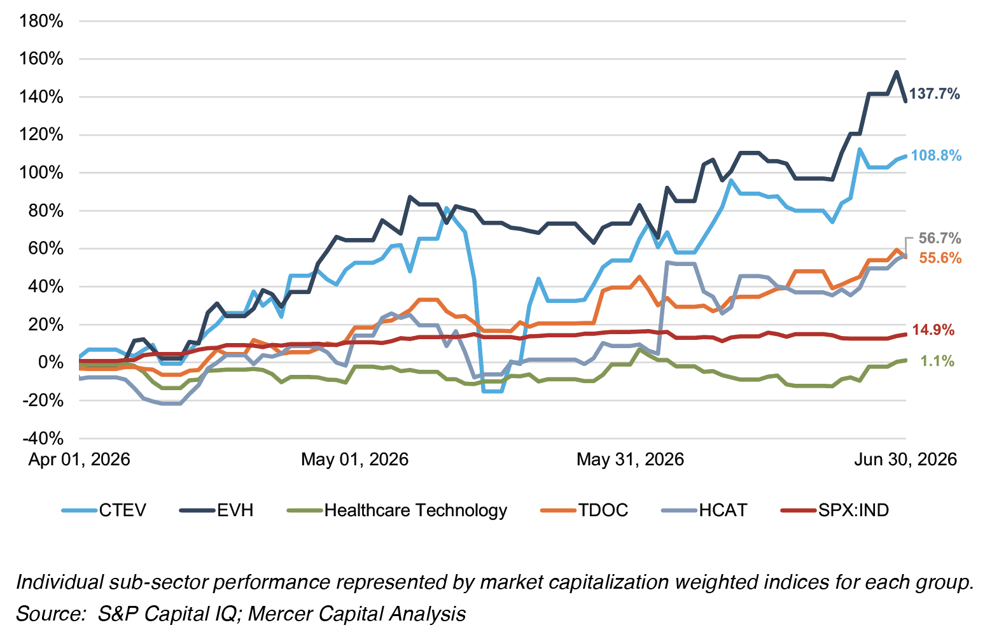
During the second quarter of 2026, the healthcare technology sector posted a positive quarter-over-quarter return (1.1%), reversing a trend of negative quarterly returns over the last twelve months. Four companies within this sector caught our attention in reviewing market returns over 2Q26: Evolent Health, Claritev, Health Catalyst, and Teladoc Health. The following charts show quarterly returns for these companies, the healthcare technology sector, and the S&P 500.
In this article, we try to make some sense of the market volatility related to the healthcare technology sector.
LTM Stock Price Performance
2Q26 Stock Price Performance
Broad Trends
Healthcare organizations appear to be applying greater scrutiny to technology spending, particularly as they evaluate a growing number of artificial intelligence and automation products. Recent industry surveys and management commentary point to several recurring priorities: clearer evidence of financial and clinical returns, compatibility with existing systems and workflows, and solutions that address multiple needs without adding the administrative burden. Although adoption patterns vary by organization and use case, purchasing decisions appear to depend less on the novelty of the underlying technology than on whether a vendor can demonstrate measurable benefits, practical implementation, and sustained operational value.
At the same time, internally developed technology represents a recognized competitive risk for healthcare technology vendors. For example, Health Catalyst identifies healthcare organizations using “homegrown solutions” as competitors while other vendors similarly acknowledge that customers may develop competing capabilities internally. These disclosures indicate that to compete effectively, vendors may increasingly need to demonstrate advantages beyond the availability of basic software or analytical functionality.
These pressures may not affect all vendors equally. They may favor companies that combine technology with proprietary data, established provider networks, specialized clinical expertise, integrated products, or measurable customer outcomes. Each of the four companies discussed below appears to possess one or more of these characteristics. Their second quarter developments provide context for their relative stock price performance, although the effect of any individual announcement cannot be isolated from broader market conditions, prior valuations, and changes in investor expectations.
The companies’ strong second quarter stock price performance should nevertheless be interpreted cautiously. Revenue growth, margins, leverage, customer retention, and business mix remained significant considerations for one or more of the selected companies.
Evolent Health
Evolent Health (EVH) provides technology-supported solutions for managing high-cost medical specialties, including oncology, cardiology, imaging, and musculoskeletal care. Evolent describes its differentiated approach as combining proprietary technology with evidence-based clinical pathways, provider networks, and specialized clinical expertise. According to the company, its oncology platform achieves an approximately 50% auto-authorization rate for submitted medical oncology regimens and increases pathway adherence by more than 30% among new partners.
In May 2026, Evolent announced that an existing national payer had agreed to expand the company’s oncology and cardiology solutions into additional commercial and Medicare markets. Evolent estimated that the expansion would generate more than $200 million of annualized revenue. The company also reported that oncology programs for Highmark and Aetna were launched successfully during the first quarter.
These developments are consistent with the investment case that rising specialty-care costs may increase demand for Evolent’s combination of technology, clinical expertise, and cost-management services. However, the company’s second quarter results also illustrated the risks associated with its performance-based contracts. Revenue increased to $652.5 million from $444.3 million in the prior-year quarter, while adjusted EBITDA decreased to $28.1 million from $37.5 million.
Claritev
Claritev (CTEV) is seeking to expand beyond its historical claims repricing business into a broader healthcare technology and data insights platform. Claritev’s principal assets include its claims data, provider network, customer relationships, and experience identifying potential healthcare cost savings. Claritev reports relationships with more than 750 healthcare payers, 100,000 employers, 60 million consumers, and 1.4 million contracted providers. The company also reported that it analyzed approximately $175 billion of medical claim charges during 2025 and identified approximately $24.7 billion of potential savings.
In its first quarter results, Claritev reported new business wins in the provider and government markets. During the second quarter, the company introduced PHCS Novera, a network-management product intended to give self-funded employers and third-party administrators greater control over provider-network design and healthcare costs. These developments are consistent with management’s strategy of using Claritev’s data and provider network across products and customer groups beyond its legacy claims repricing business.
Whether this strategy will produce sustained growth remains uncertain. Claritev reported second quarter revenue of $257.5 million, an increase of 6.6% from the same quarter in the prior year, but also reported a net loss of $59.2 million. The company’s data and network may provide meaningful competitive advantages, but its substantial leverage and the execution requirements associated with its strategic transition remain significant.
Health Catalyst
Health Catalyst (HCAT) provides healthcare-specific data and analytics products intended to help hospitals reduce costs, improve clinical outcomes, and strengthen patient engagement. Health Catalyst identifies its healthcare-specific data, domain expertise, breadth of solutions, and ability to integrate information from multiple systems as competitive strengths. The company reports that its technology incorporates more than 100 million patient records and that its improvement work has produced approximately $2.8 billion of measured and documented customer outcomes. Health Catalyst has also reported more than 380 client improvement case studies.
In June 2026, Health Catalyst agreed to sell its Vitalware revenue cycle business for $147 million. The company announced that it intended to use the proceeds, together with available cash, to repay its approximately $160 million senior secured term loan.
The sale, which closed on July 31, reduced leverage and sharpened Health Catalyst’s focus on its core healthcare intelligence and AI products, providing a potentially clearer strategic profile. Nevertheless, the company continued to face operating pressure. Second quarter revenue declined to $70.5 million from $80.7 million in the prior-year quarter, although adjusted EBITDA increased by approximately 6%. Health Catalyst also recognized a $27 million goodwill impairment during the quarter.
Teladoc Health
Teladoc Health (TDOC) is expanding beyond standalone virtual physician visits by connecting primary care, mental health services, chronic condition management, preventive screening, dermatology, and nutrition through a broader virtual care platform. Teladoc’s stated competitive assets include its nationwide provider network, clinical data, relationships with employers and health plans, and ability to offer multiple forms of care through a common platform. The company nevertheless acknowledges that health plans and other market participants may develop or acquire competing services.
During the second quarter, Teladoc expanded access to virtual urgent care, dermatology, and nutrition services through Walmart’s Better Care Services platform. The arrangement created an additional distribution channel for selected Teladoc services, although the ultimate financial contribution of the relationship has not been disclosed. Separately, Teladoc has been integrating Catapult Health’s at-home preventive screening capabilities with its chronic condition programs following its 2025 acquisition of the company. Teladoc identified the ability to direct Catapult participants into diabetes, hypertension, prediabetes, weight-management, mental health, and primary-care services as part of the strategic rationale for the acquisition. Together with the Walmart relationship, this integration supports Teladoc’s effort to position itself as an integrated virtual care platform. Whether that strategy produces renewed consolidated growth remains uncertain.
Outlook
Demand for healthcare automation, data analytics, interoperability, virtual care, and tools that reduce administrative or medical costs is likely to continue. However, adoption and financial performance may remain uneven. Healthcare organizations appear to be placing greater emphasis on demonstrable returns, while vendors face competition from established technology companies, electronic-health-record providers, other specialized vendors, and customers’ internally developed solutions.
These conditions may create greater pressure for general purpose or narrowly focused products that lack measurable differentiation. Companies with proprietary healthcare data, specialized clinical capabilities, established provider networks, integrated offerings, or demonstrated financial and clinical outcomes may be better positioned to compete. Even for those companies, however, technological differentiation does not eliminate execution risk, pricing pressure, customer concentration, leverage, or the need to demonstrate sustainable profitability.
Sources:
10-Ks, earnings releases, and other announcements from Evolent Health, Claritev, Health Catalyst, and Teladoc Health.
Qventus, Beyond the Pilot: How CIOs Are Operationalizing AI Across Health Systems in 2026 (https://www.qventus.com/wp-content/uploads/2026/04/Qventus-Beyond-the-Pilot-How-CIOs-are-operationalizing-AI-across-health-systems-in-2026.pdf)
American Hospital Association, Solving Health Care’s Gen AI Dilemma (https://trustees.aha.org/system/files/media/file/2025/02/TI_0225_genai_accenture.pdf).