This guide is intended to serve as an introduction to the business sale process, what to expect, how to think about your objectives, and how a well-structured process works on your behalf.
Introduction
Selling a business is among the most consequential decisions a private business owner will make. For many, it represents the culmination of decades of work, disciplined risk-taking, and personal sacrifice. It is also a process that often unfolds only once in a lifetime, and rarely with a second opportunity to get it right.
This guide is designed to provide a clear and practical overview of the sale process: why owners choose to sell, how to think about your goals, the structural options available, and what to expect across each phase of a transaction. While every business and every situation is unique, most sale processes follow a similar path. Understanding that path in advance reduces uncertainty, improves decision-making, and positions you for the strongest possible outcome.
The pages that follow are intended to serve as a reference, not a substitute for experienced guidance. Our role throughout this process is to provide clarity, discipline, and perspective at every stage.
Why Owners Choose to Sell
The decision to sell a business is rarely driven by a single factor. More often, it reflects a convergence of personal, financial, and strategic considerations that have been building over time. Understanding your own motivations, and being honest about them, is the first step toward structuring a process that serves your interests.
Life Stage and Succession Planning
Many business owners reach a point where the demands of ownership no longer align with their personal priorities. Whether approaching retirement, navigating a health change, or simply seeking a different chapter, life stage is one of the most common catalysts for a sale. For owners without a clear internal successor, a transaction often represents the most orderly and value-maximizing path forward.
Access to Liquidity
For most private business owners, the business itself represents the majority of their net worth. A sale provides the opportunity to convert that concentrated, illiquid position into diversified wealth, offering financial security and flexibility that ownership alone cannot provide. Partial liquidity events, such as a recapitalization, can accomplish this without requiring a full exit.
Growth Ambitions Requiring a Partner
Some owners recognize that reaching the next level of scale requires resources, relationships, or capabilities that they do not currently possess. Strategic acquirers or private equity firms can provide capital for acquisitions, technology investment, geographic expansion, or talent development. In this context, a transaction is less about an exit and more about acceleration.
Market and Competitive Dynamics
Industry consolidation, competitive disruption, or the recognition that the market environment is uniquely favorable can motivate owners to engage with buyers at a specific point in time. Timing a sale during a period of strong performance and favorable market conditions is often as important as the quality of the business itself.
Partnership or Ownership Transitions
Co-ownership structures can create misalignment over time, particularly when partners have different views on reinvestment, risk tolerance, or time horizon. A transaction can provide a structured resolution, enabling some or all shareholders to achieve their individual objectives simultaneously.
A Note on Timing
The best time to sell a business is not necessarily when you feel ready—it is when the business is performing well, the market is receptive, and you have the time and capacity to run a thoughtful process. Sellers who prepare in advance and engage proactively are consistently better positioned than those who move reactively.
Defining Your Goals
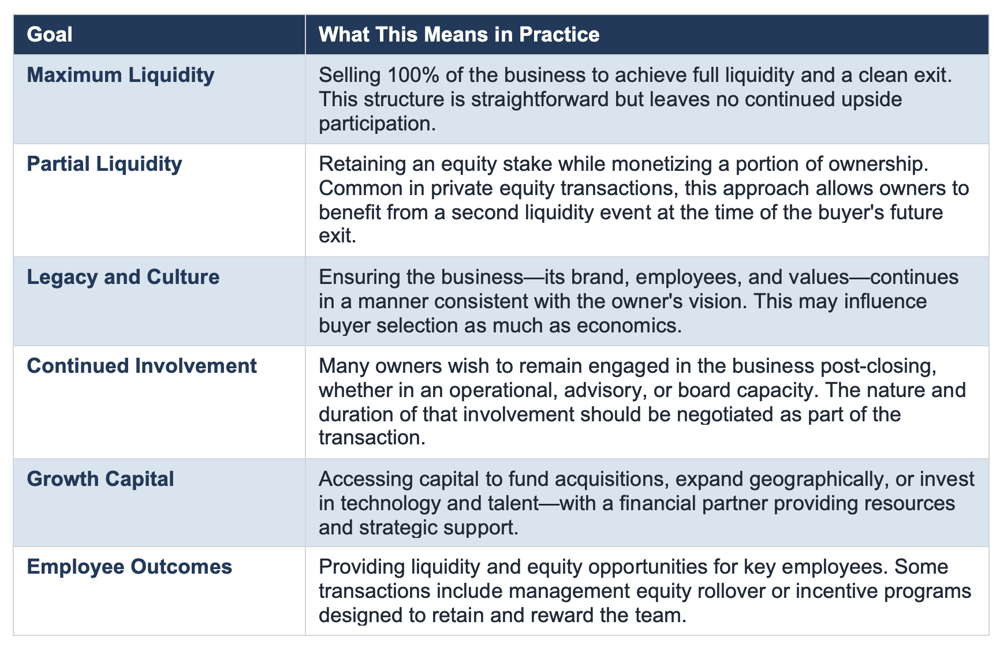
Before beginning a sale process, it is important to develop a clear and honest picture of what a successful outcome looks like for you. Valuation is often the headline consideration, but it is rarely the only one that matters. A transaction that maximizes headline price while misaligning on structure, timing, or post-closing expectations can produce outcomes that fall short of what you intended.
Owner priorities are highly individual, and they often evolve over the course of a process. Establishing clarity early, and sharing that clarity with your advisors, enables better decisions at every stage, from buyer selection to term negotiation.
Most owners hold a combination of these priorities, and some may be in tension with one another. A desire for maximum upfront liquidity may conflict with continued operational involvement; a preference for cultural continuity may trade off against headline value. Identifying and ranking your priorities in advance, and revisiting them as the process unfolds, is one of the most valuable investments you can make before engaging with buyers.
Understanding Transaction Structures
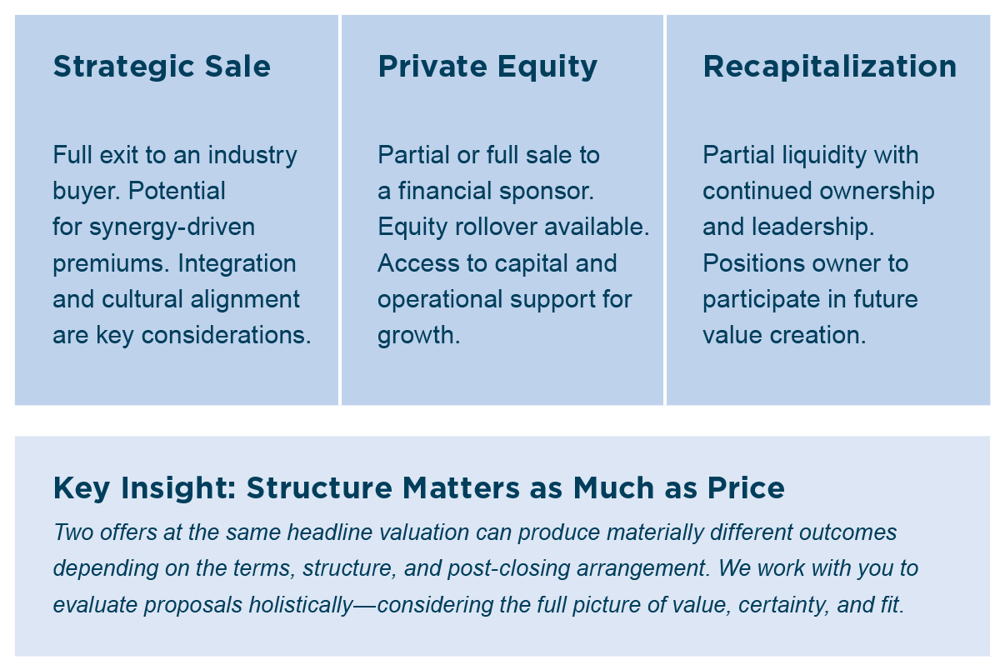
Transactions do not follow a single template. The structure of a sale determines not only how proceeds are distributed, but also how risk is shared, how you remain involved, and what opportunities remain available to you post-closing. Understanding the principal structures, and their respective trade-offs, is essential to making informed decisions throughout the process.
Sale to a Strategic Acquirer
A strategic buyer is a company, typically an industry participant or adjacent operator, that acquires a business because it complements or enhances their existing operations. Strategic acquirers often have the ability to pay a premium because they can realize synergies that a financial buyer cannot. These synergies may include revenue enhancement through cross-selling, cost reductions through operational integration, or access to new geographies and customer segments.
Strategic transactions frequently involve full ownership transfers, though earnout provisions, where a portion of the purchase price is contingent on future performance, are common. The integration process and cultural fit are important considerations, particularly for owners who care about how the business is managed post-closing.
Sale to a Financial Sponsor (Private Equity)
Private equity buyers acquire businesses with the objective of enhancing value over a defined investment horizon, typically three to seven years, before pursuing a subsequent sale or recapitalization. Unlike strategic buyers, financial sponsors may not operate existing businesses in the same industry (except for add-on acquisitions), but they bring capital, operational expertise, and acquisition-oriented growth strategies.
A hallmark of private equity transactions is the opportunity for management and ownership teams to retain a meaningful equity stake, often referred to as a “rollover.” This structure allows sellers to participate in future value creation alongside the financial sponsor, effectively providing two liquidity events: one at closing and one at the time of the sponsor’s eventual exit.
Private equity transactions often involve some degree of leverage, debt financing that amplifies both potential returns and operational discipline. Understanding how a sponsor intends to operate and grow the business is an important part of evaluating a financial buyer’s proposal.
Recapitalization
A recapitalization allows an owner to monetize a portion of their equity, achieving partial liquidity, while retaining a significant ownership stake and continuing to lead the business. This structure is particularly well-suited to owners who believe in the long-term growth trajectory of the business but wish to reduce personal financial concentration.
Recaps are most commonly executed with private equity partners, who provide capital in exchange for a minority or majority stake. The precise ownership split and governance terms are negotiated based on the owner’s objectives and the buyer’s investment criteria.
Management Buyout
A management buyout (MBO) involves the company’s existing leadership team acquiring ownership, typically with the support of a financial sponsor or lender. MBOs are most viable when management has both the depth to operate independently and access to sufficient financing. From an owner’s perspective, an MBO can be an attractive option when management continuity and legacy are primary considerations, though it may not always produce the highest valuation relative to a broad competitive process.
The Sale Process: An Overview
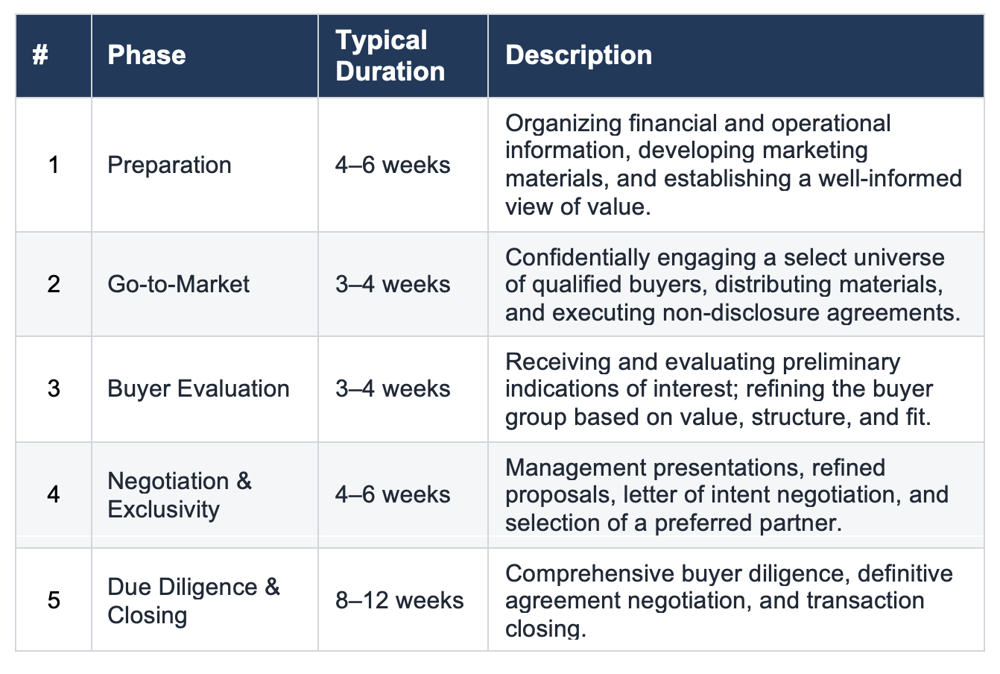
Most transactions unfold across five primary phases, each with a distinct purpose and a different set of demands on your time and attention. The overall timeline varies depending on the complexity of the business, market conditions, and the competitiveness of the buyer process, but most well-run transactions from preparation to closing span four to eight months.
The table below summarizes the phases at a high level. Each is described in greater detail in the pages that follow.
Phase 1: Preparation
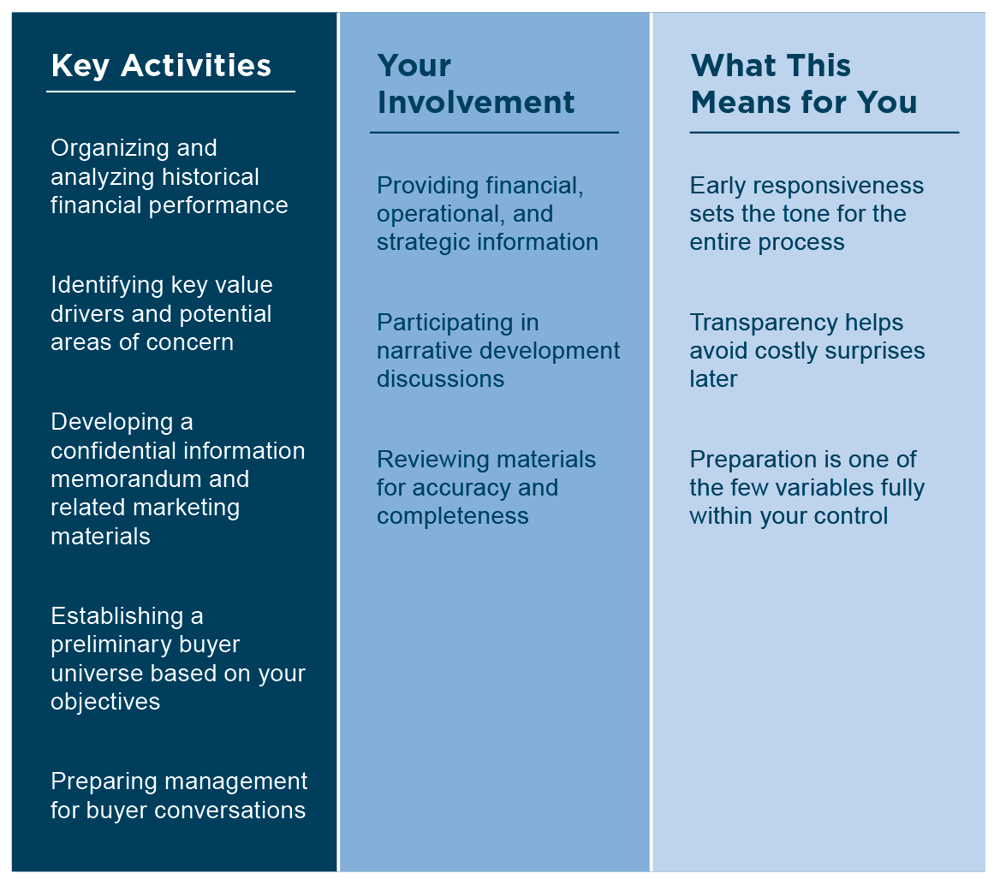
The preparation phase lays the foundation for everything that follows. Time invested here often translates directly into stronger buyer interest, a more efficient process, and improved outcomes. This stage is focused on understanding, organizing, and presenting the business in a way that highlights its strengths while thoughtfully addressing areas that may require explanation. During preparation, we work closely with you to develop a clear and credible narrative around the company’s performance, growth trajectory, and competitive positioning. Buyers will eventually diligence every aspect of the business, so establishing consistency and transparency at the outset is critical. Well-prepared companies tend to experience fewer disruptions later in the process and are better positioned to maintain negotiating leverage when it matters most. It is also during this stage that many owners begin to see their business through a buyer’s lens. Questions around customer concentration, margin sustainability, management depth, and scalability often surface for the first time. Addressing these matters proactively, rather than reactively, can meaningfully impact both value and deal certainty.
Phase 2: Go-to-Market
During the go-to-market phase, we begin engaging with prospective buyers in a structured and confidential manner. The objective is to generate broad, competitive interest among a defined universe of qualified buyers while maintaining control over the flow of information and protecting the confidentiality of the process. Initial outreach is conducted using high-level, anonymized materials designed to generate interest without disclosing your identity. As buyers express interest and execute confidentiality agreements, more detailed information is shared in a sequenced and deliberate manner. This phase is actively managed to create momentum and encourage competitive dynamics, both of which are critical to achieving strong outcomes. Behind the scenes, this stage is highly active. We are communicating with multiple parties simultaneously, answering questions, qualifying interest, and ensuring that credible buyers remain engaged. A well-executed process balances broad market exposure with appropriate selectivity.
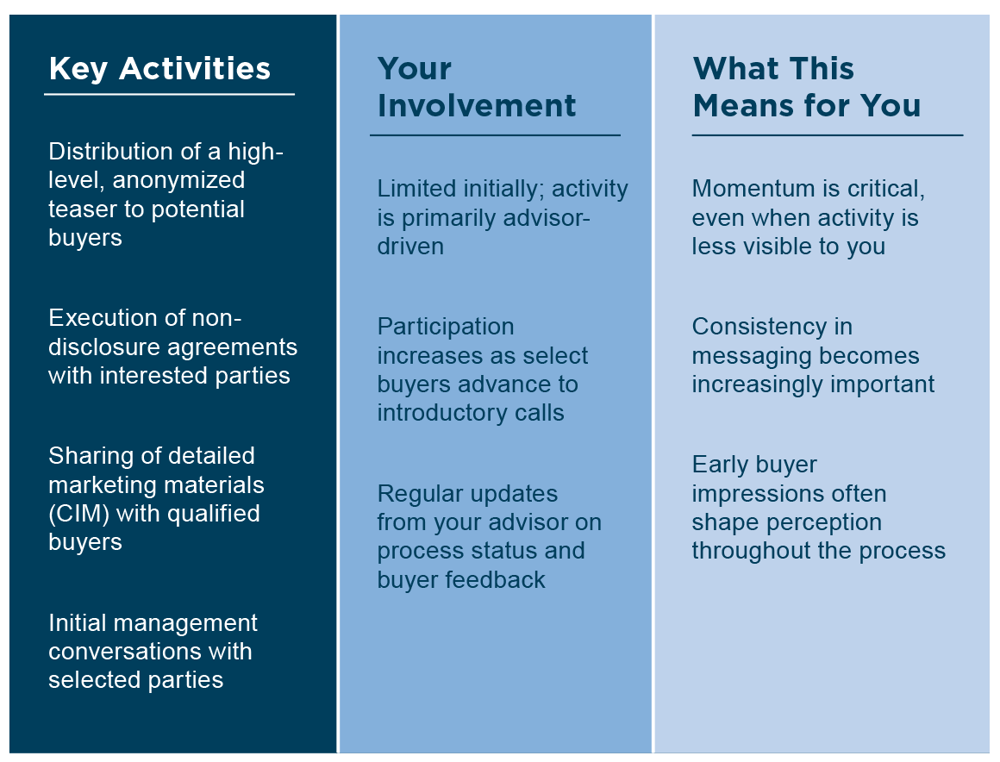
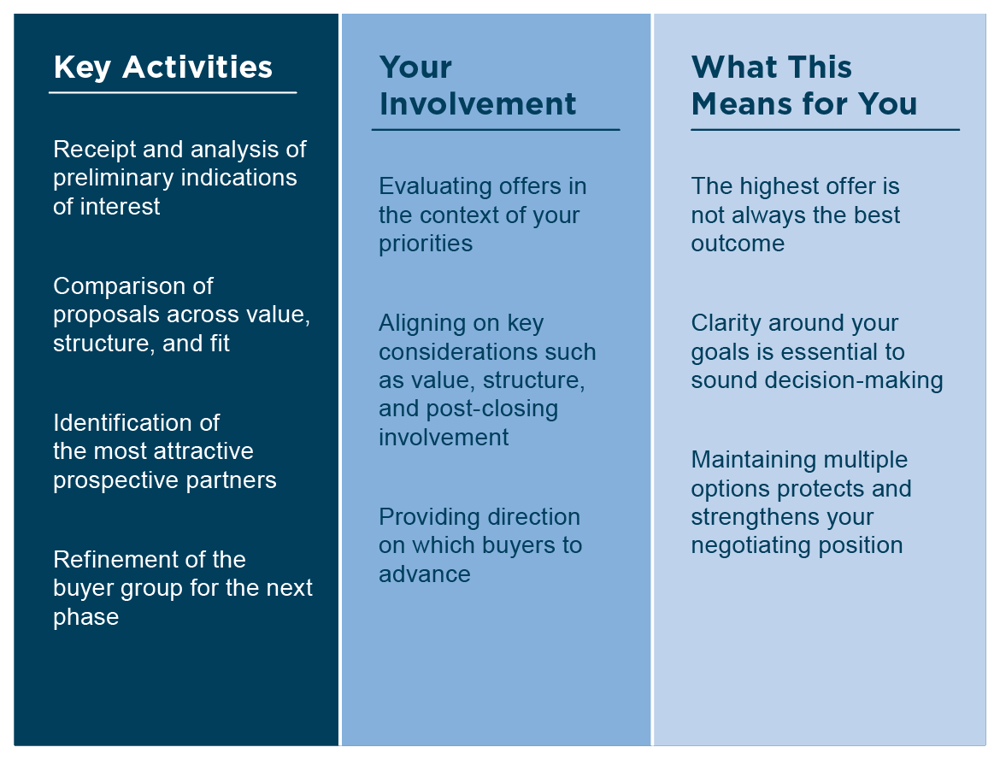
Phase: 3 Buyer Evaluation
As interested parties complete their review of materials and engage in initial discussions, they submit indications of interest (IOIs) outlining their preliminary views on valuation and transaction structure. This phase represents the first meaningful checkpoint in the process, and the first opportunity to see how the market values your business. Our role at this stage is to help you interpret these proposals beyond headline price, considering factors such as deal structure, certainty of closing, cultural fit, and alignment with your post-transaction objectives. Not all offers are directly comparable, and a disciplined evaluation framework is essential. Maintaining optionality by keeping multiple qualified parties engaged is a key driver of negotiating leverage. Selecting too few buyers to advance, or moving to exclusivity prematurely, can meaningfully reduce your ability to influence final terms.
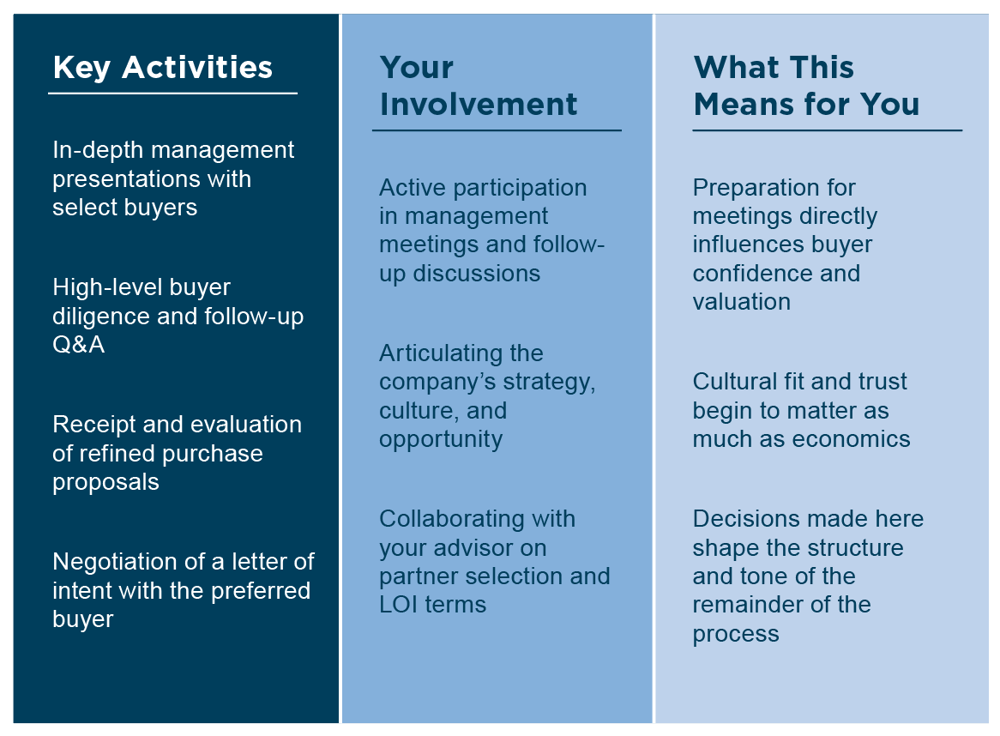
Phase 4: Negotiation & Exclusivity
In this phase, selected buyers are invited to engage more deeply with the business through in-person management presentations and targeted preliminary diligence. These interactions allow buyers to validate their investment thesis while giving you the opportunity to assess them as prospective partners, not just as capital sources. Management meetings are often one of the most consequential components of the entire process. Buyers are evaluating not only the financial performance of the business, but also the leadership team, culture, and long-term strategic potential. Preparation and consistency of message are critical. Following management presentations, buyers submit refined proposals. We then work with you to select a preferred party and negotiate a letter of intent (LOI), a document that outlines the key economic and structural terms of the proposed transaction. Entering exclusivity is a significant milestone: it signals substantive alignment on major terms and a shared commitment to completing the transaction.
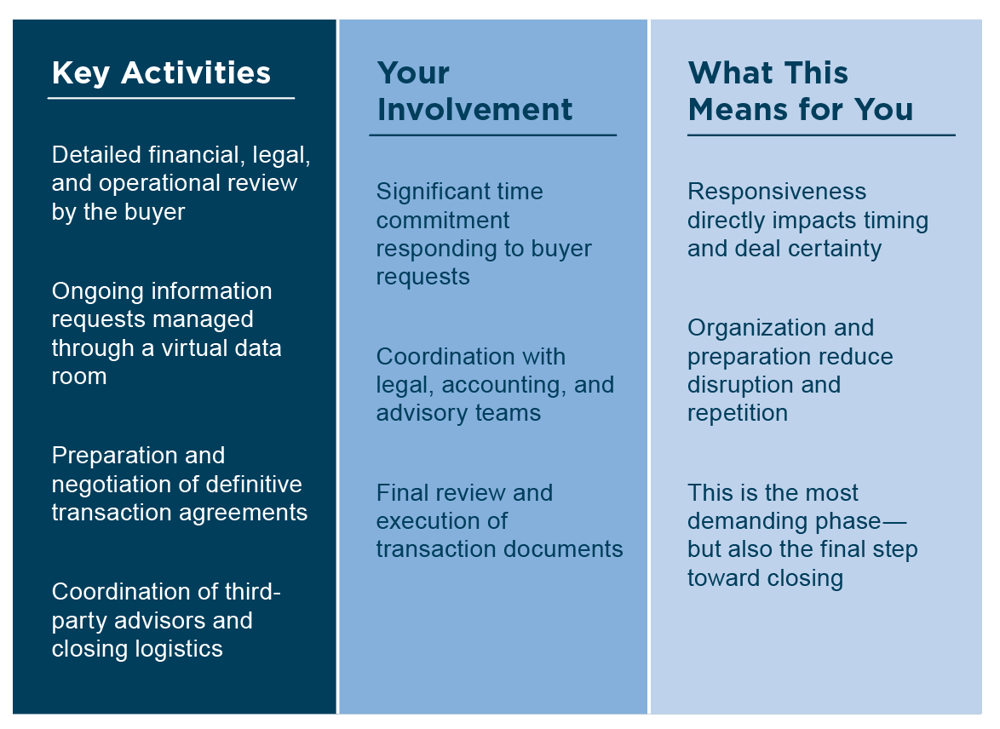
Phase 5: Due Diligence & Closing
Following execution of a LOI, the process enters its most intensive stage. The buyer conducts a comprehensive review of the business across financial, legal, operational, and other relevant dimensions. While this phase is confirmatory in nature, designed to validate what has already been represented, it is also where details matter most and where the process can be most demanding on your time. Diligence is typically fast-paced and highly detailed. Buyers will submit numerous information requests, managed through a centralized virtual data room and coordinated Q&A process. Organization, consistency, and timeliness are essential to maintaining credibility and momentum. Delays or inconsistencies at this stage can create doubt in a buyer’s mind and, in some cases, affect valuation or deal certainty. Simultaneously, legal documentation is drafted and negotiated. These agreements formalize the terms outlined in the LOI and address a wide range of considerations, including representations, warranties, indemnification, and closing conditions. A well-managed diligence process minimizes surprises and supports a smooth path to closing.
Common Challenges and How to Address Them
Even well-prepared transactions can encounter obstacles. Understanding the most common challenges in advance allows you to anticipate them, and in most cases, avoid them entirely.
Delays in Information Delivery
Buyers interpret slow or disorganized responses as potential signals about how the business is managed. Prioritizing information requests, even when the demands feel overwhelming, is essential to maintaining credibility and deal momentum.
Inconsistent Messaging
Buyers may speak with multiple members of a management team over the course of a process. Inconsistencies, whether in financial explanations, growth narratives, or competitive positioning, create doubt. Thorough preparation and alignment before buyer interactions is not optional.
Unexpected Diligence Findings
Issues that surface for the first time during buyer diligence are far more damaging than those disclosed upfront. Buyers price uncertainty; they reward transparency. Identifying and addressing potential concerns during the preparation phase, before buyers find them, is one of the most important things you can do to protect value.
Fatigue and Distraction
A sale process is demanding, and it unfolds alongside the day-to-day responsibilities of running a business. Protecting business performance throughout the process is critical, a decline in results during a transaction is one of the most common causes of valuation erosion or deal failure. Planning for the time commitment in advance, and delegating where possible, is essential.
Misaligned Expectations
Disagreements among shareholders, on valuation, structure, or post-closing involvement,can derail a process at the worst possible time. Alignment among all decision-makers before the process begins is non-negotiable.
This guide is intended to serve as a practical reference as you consider a potential transaction. It is not legal or tax advice. We encourage you to consult with qualified legal and tax advisors as part of your preparation process.
The Team Around You
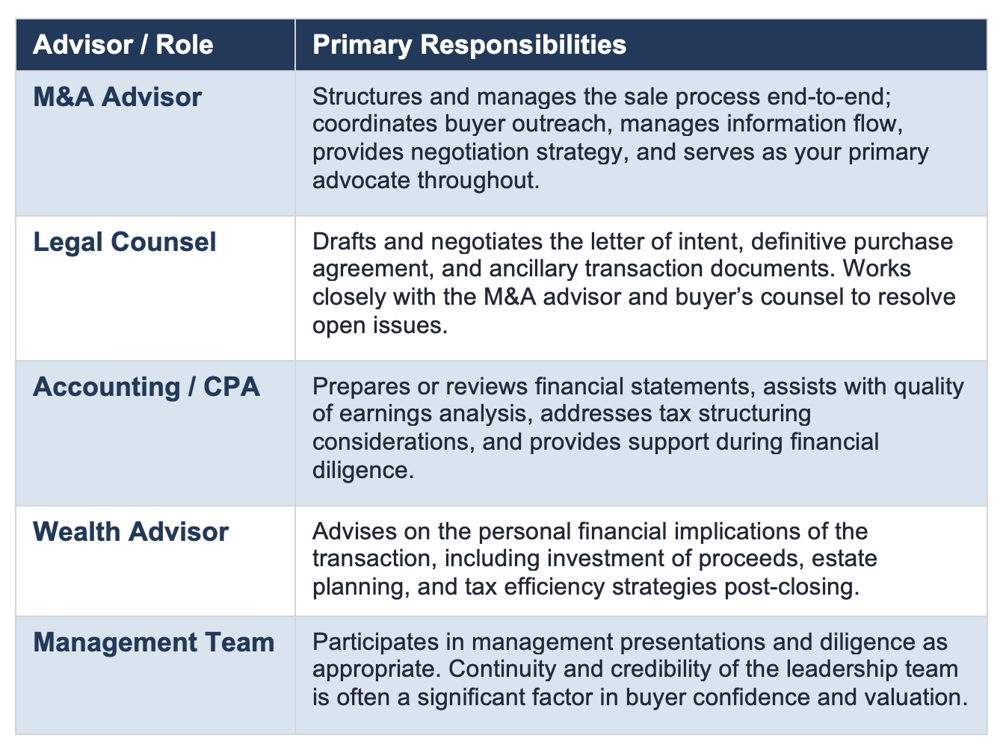
A successful transaction requires a coordinated team of experienced advisors working in alignment with your objectives. While your M&A advisor serves as the primary point of coordination and advocacy, several other professionals play important roles throughout the process.
Our Role
We serve as your advisor and advocate from the first conversation to the closing table.
Our responsibilities include structuring and managing the process, coordinating communication with buyers and advisors, providing objective counsel at critical decision points, negotiating terms to align with your objectives, and maintaining momentum toward a successful closing. Every decision we make is made with your goals in mind.