Transaction Advisory, Oil & Gas

September 17, 2018

M&A in the Bakken

Under the Radar

Over the past year, followers of the oil and gas industry have taken note of the multitude of transactions occurring in the Permian Basin with large deal values and hefty multiples. But the price differential between WTI and other benchmarks has grown over the last few months, and some attention has moved from the Permian to other domestic shale plays.  The activity in other regions such as the Bakken was at one point slow (when compared to the Permian) causing the recent increase in production and the swapping of acreage to fly under the radar while many were focused on Texas.

Transaction activity in the Bakken in 2017 marked the departure of a number of companies that were active in the play, such as Halcon Resources. At the end of 2017 and into 2018, the exodus from the Bakken to the Permian continued. Recently, the Bakken is being viewed as another viable option to the Permian Basin, which has seen a growing price differential due to insufficient infrastructure. This, and rising oil prices, has resulted in an increase in production in the region, leading to more transaction activity and inflows of capital.

Recent Transactions in the Bakken

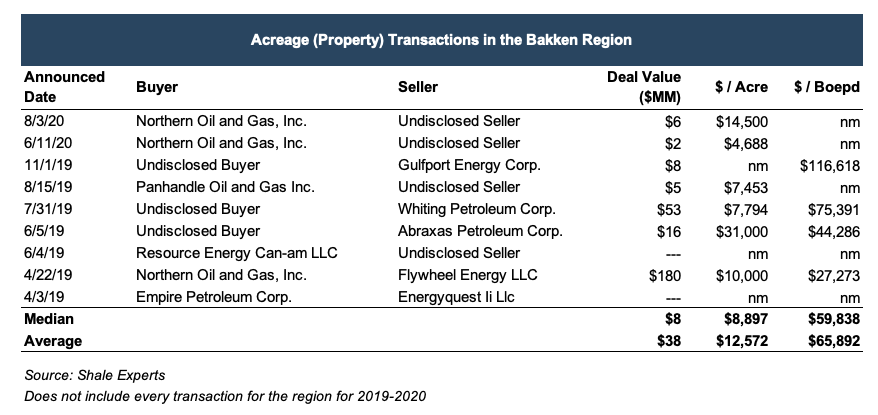
Details of recent transactions in the Bakken, including some comparative valuation metrics are shown below.

Overall, the average deal size has decreased from twelve months ago when companies sold off large bundles of assets to clean up their balance sheets and survive in the low oil price environment. While deals today may be smaller in size, they are more strategic in nature.

Whiting Acquires 65,000 Acres from Oasis

One of the largest deals in the region over the last twelve months was Whiting Petroleum Corp. purchase of 65,000 acres from Oasis Petroleum Inc. in June for $283 million.  A Seeking Alpha contributor noted that this transaction is a “case of one company believing that it can achieve better results in an area that the other company considered lower quality acreage.” This is observed in Oasis’ acceptance of a lower than average transaction price per acre, and Whiting’s willingness to pay an above average price flowing barrel.

US Energy Acquires 1,600 Acres from APEG

One of the smaller deals was US Energy Corp.’s acquisition of 1,600 acres from APEG Energy LP (a related party) for $18 million. US Energy and APEG Energy II, LP announced a strategic partnership in October of 2017 in a deleveraging transaction. APEG Energy II is one of Angelus Capital’s (a private equity firm headquartered in Austin, Texas) funds focused on acquiring domestic oil and gas assets. Since then, US Energy has focused on cleaning up its balance sheet to focus on producing oil assets. Recently, US Energy has been working to add assets that will immediately increase production in the Williston Basin and South Texas.

US Energy expects their most recent transaction “will create additional opportunities for development and acreage swaps that would permit the company to continue consolidating its leasehold position in the area.”  US Energy paid $44,500 per flowing barrel, which is in line with average production multiples paid in the region but is somewhat lower than those observed last year. Deal values last year may have been based on the expectation that production would increase in the future, inflating current multiples. Now that production has picked back up in the Bakken, deal multiples appear to have normalized somewhat.

Observed M&A Trends in the Bakken

The following are two good examples of transactions we are seeing in the region this year:

Strategic Deals Between Regional Operators

One of the disadvantages of the Bakken, as compared to the Permian, is that it is an older play and many of its sweetest spots have already been drilled.  However, age is often equated with wisdom, and the significant experience of operators who have been in this region since the early 2000s gives them a competitive edge.  As Senior Beck, a senior director at Statas Advisors explained, “The Bakken’s maturity and production characteristics could lead to a growth in consolidation over the next few years.”

Acquisitions of Property by Non-Operators

Additionally, the prominence of activity of non-operators in the Bakken has increased.  Private equity funds like Angelus Capital, single-family offices, and other providers of capital that see an opportunity in the Bakken are buying acreage and partnering with the best operators in order to realize superior returns on investment.

Combining these trends, Northern Oil and Gas Inc. is a non-operator who aims to be the Bakken’s “natural consolidator.”  In July it completed its largest acquisition yet of 10,600 net acres for $100 million cash plus approximately $190 million of Northern Oil stock.  Northern Oil is relying upon the superior abilities of longtime regional operators and the trend towards consolidation. However, it is also an example of a non-operator who has become more prominent in the last year.

The Bakken may have gone unnoticed for a couple years after the downturn in oil prices in 2014, but it may be rising back to prominence as increases in efficiency and cost reductions impress investors.

We have assisted many clients with various valuation needs in the upstream oil and gas in North America and around the world.  In addition to our corporate valuation services, Mercer Capital provides investment banking and transaction advisory services to a broad range of public and private companies and financial institutions.  We have relevant experience working with companies in the oil and gas space and can leverage our historical valuation and investment banking experience to help you navigate a critical transaction, providing timely, accurate and reliable results.  Contact a Mercer Capital professional to discuss your needs in confidence.

Continue Reading

Themes from the Q4 2025 Energy Earnings Calls
Fourth quarter 2025 earnings calls suggest an industry preparing for a transitional 2026, emphasizing organic inventory expansion, structural natural gas demand growth, and tightening service market fundamentals. Management teams appear focused less on short-term volatility and more on positioning for the next upcycle.
NAPE Summit 2026: Dealmaking at the Crossroads of Molecules, Electrons, and Minerals
Mercer Capital joined industry leaders at the 2026 NAPE Summit (NAPE Expo), held February 18th to 20th, at the George R. Brown Convention Center in Houston, Texas. As with prior Expos, NAPE delivered a focused marketplace where conversations move quickly from “nice to meet you” to “what would it take to get this done?” This year, Bryce Erickson and David Smith represented Mercer Capital on the expo floor and across the conference programming, meeting with operators, minerals groups, capital providers, and advisors.If there was one defining characteristic of NAPE 2026, it was convergence. The industry’s traditional center of gravity, upstream oil and gas dealmaking, was still very much present. But the surrounding ecosystem is widening, as programming incorporated adjacent (and increasingly intertwined) sectors. The hubs for 2026, included Offshore, Data Centers, and Critical Minerals, as part of an event lineup designed to broaden the deal flow and participant mix. Below are our key takeaways from the conference, with a tour through the hub sessions and the themes that were emphasized.The Hub Sessions Told a Clear Story: Energy Is Becoming a Multi-Asset PortfolioThe 2026 NAPE hubs provided a useful lens into where capital is flowing and how industry priorities are evolving. This year’s programming demonstrated a market that still values traditional upstream opportunities, while increasingly integrating adjacent and emerging sectors into the broader deal landscape.Prospect Preview Hub: Showcasing OpportunitiesNAPE’s Prospect Preview Hub once again served as a platform for exhibitors to showcase available prospects on the expo floor, providing concise overviews of their technical merits and commercial potential. Presenters framed their investment thesis in a narrative that reflects how assets are marketed in a competitive transaction environment.Minerals & NonOp Hub: Strategies and TrendsThe Minerals & NonOp Hub discussions focused on market trends, financing strategies, and technology-driven approaches to sourcing and managing acquisition opportunities. Presentations in this hub addressed strategies, recent trends, technologies, and related developments.Offshore Hub: Long-Cycle Capital with Global ImplicationThe Offshore Hub highlighted exploration frontiers, development innovation, and the broader geopolitical context influencing offshore investment. Particular emphasis was placed on high-potential offshore regions, navigating environmental and regulatory frameworks, supply-demand trends, and the role of offshore energy in the global energy mix. Offshore projects require significant upfront investment and longer development timelines, which heighten sensitivity to regulatory stability, cost control, and commodity price outlook assumptions. In this sense, offshore dealmaking underscores how long-cycle assets must be evaluated differently from shorter-cycle onshore plays.Renewable Energy Hub: An Integrated FrameworkThe Renewable Energy Hub reflected an industry increasingly focused on integration rather than segmentation. Presentations centered on integrating renewables with traditional energy sources, hybrid project models, sustainability pathways with a focus on technology, and strategies for navigating evolving energy markets. Rather than viewing renewables as a standalone vertical, participants frequently discussed how renewable assets fit within broader portfolios that include natural gas, storage, and transmission infrastructure.Critical Minerals Hub: Supply Chain Strategy Comes to the ForefrontThe Critical Minerals Hub emphasized the strategic importance of minerals such as lithium, cobalt, rare earth elements, and graphite within evolving energy supply chains. The three sessions - Exploration/Development, Market Dynamics, and Sustainability/Innovation - featured presentations focused on resource development pathways, supply chain positioning, sourcing practices, and recycling technologies. Unlike traditional upstream projects, critical mineral investments often face unique permitting, processing, and geopolitical risks. As capital flows into the space, differentiation increasingly depends on technical credibility and downstream integration potential.Data Center Hub: Power Demand Is Now a First-Order VariableThe Data Center Hub positioned data centers as a critical component of the global economy, emphasizing the sector’s immense and growing energy needs and the resulting opportunities for collaboration between energy and technology stakeholders. Sessions addressed (i) structuring power supply, interconnection, and grid compliance, (ii) managing data center development risk, and (iii) how rising energy demands impact data center development.In practical terms, this emerged in two ways. First, site selection and power availability are increasingly central to “deal conversations.” Co-location strategies, generation capacity, transmission access, and long-term power contracting are becoming key underwriting considerations. Second, infrastructure constraints are entering valuation frameworks. Power availability, interconnection queues, permitting timelines, and fuel optionality are no longer secondary factors; they directly influence project timing, risk, and expected returns.Our Takeaways: What We Heard Repeatedly on the FloorAcross hub sessions and meetings, three themes came up again and again:Infrastructure constraints are turning into valuation drivers. Power, pipelines, processing, and permitting are not background details—they’re often the gating items that shape cash flow timing, risk, and ultimate marketability.The market is hungry for clarity. Whether the topic is policy, commodity outlook, or capital availability, counterparties are placing a premium on deals with understandable risks and executable paths.Energy dealmaking is becoming “multi-asset” by default. Even when the transaction is traditional upstream, the conversation increasingly touches power, infrastructure, data, or minerals adjacency.Final ThoughtsMercer Capital has long valued NAPE as an event where real deal conversations happen and where shifting industry priorities can be identified early on. As the lines between upstream, infrastructure, power, and emerging energy/minerals continue to blur, independent valuation and transaction advisory services become even more important, since the hardest part isn’t building a model, it’s choosing the right assumptions.We have assisted many clients with various valuation needs in the upstream oil and gas space for both conventional and unconventional plays in North America and around the world. Contact a Mercer Capital professional to discuss your needs in confidence and learn more about how we can help you succeed.
Industry Spotlight: Natural Gas Outlook: Producers Face A Familiar Disconnect In 2026
Industry Spotlight | Natural Gas Outlook: Producers Face A Familiar Disconnect In 2026
Earlier this month, I was in Western Oklahoma for a trial. Surrounded by the wide-open Great Plains and the unmistakable presence of oil and gas infrastructure, it was impossible not to think about the industry’s influence on the region. A few people asked me if I had watched the acclaimed show, Landman, and as I hadn't, I started the series on my flights home.

Cart

Your cart is empty