Transaction Advisory, Oil & Gas

April 16, 2021

Solvency Opinions: Oil & Gas Considerations

The Key Question

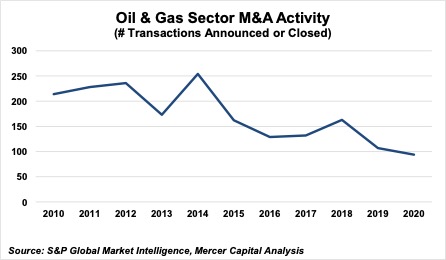
As 2020 progressed, a record number of oil & gas operators and related oil field service companies filed for Chapter 11 bankruptcy, which provides for the reorganization of the firm as opposed to full liquidation (Chapter 7).  In addition, consolidation by way of merger and acquisition (“M&A”) activity occurred, albeit such activity was at a 10-year low in 2020.
Regardless of whether a company files for Chapter 11, is party to an M&A transaction, or executes some other form of capital restructuring – such as new equity funding rounds or dividend recaps – one fundamental question takes center stage: Will the company remain solvent?

The Four Tests

As noted in our overview of solvency opinions last November, leveraged transactions that occurred pre-COVID-19 will continue to be scrutinized, with many bankruptcy courts considering the issue of solvency retroactively.  Due to increased energy price volatility in the first and second quarter of 2020, many operational and dividend programs were suspended.

As oil & gas prices have stabilized and appreciated over the past one to two quarters (in its April Short-Term-Energy Outlook report, EIA projects WTI and Brent to average $58.89 and $62.28 per barrel, respectively), a large number of oil & gas operators have significantly reduced their debt, and are considering or have resumed their operational plans and dividend programs, albeit perhaps not exactly as before their suspension.

Emerging from the chaos of 2020 with lower leverage, leaner and more efficient operations, higher commodity prices, and the continued low interest rate environment, it is not unreasonable to think that oil & gas companies may consider increasing leverage again as operations continue to recover or expand and boards approve the return of capital to shareholders by way of resuming regular or even special dividends.

Often, a board contemplating such actions will be required to obtain a solvency opinion at the direction of its lenders or corporate counsel to provide evidence that the board exercised its duty of care to make an informed decision should the decision later be challenged.

A solvency opinion, typically performed by an independent financial advisor, addresses four questions:

  • Does the fair value of the company’s assets exceed its liabilities after giving effect to the proposed action?
  • Will the company be able to pay its debts (or refinance them) as they mature?
  • Will the company be left with inadequate capital?
  • Does the fair value of the company’s assets exceed its liabilities and capital surplus to fund the transaction?
A solvency opinion addresses these questions using four primary tests:Test 1: The Balance Sheet TestDoes the fair value and present fair salable value of the Company’s total assets exceed the Company’s total liabilities, including all identified contingent liabilities? The balance sheet test takes the fair value of the subject firm on a total invested capital basis and subtracts its liabilities. Test 2: The Cash Flow TestWill the Company be able to pay its liabilities, including any identified contingent liabilities, as they become due or mature? The cash flow test examines whether projected cash flows are sufficient for debt service.  This is typically analyzed along three general dimensions, including the determination of the company’s revolving credit facility to manage cash flow needs over the forecast, the possible violation of any applicable covenants, and the likely ability to refinance any remaining debt balances at their maturity. Test 3: The Capital Adequacy TestDoes the Company have unreasonably small capital with which to operate the business in which it is engaged, as management has indicated such businesses are now conducted and as management has indicated such businesses are proposed to be conducted following the transaction? The capital adequacy test is related to the cash flow test and examines a company’s ability to service its debt with sufficient margin after giving effect to the proposed transaction.  While there is no bright line test for defining “unreasonably small capital”, we typically evaluate this concept based upon pro forma and projected leverage multiples utilizing management’s projections as a baseline scenario and alternative downside scenarios to determine if there is “unreasonably small capital” under more stressed conditions. Test 4: The Capital Surplus Test Does the fair value of the Company’s assets exceed the sum of (a) its total liabilities (including identified contingent liabilities) and (b) its capital (as calculated pursuant to Section 154 of the Delaware General Corporation Law) The capital surplus test replicates the valuation analysis prescribed under the balance sheet test, but includes the par value of the company’s stock (or entire consideration received for the stock if no par value is given), in the amount subtracted from the fair value of the company’s assets.

Solvency Considerations within Oil & Gas

Performing a solvency opinion requires careful consideration of numerous factors even when everything clearly appears to be more or less favorable in a proposed transaction that involves increasing leverage.  It may be opportune to pursue a dividend recap as debt is cheap and the company is already exhibiting strong growth in an industry potentially starting to recover.  A company may increase leverage despite already having sufficient cash on hand for a special distribution, but it wants to maintain flexibility to act on unexpected growth opportunities that may arise.  Perhaps the company’s trajectory is so great that even its downside case(s) would be a lofty goal of the next closest competitor.  Still, the independent financial advisor must maintain a critical eye, taking a medium- to long-term perspective with a skeptic lens, to determine that the company may reasonably remain solvent.

Now, consider the oil & gas sector in 2020.  Under the assumption that additional debt is needed just to survive, never mind paying special dividends, many additional questions to approaching the company’s baseline forecast and downside scenarios arise:

  • If the fair value of the company’s assets is already greatly diminished in the current down cycle, how much should you temper – if at all – the downside future scenario(s) when conducting the capital adequacy test? An appropriate stress test scenario for a company at the top or mid-point of the business cycle may look far different from an appropriate stress at the bottom of the cycle.
  • How will the balance sheet test fare given the concurrent decrease in asset fair value and increase in liabilities? Even if the capital adequacy and balance sheet tests do not raise any red flags on their own, the cash flow test may reveal significant concerns.  Is there enough flexibility with the existing revolver to address cash flow needs over the forecast, or will it need to be increased?  Could the revolver even be increased, if needed?
  • Can the company financially perform well enough over the next three to five years that future (likely) higher interest rates won’t be overly burdensome if the company must refinance maturing debts?
  • And while due diligence and financial feasibility studies are expected to be performed beforehand, what covenant violations are likely to occur and when (in the context of the forecast scenario)? Will the new debt be “covenant-light” and relatively toothless, or will the company find itself that much more constrained when the fangs sink in and the situation is already likely to be dire?
While conversations regarding these questions and their implications may likely expose sensitive topics, these discussions must be candid if the independent advisor is to develop a well-founded and defensible opinion on the prospects of solvency. Mercer Capital renders solvency opinions on behalf of private equity firms, independent committees, lenders and other stakeholders that are contemplating a transaction in which a significant amount of debt is assumed to fund shareholder dividends, an LBO, acquisition or other such transaction that materially levers the company’s capital structure.  For more information or if we can assist you, please contact us.

Continue Reading

NAPE Summit 2026: Dealmaking at the Crossroads of Molecules, Electrons, and Minerals
Mercer Capital joined industry leaders at the 2026 NAPE Summit (NAPE Expo), held February 18th to 20th, at the George R. Brown Convention Center in Houston, Texas. As with prior Expos, NAPE delivered a focused marketplace where conversations move quickly from “nice to meet you” to “what would it take to get this done?” This year, Bryce Erickson and David Smith represented Mercer Capital on the expo floor and across the conference programming, meeting with operators, minerals groups, capital providers, and advisors.If there was one defining characteristic of NAPE 2026, it was convergence. The industry’s traditional center of gravity, upstream oil and gas dealmaking, was still very much present. But the surrounding ecosystem is widening, as programming incorporated adjacent (and increasingly intertwined) sectors. The hubs for 2026, included Offshore, Data Centers, and Critical Minerals, as part of an event lineup designed to broaden the deal flow and participant mix. Below are our key takeaways from the conference, with a tour through the hub sessions and the themes that were emphasized.The Hub Sessions Told a Clear Story: Energy Is Becoming a Multi-Asset PortfolioThe 2026 NAPE hubs provided a useful lens into where capital is flowing and how industry priorities are evolving. This year’s programming demonstrated a market that still values traditional upstream opportunities, while increasingly integrating adjacent and emerging sectors into the broader deal landscape.Prospect Preview Hub: Showcasing OpportunitiesNAPE’s Prospect Preview Hub once again served as a platform for exhibitors to showcase available prospects on the expo floor, providing concise overviews of their technical merits and commercial potential. Presenters framed their investment thesis in a narrative that reflects how assets are marketed in a competitive transaction environment.Minerals & NonOp Hub: Strategies and TrendsThe Minerals & NonOp Hub discussions focused on market trends, financing strategies, and technology-driven approaches to sourcing and managing acquisition opportunities. Presentations in this hub addressed strategies, recent trends, technologies, and related developments.Offshore Hub: Long-Cycle Capital with Global ImplicationThe Offshore Hub highlighted exploration frontiers, development innovation, and the broader geopolitical context influencing offshore investment. Particular emphasis was placed on high-potential offshore regions, navigating environmental and regulatory frameworks, supply-demand trends, and the role of offshore energy in the global energy mix. Offshore projects require significant upfront investment and longer development timelines, which heighten sensitivity to regulatory stability, cost control, and commodity price outlook assumptions. In this sense, offshore dealmaking underscores how long-cycle assets must be evaluated differently from shorter-cycle onshore plays.Renewable Energy Hub: An Integrated FrameworkThe Renewable Energy Hub reflected an industry increasingly focused on integration rather than segmentation. Presentations centered on integrating renewables with traditional energy sources, hybrid project models, sustainability pathways with a focus on technology, and strategies for navigating evolving energy markets. Rather than viewing renewables as a standalone vertical, participants frequently discussed how renewable assets fit within broader portfolios that include natural gas, storage, and transmission infrastructure.Critical Minerals Hub: Supply Chain Strategy Comes to the ForefrontThe Critical Minerals Hub emphasized the strategic importance of minerals such as lithium, cobalt, rare earth elements, and graphite within evolving energy supply chains. The three sessions - Exploration/Development, Market Dynamics, and Sustainability/Innovation - featured presentations focused on resource development pathways, supply chain positioning, sourcing practices, and recycling technologies. Unlike traditional upstream projects, critical mineral investments often face unique permitting, processing, and geopolitical risks. As capital flows into the space, differentiation increasingly depends on technical credibility and downstream integration potential.Data Center Hub: Power Demand Is Now a First-Order VariableThe Data Center Hub positioned data centers as a critical component of the global economy, emphasizing the sector’s immense and growing energy needs and the resulting opportunities for collaboration between energy and technology stakeholders. Sessions addressed (i) structuring power supply, interconnection, and grid compliance, (ii) managing data center development risk, and (iii) how rising energy demands impact data center development.In practical terms, this emerged in two ways. First, site selection and power availability are increasingly central to “deal conversations.” Co-location strategies, generation capacity, transmission access, and long-term power contracting are becoming key underwriting considerations. Second, infrastructure constraints are entering valuation frameworks. Power availability, interconnection queues, permitting timelines, and fuel optionality are no longer secondary factors; they directly influence project timing, risk, and expected returns.Our Takeaways: What We Heard Repeatedly on the FloorAcross hub sessions and meetings, three themes came up again and again:Infrastructure constraints are turning into valuation drivers. Power, pipelines, processing, and permitting are not background details—they’re often the gating items that shape cash flow timing, risk, and ultimate marketability.The market is hungry for clarity. Whether the topic is policy, commodity outlook, or capital availability, counterparties are placing a premium on deals with understandable risks and executable paths.Energy dealmaking is becoming “multi-asset” by default. Even when the transaction is traditional upstream, the conversation increasingly touches power, infrastructure, data, or minerals adjacency.Final ThoughtsMercer Capital has long valued NAPE as an event where real deal conversations happen and where shifting industry priorities can be identified early on. As the lines between upstream, infrastructure, power, and emerging energy/minerals continue to blur, independent valuation and transaction advisory services become even more important, since the hardest part isn’t building a model, it’s choosing the right assumptions.We have assisted many clients with various valuation needs in the upstream oil and gas space for both conventional and unconventional plays in North America and around the world. Contact a Mercer Capital professional to discuss your needs in confidence and learn more about how we can help you succeed.
Industry Spotlight: Natural Gas Outlook: Producers Face A Familiar Disconnect In 2026
Industry Spotlight | Natural Gas Outlook: Producers Face A Familiar Disconnect In 2026
Earlier this month, I was in Western Oklahoma for a trial. Surrounded by the wide-open Great Plains and the unmistakable presence of oil and gas infrastructure, it was impossible not to think about the industry’s influence on the region. A few people asked me if I had watched the acclaimed show, Landman, and as I hadn't, I started the series on my flights home.
Just Released: Q4 2025 Oil & Gas Industry Newsletter

Region Focus: Haynesville Shale

Overall, the Appalachian basin enters late-2025 on firmer footing than a year ago, characterized by stable production, recovering equity performance, and improving infrastructure fundamentals. Continued progress on export capacity and incremental LNG demand should provide a constructive backdrop for basin economics heading into 2026.

Cart

Your cart is empty