Transaction Advisory, Oil & Gas

March 17, 2020

Energy Valuations: Freefall Into Bankruptcy Or Is This Time Different?

This post originally appeared on Forbes.com on Monday, March 9, 2020. Energy valuations are taking an epic pummeling. Considering declining demand amid COVID-19 concerns, the initial fallout to the Saudi-Russia feud was predictable. Within hours, prices had dropped like an anchor (to $33 a barrel as of this morning). Several companies have already announced cutbacks, including Diamondback Energy, as they dropped two additional drilling crews. Parsley Energy made a similar announcement and more are sure to follow. Perhaps even more draconian, SM Energy’s unsecured bonds fell to $0.42 on the dollar and pushed the yield up to around 25%. These bonds traded above $0.90 as recently as February 24th. Trading has been halted this morning amid the panic. Whether the market fallout has hit rock bottom remains to be seen. Regardless of what Russia may have been thinking, the geopolitical climate has put more pressure on U.S. producers and bankers. Operators who were contemplating hedging production at $50 per barrel but waiting to act are kicking themselves today. Energy and related bankruptcies that were estimated to rise in 2020 will likely accelerate a few notches. According to Haynes and Boone’s Oilfield Services Bankruptcy Tracker, there were six (6) new bankruptcies in the oilfield services area in the fourth quarter of 2019. Up until this point in 2020, Pioneer Energy Services is the only major oilfield services company to enter Chapter 11 bankruptcy. That’s almost undoubtedly going to change soon. As upstream companies have vowed to spend within their cash flow, oilfield services will take the biggest brunt of this at first. However, producers with high leverage capital structures could quickly follow. Gas prices have held their ground but they’re so low anyway, it’s hard to know how much lower they could go.

Can Banks Hold On?

The looming factor for companies is how banks will go about determining borrowing bases this year. It’s a tough position to be in at this point. Bankers at the Hart Energy Capital Conference in Dallas last week did their best to portray patience towards the upstream sector, but were also clear about expectations. Those expectations were that borrowers can meet their obligations, and that borrowing bases will shrink with valuations. One of the speakers, Tom Petrie, expressed concern about $110 billion in debt coming due in the next decade for the energy market.

As working interest values for producing interests dive, the expected returns have changed from PV10 to closer to PV20. This has degraded credit quality. The mix of below-investment grade debt has worsened in the past year. In high yield markets, CCC or below is the most common rating according to some recent data.

High Yield Debt Rating Mix
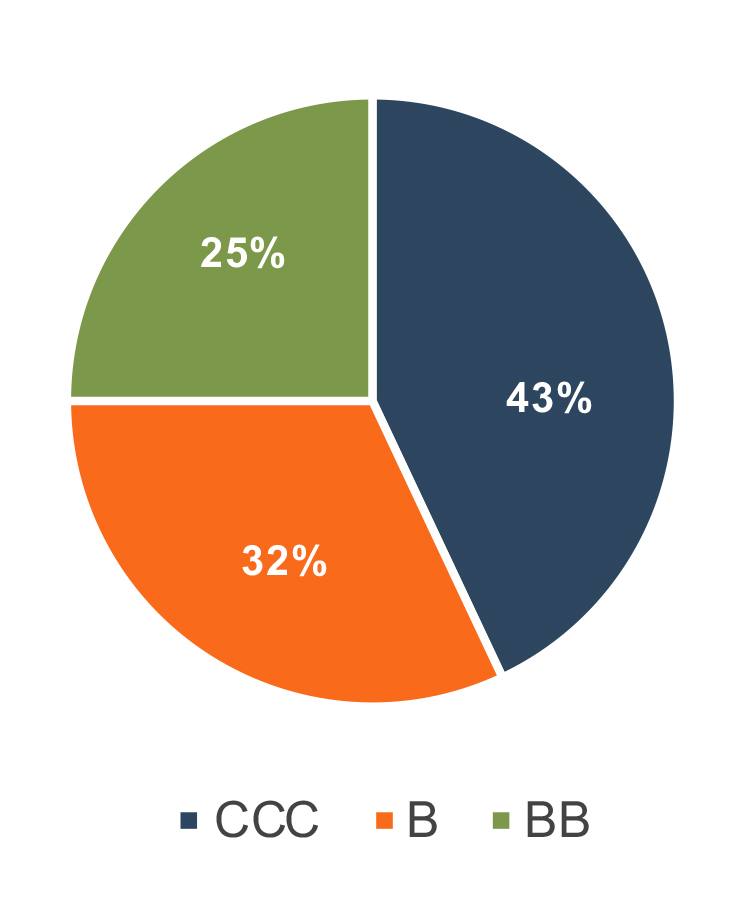
SOURCE: JP MORGAN CORPORATE ENERGY & POWER PRESENTATION


Even if bankers lending on reserves maintain their lending ratios, the borrowing bases will shrink accordingly. However, based on recent indications, lending ratios have and will continue to shrink alongside values. Debt-to-EBITDA ratios which used to often float in the 3.5x to 4.5x range are now, not surprisingly, in the 2.5x to 3.5x range. Enterprise values for upstream producers were often between 6.0x to 8.0x EBITDA too. That is in the past.

Shifting Credit Ratios
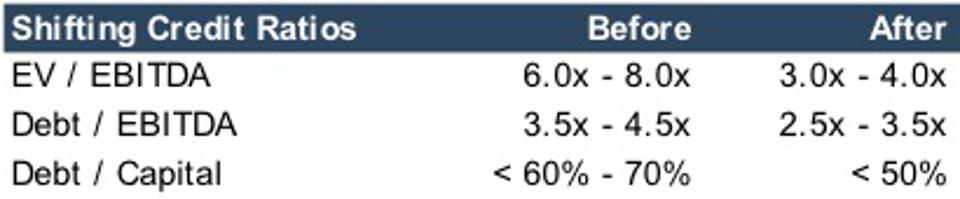
SOURCE: OCC GUIDELINES AND AMEGY BANK PRESENTATION


Impacts appear bad and immediate. However, this plunge could, ironically, buy the market a little more time. The founder of OnyxPoint Global Management, L.P., Shaia Hosseinzadeh, told Bloomberg just last week that “Things are so bad now, that the banks can kick the can down the road and say ‘there’s no point of rushing everybody into bankruptcy, we’ll wait until October.’ But if it’s business as usual, it’s going to be a horror show.” That may be a prescient thought. Another consideration is that fewer banks are even lending to energy companies anymore. The rise of the environmental, social, and governance (“ESG”) movement, alongside weak returns, have pushed many bankers and other investors out of the space. There isn’t as much capital to go around, not that it’s cheaply available right now anyway.

Due to valuations being so low, the recovery for bankers coming out of Chapter 7 situations may be less attractive, especially on the oilfield service side. The market value of intangible assets is so depressed compared to other times in the commodity cycle, that it may not make economic sense to rush into the process for some.

Can Values Recover?

This prognostication about delayed bank behavior may be a moot point if liquids values can’t recoup over time. This is an undercurrent that has been a factor in keeping values down recently. Electrification trends and the idea that liquids demand will wane have proffered the notion that demand for liquids will be flat to even shrinking in the future, all while supply becomes bountiful. Some project the electrical passenger car trends to reach around 20% by the end of this decade. However, while the short-term appears bleak, many projections about the medium- and longer-term remain more optimistic for upstream producers and servicers. J.P. Morgan Cazenove recently suggested that the oil industry may be under-equipped to meet demand recovery in 2021 and beyond. Another way of putting that is downward pressure on prices could be its own cure in the medium term. Capex budgets have been slashed and continue to be. Over 200 oil drilling rigs (and counting) have been shut down in the past six months. Production will suffer, even with drilling and production efficiencies achieved in recent years. Especially in the U.S. shale markets, declines on existing wells drop off so fast, that their effect on supply will show up sooner rather than later.

Producers are hopeful for this. Regardless of the market’s relentless pounding down on reserve values, producers know that, particularly proven reserves are next year’s production. They do not want to sell or unload them for the pennies on the dollar (or less) that implied valuation multiples suggest right now. Intrinsically, they have much more value than inferred by market capitalizations. Management teams believe that enterprise values shouldn’t be trading at a fraction of PV10 values over a long period of time. At a minimum, many producers believe there is an optionality to their future drilling inventory.

The question remains, could that happen fast enough to save a bankruptcy slog this year? Only time will tell.


Continue Reading

EP Second Quarter 2026 Permian Basin
E&P Second Quarter 2026

Region Focus: Permian Basin

The Permian Basin continued to demonstrate its resilience in the twelve-month period through June 30, 2026 (the review period). Despite a modest decline in rig counts, production reached new highs as operators continued to emphasize capital discipline, drilling efficiencies, and productivity improvements. Heightened geopolitical tensions introduced considerably greater volatility into commodity markets during the latter portion of the review period, yet oil prices ended above year-earlier levels and Permian public companies posted strong stock price appreciation. While basin operators continue to balance disciplined capital allocation with long-term production growth, the Permian remains the nation’s premier oil-producing basin and continues to demonstrate its ability to adapt to changing market conditions.
Just Released: Q2 2026 Oil & Gas Industry Newsletter
Regional Focus: The Permian BasinThe Permian continued to demonstrate its resilience in the twelve-month period through June 30, 2026 (the review period). Despite a modest decline in rig counts, production reached new highs as operators continued to emphasize capital discipline, drilling efficiencies, and productivity improvements. Heightened geopolitical tensions introduced considerably greater volatility into commodity markets during the latter portion of the review period, yet oil prices ended above year-earlier levels and Permian public companies posted strong stock price appreciation. While basin operators continue to balance disciplined capital allocation with long-term production growth, the Permian remains the nation’s premier oil-producing basin and continues to demonstrate its ability to adapt to changing market conditions.
Bryce Erickson Discusses the Changing Economics of Upstream Asset Valuations with Hart Energy
Mercer Capital’s Energy Industry Team Leader, Bryce Erickson, ASA, MRICS, recently shared his perspective on upstream asset valuations in two features published by Hart Energy.Bryce joined other industry professionals at Hart Energy’s 2026 Energy Capital Conference, where he participated in the panel, “Asset Valuations in a High-Price World: Separating Signal from Noise.” The discussion examined how investors, lenders, and operators are assessing energy assets amid elevated commodity prices, increasingly scarce drilling inventory, and continued consolidation across the upstream sector.Markets Turn Their Attention to Tier 2 and Tier 3 AcreageIn a video interview with Hart Energy’s Chris Mathews, Bryce discusses how the scarcity of available Tier 1 acreage is directing greater attention toward Tier 2 and Tier 3 opportunities.As the inventory of premium drilling locations becomes increasingly concentrated, buyers are looking more closely at assets that may previously have received less attention. Higher commodity prices and continued improvements in drilling and completion techniques can make some of these locations more economically attractive. However, broad acreage classifications tell only part of the story. Investors must still examine the specific geology, operating costs, development plans, decline expectations, and risks associated with each asset. Bryce’s comments underscore the importance of disciplined, asset-specific underwriting as competition expands beyond traditionally defined core acreage.How the “Last Cheap Barrels” May Influence BidsHart Energy’s Lisa El-Amin further explores the relationship between inventory scarcity and upstream deal values in “How the Last Cheap Barrels May Be Shaping Today’s Bids” (subscription required).The article considers how competition is shifting toward a diminishing pool of drilling locations capable of generating attractive returns at approximately $50 oil, with much of that inventory concentrated in the Permian Basin. As low-breakeven locations become harder to acquire or replace, buyers may be willing to place greater value on assets offering durable inventory, favorable cost structures, and a long development runway. The result is an M&A market in which bids are increasingly influenced by the quality and scarcity of future drilling opportunities—not simply current production or near-term commodity prices.Valuation ImplicationsTogether, the two Hart Energy features highlight that asset quality and inventory durability are becoming more visible, and potentially more valuable, as the shale sector matures.Determining how these factors affect a particular company or asset requires careful analysis of its reserves, development inventory, cost structure, operating assumptions, and expected cash flows. Mercer Capital has assisted clients with a wide range of valuation needs in the upstream oil and gas industry across both conventional and unconventional plays in North America and around the world. Contact a Mercer Capital professional to discuss your valuation needs in confidence.

Cart

Your cart is empty