Corporate Valuation, Oil & Gas

May 28, 2020

Royalties And Minerals: A New Market Is Emerging

The marketplace has delivered some jarring blows over the past few months to players in the mineral and royalty space. Although this asset class enjoys certain benefits relative to oil and gas producers, its value is still connected to commodity prices. The recent swing downward has staggered market participants and quickly changed several assumptions regarding a sense of normalcy. In analyzing the sector, we pulsed EnergyNet, one of the largest private mineral transaction platforms in the market. Chris Atherton, EnergyNet’s CEO, is about as close to the royalty and mineral market as anyone. How close? Consider the following:

  • EnergyNet has closed over 400 royalty, overriding royalty, and/or mineral transactions this year through April 2020.
  • The platform frequently handles transactions with participants ranging from individuals all the way to integrated majors such as Chevron CVX and Shell.
  • Geographically, they handle transactions across the contiguous United States.
  • They regularly broker transactions across the dollar size spectrum in this market, ranging all the way from five figures to eight figures.
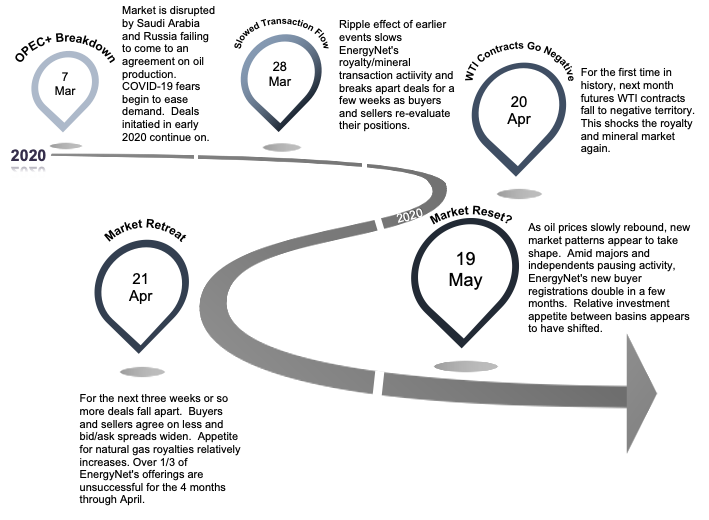
Therefore, it is reasonable to suggest EnergyNet represents an excellent glimpse into the royalty and mineral market at large (no – I did not get paid to say that). In the course of my correspondence with Chris Atherton, several interesting market movements began to emerge. After the March 7th launching point with the OPEC+ impasse, EnergyNet’s platform has taken several twists and turns. Both demand and supply shocks have squeezed the market and values have plummeted. The timeline below chronicles this: [caption id="attachment_31848" align="alignnone" width="709"]Source: EnergyNet[/caption]

Observations

The fact that valuations have decreased is not news at this point, but what is interesting is that this environment has changed a lot of things along the way:

  • Buyer Pool – Currently EnergyNet has 33,000 buyers vs. 7,000 sellers on its platform. Buyer registrations have skyrocketed in the past few months. New investors are seeking what they perceive as a potential good deal. At the same time, many of the larger participants on their platform (majors and independent producers) have paused much of their selling activity. Possibilities for this hiatus can vary. Changing economics are certainly a factor, but sellers also may be concerned about entering restructuring negotiations and do not want to be divesting assets in the time leading up to what may eventually be a bankruptcy filing.
  • Liquidity and Valuations – Although typically not falling as far as upstream producers, valuations for minerals and royalties have plummeted. Deals, even in quality basins, are trading for half of what they were a few months ago. Liquidity has been a part of this. As buyers and sellers wallow in uncertainty, more and more deals are either terminating or not happening at all.

[caption id="attachment_31849" align="alignnone" width="640"]Source: EnergyNet [/caption]
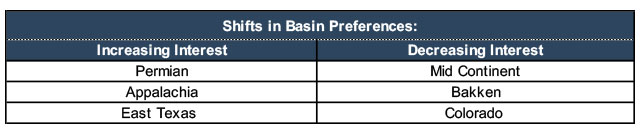
  • Basin Preferences – During this time, a previously unexpected occurrence has happened: gas assets are considered a more “tradeable” investment. Said Atherton: “With gas in the proverbial doghouse, buyers are becoming more attracted to its relative stability. Sellers have noticed this too and are more reticent to trade. The transaction volume is still thin, but interestingly, the rationale has shifted.” This has led to an uptick in Appalachian and East Texas interest. Colorado has lost favor, as much due to its changing regulatory climate as commodity prices. The Bakken has had decreasing interest as well with its higher breakeven prices and transportation issues.
[caption id="attachment_31850" align="alignnone" width="640"]Source: EnergyNet [/caption]

Takeaways

“We are going to have a different market coming out of this.” says Atherton. What exactly that market will look like is another question. Speaking of questions, what will drilling activity look like going forward? How might the relationship between the mineral owner and operator change? It is possible that litigations between royalty owners and operators will pick up?

Arguably, the most pertinent question above all is this: How will horizontal wells respond to being shut-in? This is an experiment that has never been tried before. Nobody knows how the wells may or may not respond when the spigots get re-opened at some future point. This uncertainty is part of why values are so depressed right now. The answer, whenever it comes, could be the lynchpin to what royalty and mineral valuations will look like in the future.


Originally appeared on Forbes.com.

Continue Reading

EP Second Quarter 2026 Permian Basin
E&P Second Quarter 2026

Region Focus: Permian Basin

The Permian Basin continued to demonstrate its resilience in the twelve-month period through June 30, 2026 (the review period). Despite a modest decline in rig counts, production reached new highs as operators continued to emphasize capital discipline, drilling efficiencies, and productivity improvements. Heightened geopolitical tensions introduced considerably greater volatility into commodity markets during the latter portion of the review period, yet oil prices ended above year-earlier levels and Permian public companies posted strong stock price appreciation. While basin operators continue to balance disciplined capital allocation with long-term production growth, the Permian remains the nation’s premier oil-producing basin and continues to demonstrate its ability to adapt to changing market conditions.
Just Released: Q2 2026 Oil & Gas Industry Newsletter
Regional Focus: The Permian BasinThe Permian continued to demonstrate its resilience in the twelve-month period through June 30, 2026 (the review period). Despite a modest decline in rig counts, production reached new highs as operators continued to emphasize capital discipline, drilling efficiencies, and productivity improvements. Heightened geopolitical tensions introduced considerably greater volatility into commodity markets during the latter portion of the review period, yet oil prices ended above year-earlier levels and Permian public companies posted strong stock price appreciation. While basin operators continue to balance disciplined capital allocation with long-term production growth, the Permian remains the nation’s premier oil-producing basin and continues to demonstrate its ability to adapt to changing market conditions.
Bryce Erickson Discusses the Changing Economics of Upstream Asset Valuations with Hart Energy
Mercer Capital’s Energy Industry Team Leader, Bryce Erickson, ASA, MRICS, recently shared his perspective on upstream asset valuations in two features published by Hart Energy.Bryce joined other industry professionals at Hart Energy’s 2026 Energy Capital Conference, where he participated in the panel, “Asset Valuations in a High-Price World: Separating Signal from Noise.” The discussion examined how investors, lenders, and operators are assessing energy assets amid elevated commodity prices, increasingly scarce drilling inventory, and continued consolidation across the upstream sector.Markets Turn Their Attention to Tier 2 and Tier 3 AcreageIn a video interview with Hart Energy’s Chris Mathews, Bryce discusses how the scarcity of available Tier 1 acreage is directing greater attention toward Tier 2 and Tier 3 opportunities.As the inventory of premium drilling locations becomes increasingly concentrated, buyers are looking more closely at assets that may previously have received less attention. Higher commodity prices and continued improvements in drilling and completion techniques can make some of these locations more economically attractive. However, broad acreage classifications tell only part of the story. Investors must still examine the specific geology, operating costs, development plans, decline expectations, and risks associated with each asset. Bryce’s comments underscore the importance of disciplined, asset-specific underwriting as competition expands beyond traditionally defined core acreage.How the “Last Cheap Barrels” May Influence BidsHart Energy’s Lisa El-Amin further explores the relationship between inventory scarcity and upstream deal values in “How the Last Cheap Barrels May Be Shaping Today’s Bids” (subscription required).The article considers how competition is shifting toward a diminishing pool of drilling locations capable of generating attractive returns at approximately $50 oil, with much of that inventory concentrated in the Permian Basin. As low-breakeven locations become harder to acquire or replace, buyers may be willing to place greater value on assets offering durable inventory, favorable cost structures, and a long development runway. The result is an M&A market in which bids are increasingly influenced by the quality and scarcity of future drilling opportunities—not simply current production or near-term commodity prices.Valuation ImplicationsTogether, the two Hart Energy features highlight that asset quality and inventory durability are becoming more visible, and potentially more valuable, as the shale sector matures.Determining how these factors affect a particular company or asset requires careful analysis of its reserves, development inventory, cost structure, operating assumptions, and expected cash flows. Mercer Capital has assisted clients with a wide range of valuation needs in the upstream oil and gas industry across both conventional and unconventional plays in North America and around the world. Contact a Mercer Capital professional to discuss your valuation needs in confidence.

Cart

Your cart is empty