Corporate Valuation, Oil & Gas
cover-image-9.52.13-AM.jpg

April 8, 2022

Private Oil Company Values Are Readying For Take Off: While Publics Remain On Runway

As the term “energy security” comes back into the public lexicon, the values of U.S. oil companies are rising. This comes at the delight of some and chagrin of others. Regardless, it represents a foreshadowing of a potential longer-term cycle; whereby U.S. oil production being able to meet energy demands will be increasingly important. Many believe the U.S. is now the world’s “swing” producer (although John Hess disagrees), and it is not due to government action (or inaction). Biden’s third SPR release in the last six months is largely symbolic and more of a political gesture than a meaningful macro-economic needle mover. Demand and supply were drifting apart before Russia’s invasion of Ukraine and this geopolitical dynamic has only widened that gap. The market participants best positioned to seize upon this unexpected gap are private U.S. operators.

The current price expectations of oil make a lot of reserves economically attractive. The rate of return on capital deployed for drilling is going to (if not already) outstrip the demand for other capital deployment options such as dividends or debt repayment. However, most U.S. public companies are not shifting their strategies.

Domestic Dynamics (Not Russia’s) Keeping Public Valuations Relatively Grounded

As I have written before, shareholders have demanded returns from oil companies for years now in forms other than production growth. Oil company valuation in its fundamental form is a function of the present value of future cash flows. Therefore, if capital available today is best served in drilling more wells tomorrow, then production growth is the most efficient path to a higher value. At historical prices from a year ago, the decision to return more capital to shareholders (as opposed to deploying it in capex) made sense. It doesn’t now. However, public companies have yet to change the courses they’ve been setting for the past several years. That’s partly why the public sector (using XOP as a proxy) only rose 62% in the past year while prices nearly doubled.
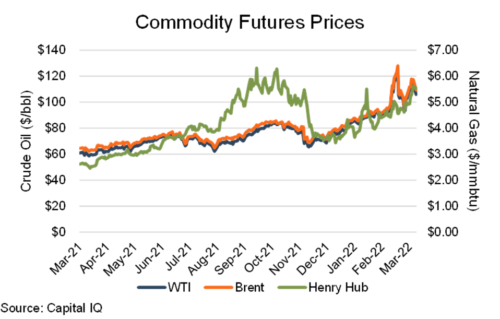
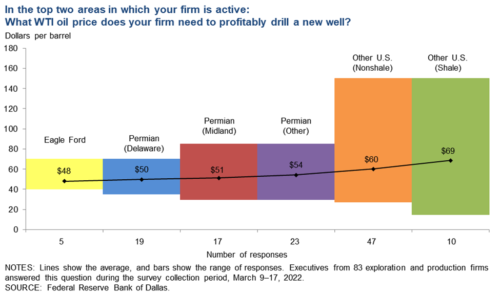
Demand is strong with the anticipated depletion of Russian oil on world markets. U.S. capital budgets would have to quadruple by the end of 2024 for shale to replace Russian oil exports to continental Europe according to Wells Fargo. In addition, break even prices in most basins for new wells are still around where they were a year ago according to the Dallas Fed Survey. That cost is going up and will continue to, but there is still lots of room for profitability at over $100 per barrel. Also, as I have mentioned before as well, DUC wells continue to shrink. In summary, there are a lot of signals to public companies to “drill baby drill”, yet they aren’t. To be fair there are some caution signs on the horizon that should be considered and are baked into these public valuations. First, the futures curve is still backwardated, meaning that prices are anticipated to fall in the future (not rise). However, even the long-term NYMEX curveis still over $70 in four years, which is still profitable for a lot of reserve inventory. Second, new wells drilled today appear to be less productive. The EIA’s drilling productivity report shows that new well production per rig is going down (although they acknowledge that metric is “unstable” right now). Lastly oilfield services markets have become very tight: “ Labor and equipment shortages, along with inflation in oil country tubular goods and shortages of key equipment and materials, will limit growth in our business and U.S. oil production. In particular, truck drivers are in critical shortage, perhaps due to competition from delivery services.” – Dallas Fed Survey Respondent
Private Companies Take To The Front

Enter the private oil companies. If forecasts suggest the U.S. can add between 600,000 and 800,000 barrels of oil by the end of the year (EIA says this can be 760,000) then the path to get there will be through the drill bits of private and private equity backed producers. According to an Enverus Report cited by Hart Energy, these types of operators have assumed the vast majority of new rig activity since the summer of 2020. With fewer external concerns, less ESG pressure, and lower regulatory costs, the private sector’s flexibility and nimbleness allow it to surge in front in search of the growth that the fundamental economics suggest is lurking.

As an example, Mercer Capital’s latest merger and acquisition discussion focused on the Eagle Ford shale suggested that the market have signaled to potential buyers that the time was right to increase their footprint in southern Texas while conversely providing for an exit for sellers who could either capitalize on the prospect of a continued upswing in energy prices or redeploy capital elsewhere.

Whatever the exact incentives may have been that drove the M&A activity, the result was ten deals closed, mostly by private buyers or small-cap producers such as SilverBow Resources.
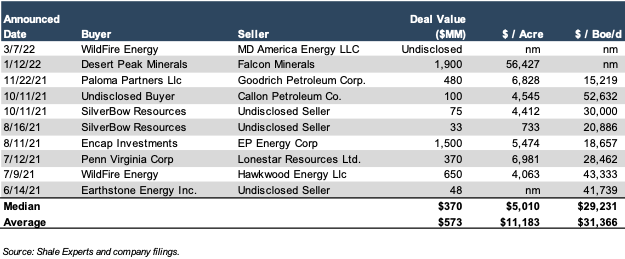
These implied valuation metrics in the table above suggest that there are outsized returns to be made on incremental new wells at the present time. Lots of eyes are turning to watch U.S. production, not only in the Permian, but South Texas, Oklahoma, and the Bakken as well. What they are seeing right now is public companies remaining grounded with their capital, while private companies could be leaving them behind - and quickly.


Originally appeared on Forbes.com.

Continue Reading

Defying the Cycle: Haynesville Production Strength in a Shifting Gas Market
Haynesville shale production defied broader market softness in 2025, leading major U.S. basins with double-digit year-over-year growth despite heightened volatility and sub-cycle drilling activity. Efficiency gains, DUC drawdowns, and Gulf Coast demand dynamics allowed operators to sustain output even as natural gas prices fluctuated sharply.
Haynesville Shale M&A Update: 2025 in Review
Key TakeawaysHaynesville remains a strategic LNG-linked basin. 2025 transactions emphasized long-duration natural gas exposure and proximity to Gulf Coast export infrastructure, reinforcing the basin’s importance in meeting global LNG demand.International utilities drove much of the activity. Japanese power and gas companies pursued direct upstream ownership, signaling a shift from traditional offtake agreements toward greater control over U.S. gas supply.M&A was selective but meaningful in scale and intent. While overall deal volume was limited, announced transactions and reported negotiations reflected deliberate, long-term positioning rather than opportunistic shale consolidation.OverviewM&A activity in the Haynesville Shale during 2025 was marked by strategic, LNG-linked transactions and renewed international investor interest in U.S. natural gas assets. While investors remained selective relative to prior shale upcycles, transactions that did occur reflected a clear pattern: buyers focused on long-duration gas exposure, scale, and proximity to Gulf Coast export markets rather than short-term development upside.Producers and capital providers increasingly refocused efforts on the Haynesville basin during the year, including raising capital to acquire both operating assets and mineral positions. This renewed attention followed a period of subdued transaction activity and underscored the basin’s continued relevance within global natural gas portfolios.Although the Haynesville did not experience the breadth of consolidation seen in some oil-weighted plays, the size, counterparties, and strategic motivations behind 2025 transactions reinforced the basin’s role as a long-term supply source for LNG-linked demand.Announced Upstream TransactionsTokyo Gas (TG Natural Resources) / ChevronIn April 2025, Tokyo Gas Co., through its U.S. joint venture TG Natural Resources, entered into an agreement to acquire a 70% interest in Chevron’s East Texas natural gas assets for $525 million. The assets include significant Haynesville exposure and were acquired through a combination of cash consideration and capital commitments.The transaction was characterized as part of Tokyo Gas’s broader strategy to secure long-term U.S. natural gas supply and expand its upstream footprint. The deal reflects a growing trend among international utilities to obtain direct exposure to U.S. shale gas through ownership interests rather than relying solely on long-term offtake contracts or third-party supply arrangements.From an M&A perspective, the transaction highlights continued willingness among major operators to monetize non-core or minority positions while retaining operational involvement, and it underscores the Haynesville’s attractiveness to buyers with a long-term, strategic view of gas demand.JERA / Williams & GEP Haynesville IIIn October 2025, JERA Co., Japan’s largest power generator, announced an agreement to acquire Haynesville shale gas production assets from Williams Companies and GEP Haynesville II, a joint venture between GeoSouthern Energy and Blackstone. The transaction was valued at approximately $1.5 billion.This acquisition marked JERA’s first direct investment in U.S. shale gas production, representing a notable expansion of the company’s upstream exposure and reinforcing JERA’s interest in securing supply from regions with strong connectivity to U.S. LNG export infrastructure.This transaction further illustrates the appeal of the Haynesville to international buyers seeking stable, scalable gas assets and highlights the role of upstream M&A as a tool for portfolio diversification among global utilities and energy companies.Reported Negotiations (Not Announced)Mitsubishi / Aethon Energy ManagementIn June 2025, Reuters reported that Mitsubishi Corp. was in discussions to acquire Aethon Energy Management, a privately held operator with substantial Haynesville production and midstream assets. The potential transaction was reported to be valued at approximately $8 billion, though Reuters emphasized that talks were ongoing and that no deal had been finalized at the time.While the transaction was not announced during 2025, the reported discussions were notable for both their scale and the identity of the potential buyer. Aethon has long been viewed as one of the largest private platforms in the Haynesville, and any transaction involving the company would represent a significant consolidation event within the basin.The reported talks underscored the depth of international interest in Haynesville-oriented platforms and highlighted the potential for large-scale transactions even in an otherwise measured M&A environment.ConclusionWhile overall deal volume remained selective, the transactions and reported negotiations in 2025 reflected sustained global interest in U.S. natural gas assets with long-term relevance. Collectively, the transactions and negotiations discussed above point to a Haynesville M&A landscape driven less by opportunistic consolidation and more by deliberate, long-term positioning. As global energy portfolios continue to evolve, the Haynesville basin remains a focal point for strategic investment, particularly for buyers seeking exposure tied to U.S. natural gas supply and LNG export linkages.
Mineral Aggregator Valuation Multiples Study Released-Data as of 06-11-2025
Mineral Aggregator Valuation Multiples Study Released

With Market Data as of June 11, 2025

Mercer Capital has thoughtfully analyzed the corporate and capital structures of the publicly traded mineral aggregators to derive meaningful indications of enterprise value. We have also calculated valuation multiples based on a variety of metrics, including distributions and reserves, as well as earnings and production on both a historical and forward-looking basis.

Cart

Your cart is empty