Corporate Valuation, Oil & Gas
Energy-2021-2022-shutterstock_2053482815.jpg

January 12, 2022

What a Difference a Year Makes: Part I

Key Aspects of the Energy Industry in 2021

The close of 2021 marked the end of a long upward march for the energy sector.  With oil closing up the year at $75 (compared to $48 at the end of 2020) and gas at nearly $4 per mmbtu (compared to $2.36 at the end of 2020), the commodity markets driving the energy sector were much more economically attractive to producers.  Stock indices such as the XLE, which primarily tracks the broader energy sector, was up over 50% for 2021 and was by far the best performing sector.  Rig counts, although with more cautious deployment than in the past, rose along with prices and increased by 235 for the year (586 at year-end 2021 vs. 351 at year-end 2020).  Crude production rose to 11.7 million bbls/day with room to grow as inventories were about 7% below the five-year average.  OPEC+ also has signaled it will continue its scheduled output growth.

All of this growth is coming alongside the ascent of wind and solar.  The Omicron variant raises uncertainty about the markets and took a cut into prices in December.  However, while COVID may dampen demand growth, most analysts believe it won’t stop it.
Prices & Production

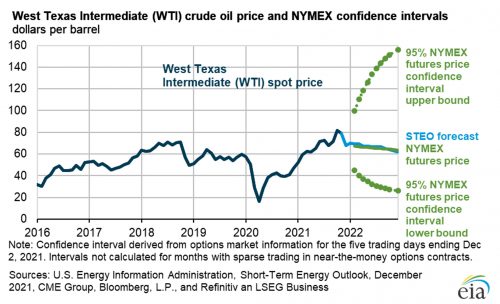
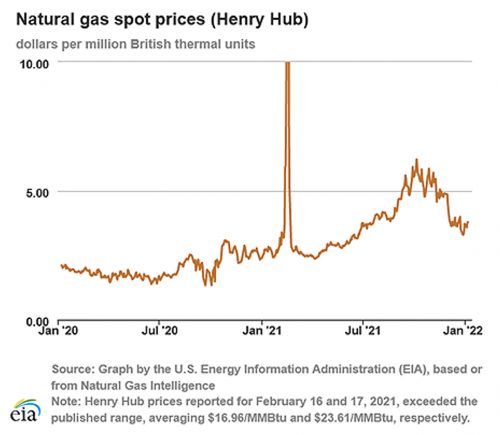
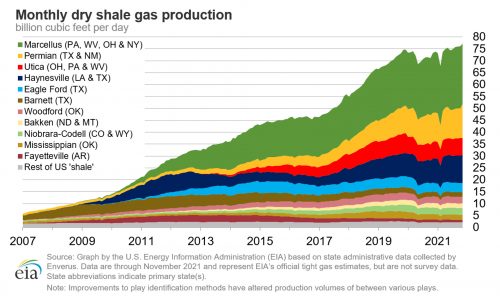
“We expect Brent prices will average $71/b in December and $73/b in the first quarter of 2022 (1Q22). For 2022 as a whole, we expect that growth in production from OPEC+, of U.S. tight oil, and from other non-OPEC countries will outpace slowing growth in global oil consumption, especially in light of renewed concerns about COVID-19 variants. We expect Brent prices will remain near current levels in 2022, averaging $70/b.” – EIA – December 7, 2021 The steady climb of prices in 2021 reflected a rebound in demand that exceeded earlier expectations.  It also reflected a more cautious approach to bringing more production online and the curtailed capital environment as well.  However, that may not last much longer as more estimates accumulate that suggest capital spending for upstream producers will pick up in 2022. Perhaps even more impactful for upstream producers has been the rise of natural gas prices in 2021 as well.  After languishing for so long, prices not only exceeded  $3.00 per mmbtu they rose to over $5.00 for a brief period. These price levels have been unseen for many years and are anticipated to remain near $4.00 mmbtu in 2022, however, volatility is expected to be higher as well.  Production has increased, particularly in Appalachia and has now reached pre-pandemic levels. Perhaps in 2022 the restraint will come off on production efforts more than the past few years.  According to the Dallas Fed Energy Survey 75% of companies surveyed plan to spend more in 2022 vs. 49% in the same survey given at the end of 2020.  Cowen & Co. says the E&P companies it tracks plan to spend 13% more in 2022 vs. 2021 after significant drops of 48% in 2020 and 12% in 2019.  Much of this growth vigor is fueled by smaller E&P companies that have struggled so much in recent years.  However, there is still a lot of uncertainty with inflation and other issues which are keeping larger companies more conservative with their capital as reflected in comments like this: “Supply-chain issues continue to create logistical challenges, and it is difficult to plan and/or coordinate upstream operational activity.  Labor shortages have contributed to this issue as well.  Pandemic worries are definitely impacting the oil demand side, with resultant uncertainty with respect to commodity pricing and supply forecasting.” – Dallas Fed Respondent For larger companies, debt reduction and quality asset acquisitions are a higher priority as opposed to riding the drill bit.
LNG Delays - But Rest Assured, It Is Coming

One of the outlets for production growth has been the development of LNG facilities along the Gulf Coast.  At the end of 2020, there were five (5) facilities under construction.  Unfortunately, as of the end of 2021, only one of those terminals got finished.  There are still four (4) terminals under construction and no other approved terminals (there are 13 of those) have gotten going as well.  This has inhibited production growth for natural gas as LNG is a major global demand growth outlet for U.S. production.  The pandemic has delayed bringing online over eight (8) Bcfd of processing capacity.  The Biden administration has also not made it any easier either.  However, more should come online in 2022 which should help continue the growth trend for gas in the U.S.

Regulatory Prognostications

Speaking of the Biden administration, last year around the election we were discussing some potential policy and impacts of a Biden administration.  Several of those potentials have come to pass such as permit rejections, the stoppage of the Dakota Access Pipeline, and a decline in drilling on federal lands.

One thing that has not borne out is the projection by some of a decline in oil production of as much as two million b/d by 2025.  Production has held strong so far as prices increased in 2021.  Considering the volatility in both regulation and markets, that’s pretty good in the prediction department.

Continue Reading

Defying the Cycle: Haynesville Production Strength in a Shifting Gas Market
Haynesville shale production defied broader market softness in 2025, leading major U.S. basins with double-digit year-over-year growth despite heightened volatility and sub-cycle drilling activity. Efficiency gains, DUC drawdowns, and Gulf Coast demand dynamics allowed operators to sustain output even as natural gas prices fluctuated sharply.
Haynesville Shale M&A Update: 2025 in Review
Key TakeawaysHaynesville remains a strategic LNG-linked basin. 2025 transactions emphasized long-duration natural gas exposure and proximity to Gulf Coast export infrastructure, reinforcing the basin’s importance in meeting global LNG demand.International utilities drove much of the activity. Japanese power and gas companies pursued direct upstream ownership, signaling a shift from traditional offtake agreements toward greater control over U.S. gas supply.M&A was selective but meaningful in scale and intent. While overall deal volume was limited, announced transactions and reported negotiations reflected deliberate, long-term positioning rather than opportunistic shale consolidation.OverviewM&A activity in the Haynesville Shale during 2025 was marked by strategic, LNG-linked transactions and renewed international investor interest in U.S. natural gas assets. While investors remained selective relative to prior shale upcycles, transactions that did occur reflected a clear pattern: buyers focused on long-duration gas exposure, scale, and proximity to Gulf Coast export markets rather than short-term development upside.Producers and capital providers increasingly refocused efforts on the Haynesville basin during the year, including raising capital to acquire both operating assets and mineral positions. This renewed attention followed a period of subdued transaction activity and underscored the basin’s continued relevance within global natural gas portfolios.Although the Haynesville did not experience the breadth of consolidation seen in some oil-weighted plays, the size, counterparties, and strategic motivations behind 2025 transactions reinforced the basin’s role as a long-term supply source for LNG-linked demand.Announced Upstream TransactionsTokyo Gas (TG Natural Resources) / ChevronIn April 2025, Tokyo Gas Co., through its U.S. joint venture TG Natural Resources, entered into an agreement to acquire a 70% interest in Chevron’s East Texas natural gas assets for $525 million. The assets include significant Haynesville exposure and were acquired through a combination of cash consideration and capital commitments.The transaction was characterized as part of Tokyo Gas’s broader strategy to secure long-term U.S. natural gas supply and expand its upstream footprint. The deal reflects a growing trend among international utilities to obtain direct exposure to U.S. shale gas through ownership interests rather than relying solely on long-term offtake contracts or third-party supply arrangements.From an M&A perspective, the transaction highlights continued willingness among major operators to monetize non-core or minority positions while retaining operational involvement, and it underscores the Haynesville’s attractiveness to buyers with a long-term, strategic view of gas demand.JERA / Williams & GEP Haynesville IIIn October 2025, JERA Co., Japan’s largest power generator, announced an agreement to acquire Haynesville shale gas production assets from Williams Companies and GEP Haynesville II, a joint venture between GeoSouthern Energy and Blackstone. The transaction was valued at approximately $1.5 billion.This acquisition marked JERA’s first direct investment in U.S. shale gas production, representing a notable expansion of the company’s upstream exposure and reinforcing JERA’s interest in securing supply from regions with strong connectivity to U.S. LNG export infrastructure.This transaction further illustrates the appeal of the Haynesville to international buyers seeking stable, scalable gas assets and highlights the role of upstream M&A as a tool for portfolio diversification among global utilities and energy companies.Reported Negotiations (Not Announced)Mitsubishi / Aethon Energy ManagementIn June 2025, Reuters reported that Mitsubishi Corp. was in discussions to acquire Aethon Energy Management, a privately held operator with substantial Haynesville production and midstream assets. The potential transaction was reported to be valued at approximately $8 billion, though Reuters emphasized that talks were ongoing and that no deal had been finalized at the time.While the transaction was not announced during 2025, the reported discussions were notable for both their scale and the identity of the potential buyer. Aethon has long been viewed as one of the largest private platforms in the Haynesville, and any transaction involving the company would represent a significant consolidation event within the basin.The reported talks underscored the depth of international interest in Haynesville-oriented platforms and highlighted the potential for large-scale transactions even in an otherwise measured M&A environment.ConclusionWhile overall deal volume remained selective, the transactions and reported negotiations in 2025 reflected sustained global interest in U.S. natural gas assets with long-term relevance. Collectively, the transactions and negotiations discussed above point to a Haynesville M&A landscape driven less by opportunistic consolidation and more by deliberate, long-term positioning. As global energy portfolios continue to evolve, the Haynesville basin remains a focal point for strategic investment, particularly for buyers seeking exposure tied to U.S. natural gas supply and LNG export linkages.
Mineral Aggregator Valuation Multiples Study Released-Data as of 06-11-2025
Mineral Aggregator Valuation Multiples Study Released

With Market Data as of June 11, 2025

Mercer Capital has thoughtfully analyzed the corporate and capital structures of the publicly traded mineral aggregators to derive meaningful indications of enterprise value. We have also calculated valuation multiples based on a variety of metrics, including distributions and reserves, as well as earnings and production on both a historical and forward-looking basis.

Cart

Your cart is empty