Corporate Valuation, Oil & Gas

May 17, 2019

Royalty and Mineral Value Proposition Highlights Otherwise Underperforming Energy Sector

The burgeoning mineral market is leading the way for an energy sector that has lagged in returns for several years now.  This was one of the themes from the DUG Permian Basin Conference in Fort Worth last month.  Among the discussion, presenters including Scott Noble, CEO of Noble Royalties and Rusty Shepherd of RBC Capital Markets highlighted the ascension of the estimated $400 to $600 billion onshore mineral market in the U.S., depending on who’s doing the estimating.

The interest in the segment has been undergirded by the attractive cash returns coupled with fewer risks and burdens.

The interest in the segment has been undergirded by the attractive cash returns coupled with fewer liability risks, operating risks, and expense burdens.  In addition, royalty owners retain ownership rights to perpetuity.  These characteristics of royalty and mineral plays have drawn investors in as compared to the market’s negative response to upstream management teams merely seeking to beef up the size of their reserve reports.

Overall, the energy market’s returns have been subpar.  As a sector, energy has lagged all other major sectors over the past several years. In 2018, the returns were again at the bottom of the heap.
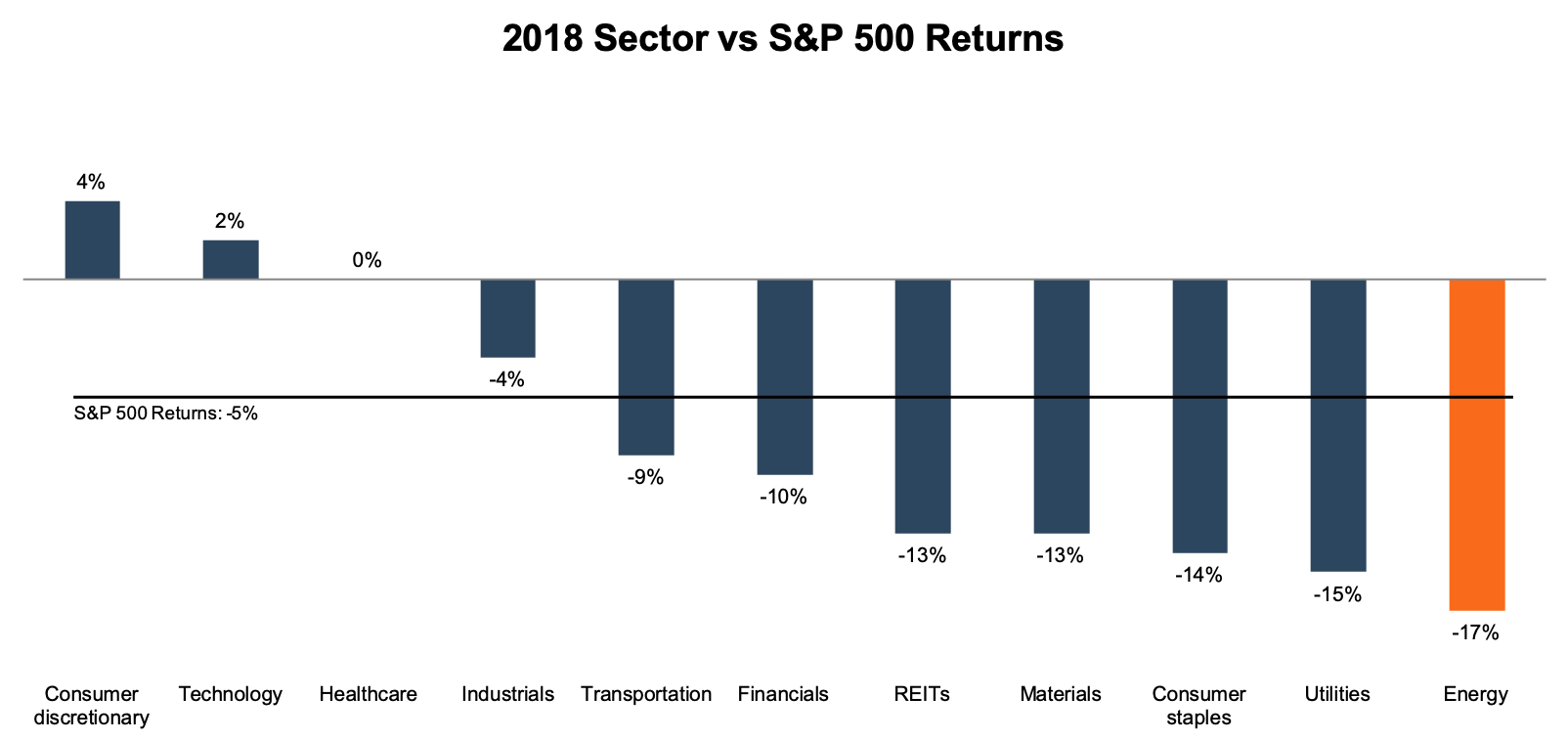
[caption id="attachment_26449" align="aligncenter" width="940"]Source: Company filings and FactSet[/caption]

However, there is an energy sub-sector that has been an emerging bright spot: public mineral aggregators. Brigham Minerals (MNRL) is the latest mineral acquisition company to go public following a trend of other large mineral rights and royalty companies to IPO in recent years. Brigham began trading on April 18 at $18.00 per share on the New York Stock Exchange.  Brigham became the fifth mineral company to go public since 2014, far outpacing the energy sector in general.
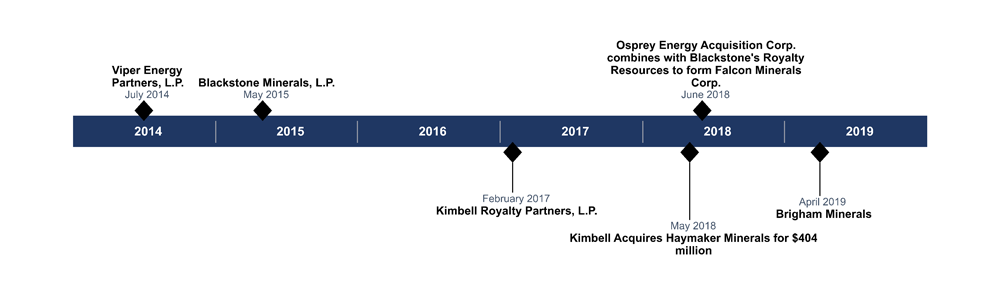
[caption id="attachment_26456" align="aligncenter" width="885"]Source: Company filings and Brigham S-1[/caption]

The attraction and growing appetite for mineral aggregators lies in its asset level economics.  Several presenters at the conference touched on various factors that are driving returns and valuations.  While current producing wells bring in monthly cash flow, they also demand the lowest returns.  According to B.J. Brandenberger of Ten Oaks Energy Advisors, producing minerals are commonly purchased on expected returns of 8% to 10%, whereby DUC wells and permitted wells currently have expected returns around 12% and 15%.  Undeveloped properties are often valued at over 20% expected return profiles depending on various factors such as the hydrocarbon producing layers in the ground (or “benches” as the industry sometimes calls them).  Most of the uncertainty and intrigue has to do with undeveloped properties.  The reasons that expected returns are so much higher than producing properties lies in unknowns such as drilling timing, operator quality and expertise, production assumptions, and pricing differentials to name a few.

The mineral segment is representing an economic bright spot in a sector that, while improving, has resided in the dark from a stock return perspective.

This kind of uncertainty comes with the opportunity for outsized returns resulting in market attraction.  According to Oil and Gas Investors reckoning, there were 12 companies listed in their mineral company directory in 2015.  In 2019, this has ballooned to 140.

Public momentum has grown as demand for these investment vehicles is high. Given most new entrants in the market are private equity funded with exit expectations in upcoming years, the chances are high that we see an increase in the number of IPOs from mineral aggregators in the future compared to upstream and E&P companies.  Time will tell.  In the meantime, the mineral segment is representing an economic bright spot in a sector that, while improving, has resided in the dark from a stock return perspective.

Continue Reading

EP Second Quarter 2026 Permian Basin
E&P Second Quarter 2026

Region Focus: Permian Basin

The Permian Basin continued to demonstrate its resilience in the twelve-month period through June 30, 2026 (the review period). Despite a modest decline in rig counts, production reached new highs as operators continued to emphasize capital discipline, drilling efficiencies, and productivity improvements. Heightened geopolitical tensions introduced considerably greater volatility into commodity markets during the latter portion of the review period, yet oil prices ended above year-earlier levels and Permian public companies posted strong stock price appreciation. While basin operators continue to balance disciplined capital allocation with long-term production growth, the Permian remains the nation’s premier oil-producing basin and continues to demonstrate its ability to adapt to changing market conditions.
Just Released: Q2 2026 Oil & Gas Industry Newsletter
Regional Focus: The Permian BasinThe Permian continued to demonstrate its resilience in the twelve-month period through June 30, 2026 (the review period). Despite a modest decline in rig counts, production reached new highs as operators continued to emphasize capital discipline, drilling efficiencies, and productivity improvements. Heightened geopolitical tensions introduced considerably greater volatility into commodity markets during the latter portion of the review period, yet oil prices ended above year-earlier levels and Permian public companies posted strong stock price appreciation. While basin operators continue to balance disciplined capital allocation with long-term production growth, the Permian remains the nation’s premier oil-producing basin and continues to demonstrate its ability to adapt to changing market conditions.
Bryce Erickson Discusses the Changing Economics of Upstream Asset Valuations with Hart Energy
Mercer Capital’s Energy Industry Team Leader, Bryce Erickson, ASA, MRICS, recently shared his perspective on upstream asset valuations in two features published by Hart Energy.Bryce joined other industry professionals at Hart Energy’s 2026 Energy Capital Conference, where he participated in the panel, “Asset Valuations in a High-Price World: Separating Signal from Noise.” The discussion examined how investors, lenders, and operators are assessing energy assets amid elevated commodity prices, increasingly scarce drilling inventory, and continued consolidation across the upstream sector.Markets Turn Their Attention to Tier 2 and Tier 3 AcreageIn a video interview with Hart Energy’s Chris Mathews, Bryce discusses how the scarcity of available Tier 1 acreage is directing greater attention toward Tier 2 and Tier 3 opportunities.As the inventory of premium drilling locations becomes increasingly concentrated, buyers are looking more closely at assets that may previously have received less attention. Higher commodity prices and continued improvements in drilling and completion techniques can make some of these locations more economically attractive. However, broad acreage classifications tell only part of the story. Investors must still examine the specific geology, operating costs, development plans, decline expectations, and risks associated with each asset. Bryce’s comments underscore the importance of disciplined, asset-specific underwriting as competition expands beyond traditionally defined core acreage.How the “Last Cheap Barrels” May Influence BidsHart Energy’s Lisa El-Amin further explores the relationship between inventory scarcity and upstream deal values in “How the Last Cheap Barrels May Be Shaping Today’s Bids” (subscription required).The article considers how competition is shifting toward a diminishing pool of drilling locations capable of generating attractive returns at approximately $50 oil, with much of that inventory concentrated in the Permian Basin. As low-breakeven locations become harder to acquire or replace, buyers may be willing to place greater value on assets offering durable inventory, favorable cost structures, and a long development runway. The result is an M&A market in which bids are increasingly influenced by the quality and scarcity of future drilling opportunities—not simply current production or near-term commodity prices.Valuation ImplicationsTogether, the two Hart Energy features highlight that asset quality and inventory durability are becoming more visible, and potentially more valuable, as the shale sector matures.Determining how these factors affect a particular company or asset requires careful analysis of its reserves, development inventory, cost structure, operating assumptions, and expected cash flows. Mercer Capital has assisted clients with a wide range of valuation needs in the upstream oil and gas industry across both conventional and unconventional plays in North America and around the world. Contact a Mercer Capital professional to discuss your valuation needs in confidence.

Cart

Your cart is empty