On June 1, 2026, FedEx Freight (FDXF) was spun out from the parent company FedEx (FDX). FedEx distributed 80.1% of the outstanding shares of FDXF to the holders of FedEx stock; FedEx retained theh remaining 19.9% interest. FedEx anticipates using those shares within the next two years to repay FDX debt, to make distributions to FDX shareholders, or to exchange for FDX shares. Before the spin-off, the markets had no choice but to value the parcel/express and LTL businesses lines together. After the spin, the market could evaluate each of the resulting companies against separate public peers. The FedEx Freight separation provides a useful case study in how business mix, profitability, growth expectations, and capital structures influence valuation multiples within the transportation industry.
Note: This information uses only information through June 30, 2026. With only one month of post-spin trading history, this analysis represents an initial market assessment, rather than a settled valuation conclusion. Stay tuned for future articles that incorporate more data.
Following the spin-off, FDX is essentially an integrated parcel, express, air freight, and logistics entity. Its natural comps are UPS and DHL. FDXF is an LTL trucking company.
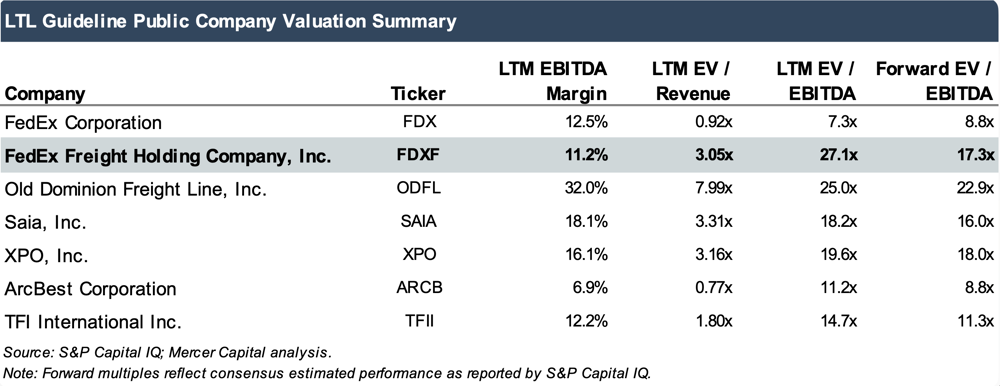
Its natural peer group includes Old Dominion Freight Line (ODFL), Saia (SAIA), XPO, ArcBest Corporation (ARCB), and TFI International (TFII).
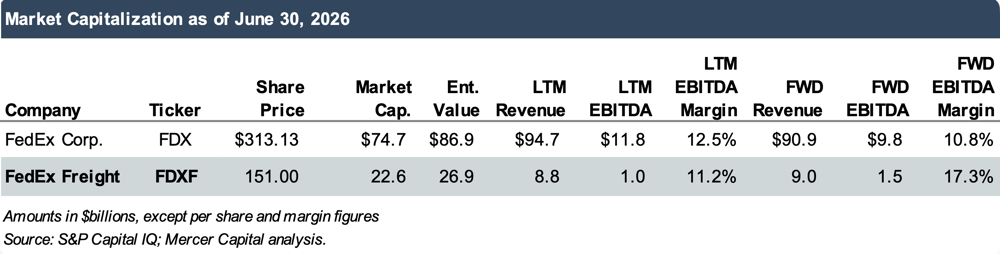
The first table summarizes the market capitalizations of FDX and FDXF as of June 30, 2026.
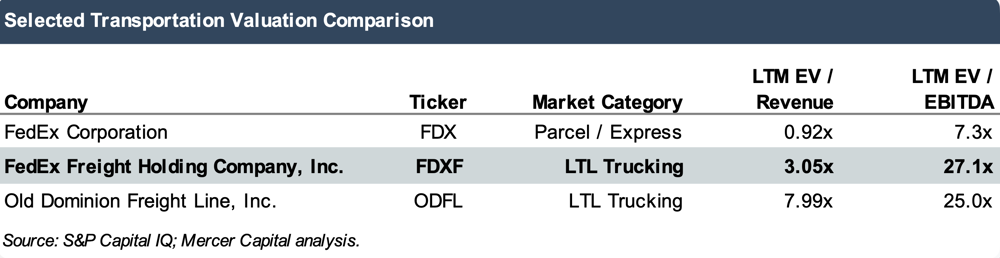
The second and third table summarizes the valuations of FDX and FDXF as of June 30, 2026. The same corporate family resulted in two siblings with wildly different multiples.
However, these headline multiples require context. Consensus estimates anticipate significantly higher EBITDA for FDXF over the forward period. As a result, FDXF's current enterprise value appears particularly high relative to its trailing earnings base, with its EV/EBITDA multiple declining from 27.1x on an LTM basis to 17.3x on a forward basis. This illustrates a key valuation concept: multiples are not meaningful without understanding the denominator to which they are applied. FDXF does not look expensive because it has an extraordinary valuation. FDXF looks expensive because its trailing profitability is depressed relative to its projections.
Compared to its direct peer group, FDXF reports the second lowest LTM EBITDA margin among the selected companies. ODFL stands out for both its financial performance and the premium valuation reflected in the multiples. ODFL has a revenue multiple of nearly 8x, but that revenue is attached to the highest margin of the bunch. This provides evidence that higher LTL multiples are not simply due to the nature of LTLs, but rather that the market is paying for profitability. On a forward EBITDA basis, FDXF falls right in between SAIA and XPO. In other words, once anticipated earnings improvement is incorporated, the market's initial valuation of FDXF actually looks reasonably consistent with those LTL peers rather than unusually rich or cheap. The separation may allow investors to value FedEx Freight as an LTL company, but becoming an LTL pure play does not automatically make it Old Dominion. The valuation upside from here therefore depends not simply on industry classification but on whether FDXF can improve margins, utilization, service, pricing, and returns sufficiently to narrow the operating gap.
As of June 30, FDX traded at lower multiples than FDXF was achieving as of June 30, 2026. This difference illustrates the potential valuation rationale for the separation: a higher-multiple LTL operation embedded within a lower-multiple integrated transportation company may not receive the same valuation recognition it could receive independently. With only one month of trading under our belts, it is too early to conclude whether the spin-off ultimately increased aggregate shareholder value.
The FedEx separation demonstrates why transportation-company multiples cannot be applied simply on the basis of industry labels. FDX, FDXF, and ODFL all move freight, but their operating models, margins, growth expectations, capital requirements, and risks differ substantially—and so do their market valuations. FDXF's initial valuation suggests investors expect significant improvement from its current earnings base. Whether it can deliver that improvement and eventually narrow the valuation gap with the industry's premium operators will be one of the more interesting transportation valuation stories to watch.