Introduction
For many insurance agency owners, the sale or recapitalization of the business is not a clean exit. It is often a partial liquidity event: cash at closing, rollover equity in a larger platform, potential earnout payments, and continued exposure to the next private equity exit. From a wealth transfer perspective, that combination creates a difficult fact pattern. Value may be increasing quickly, but the assets often remain illiquid, complex, and difficult to value.
The insurance brokerage industry has experienced sustained consolidation over the past decade, driven by private equity capital, favorable recurring revenue characteristics, and a highly fragmented ownership base. Many agency owners have benefited from this trend through meaningful appreciation in enterprise value. However, that appreciation can create gift and estate tax planning challenges, particularly when wealth is concentrated in closely held business interests or private equity-backed ownership structures.
For insurance brokerage owners and investors, transfer tax planning is rarely just a matter of drafting the right legal documents. The effectiveness of the planning often depends on valuation: what interest is being transferred, when the transfer occurs, what information was known or knowable at the valuation date, and how the rights, restrictions, and risks associated with the interest affect fair market value.
This article discusses common gift and estate tax planning issues for insurance brokerage owners and investors, explains why valuation is central to those issues, and outlines how Mercer Capital assists business owners and their advisors in this process.
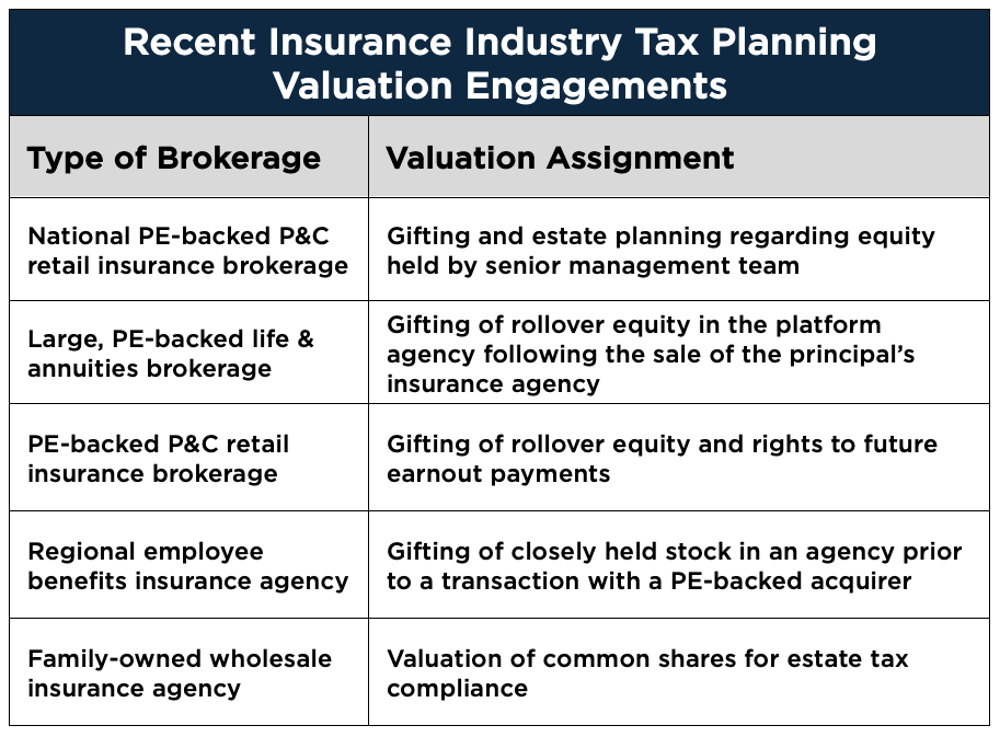
Exhibit 1
Three Common Fact Patterns
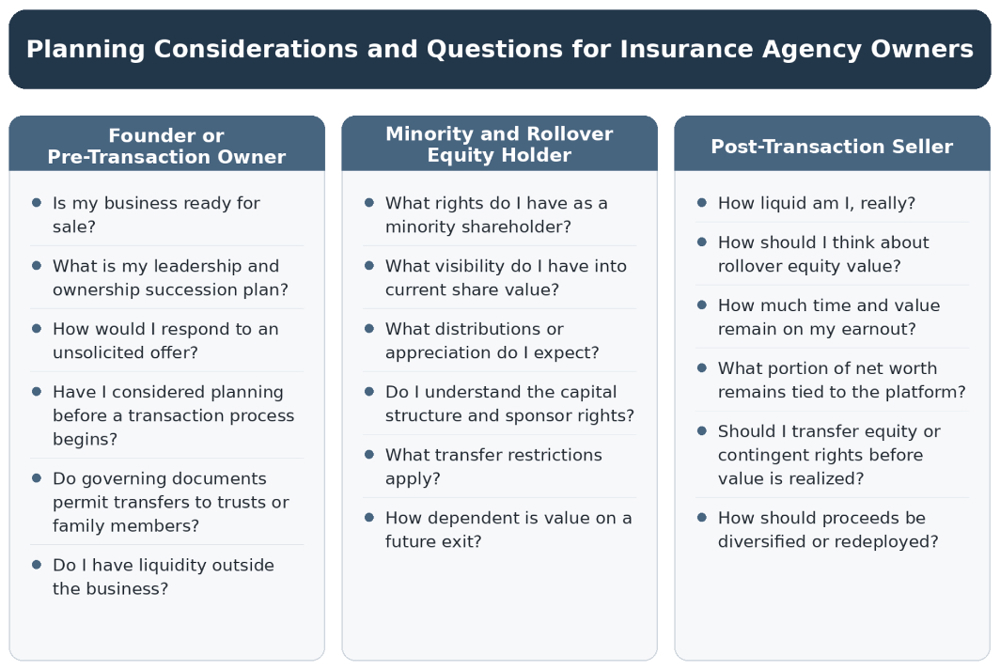
While each situation is fact-specific, many insurance brokerage owners and investors fall into one of three broad categories.
Pre-Transaction Founder or Agency Owner. A founder or majority owner may hold a controlling interest in a closely held insurance agency and may be considering sale or recapitalization. In these situations, the owner’s net worth is often highly concentrated in the business. Planning opportunities may exist before a transaction, particularly if the owner can transfer minority interests before value is more clearly established through a signed letter of intent, definitive purchase agreement, or closing. The challenge is timing. Planning too late can reduce the opportunity or increase audit risk. Planning too early may be difficult if the owner is not yet focused on estate planning or if the future transaction path remains uncertain.
Minority Investor or Rollover Equity Holder. Many agency owners roll over a portion of their sale proceeds into equity of a larger platform company. In addition, key executives, producers, or other managers may receive equity participation as part of a recapitalization or ongoing incentive program. These interests are typically non-controlling, illiquid, and subject to transfer restrictions. They may also sit within a complex private equity-sponsored capital structure that includes preferred equity, common equity, profits interests, options, or multiple tiers of holding companies. From an estate planning perspective, these interests can be attractive planning assets. They may have meaningful appreciation potential, but their lack of control and marketability may support valuation discounts.
Post-Transaction Seller. After a transaction, a seller may hold a mix of cash, rollover equity, seller notes, earnouts, or other contingent consideration. The planning focus often shifts from pre-transaction value transfer to diversification, liquidity management, and future estate growth. The post-transaction seller may have more liquidity than before, but not necessarily a simpler estate planning profile. Rollover equity and earnouts may represent substantial value, yet both can be difficult to transfer, difficult to monetize, and difficult to value.
Gift and Estate Tax Planning Issues
Timing Around Liquidity Events
One of the most consequential variables in transfer tax planning is timing. For an insurance agency owner, enterprise value may increase materially as a transaction process develops. A minority interest transferred before a sale process matures may have a lower fair market value than the same interest after a transaction is negotiated or closed.
Pre-transaction planning can therefore be powerful. By transferring interests before value is crystallized in a sale or recapitalization, an owner may shift future appreciation to family members or trusts while using less gift tax exemption.
However, transfers near a known or anticipated liquidity event can attract scrutiny. The IRS may argue that the transfer should be valued in light of the pending transaction rather than as a standalone interest. A valuation performed shortly before a transaction must therefore carefully consider what was known or reasonably knowable as of the valuation date.
The key planning point is straightforward: owners generally have more flexibility before transaction momentum builds. Once a buyer has been identified, valuation indications have been exchanged, or a letter of intent has been signed, the planning window may narrow substantially.
Concentration and Liquidity Constraints
Insurance agency owners often have substantial wealth tied up in a single operating business or related private investment interests. Even after a sale, rollover equity and contingent consideration can leave the owner exposed to the same business, the same management team, and the same sponsor-controlled exit process.
This concentration can create liquidity problems for estate tax purposes. An estate may owe tax based on the value of private business interests that cannot be readily sold. If liquidity planning is inadequate, heirs may be forced to sell assets under unfavorable conditions, borrow against assets, or negotiate with other owners or sponsors from a weak position.
Planning often focuses on gradually reducing concentration, shifting appreciation out of the estate, and ensuring that sufficient liquidity is available to meet future obligations. Life insurance, staged transfers, trust planning, and diversification of sale proceeds may all play a role.
Control, Governance, and Retained Rights
Transfers of business interests frequently involve non-controlling positions. A founder might transfer non-voting interests to a trust while retaining voting control. A rollover equity holder may own a small minority interest with no ability to control distributions, exit timing, or major corporate decisions.
These governance characteristics matter and affect both tax planning and valuation. The specific rights attached to the interest being transferred (e.g., voting rights, distribution rights, put or call rights, tag-along or drag-along provisions, transfer restrictions, redemption rights, information rights) can materially affect fair market value.
Retained rights and related structural considerations should be evaluated with qualified legal and tax advisors. While those issues are outside the scope of this article and the role of the valuation advisor, they can affect the definition of the interest being valued. For valuation purposes, the relevant question is what rights, restrictions, and economic attributes are attached to the specific interest as of the valuation date.
Use of Transfer Vehicles
Common planning vehicles include family limited partnerships, limited liability companies, and various types of grantor trusts. The appropriate vehicle depends on the owner’s objectives, family circumstances, liquidity needs, and tax profile.
From a valuation perspective, the critical issue is not merely the name of the vehicle. The key issue is what asset the vehicle receives. A valuation assignment may involve a minority interest in a standalone agency, non-voting LLC units, rollover equity in a private equity-backed holding company, profits interests, or contingent payment rights.
Each of these assets has a different risk profile, different expected cash flow characteristics, and different marketability considerations.
Earnouts and Contingent Consideration
Earnouts and contingent payments are common in insurance brokerage M&A transactions, particularly where buyer and seller expectations differ regarding post-closing growth, retention, or profitability. These structures can help bridge valuation gaps and align incentives after closing.
From a gift and estate tax perspective, contingent consideration introduces substantial complexity. Earnouts may be tied to revenue growth, EBITDA, client retention, producer retention, or other performance metrics. Some arrangements may represent purchase price consideration, while others may have compensation-like features depending on the facts and structure.
Valuing these rights requires analysis of expected future outcomes, probability of achievement, timing of payment, counterparty risk, and appropriate discount rates. The uncertainty associated with an earnout may reduce current fair market value, but that conclusion must be supported by evidence rather than asserted.
Valuation Considerations
In a transfer tax context, the relevant standard of value is generally fair market value: the price at which property would change hands between a hypothetical willing buyer and willing seller, neither under compulsion, and both having reasonable knowledge of relevant facts.
That standard requires a valuation of the actual interest being transferred, not simply the value of the company as a whole or the price implied by a strategic transaction.
Valuation of Insurance Brokerages
Insurance brokerages are typically valued using a combination of income and market approaches. The following exhibit illustrates some of the key value drivers.
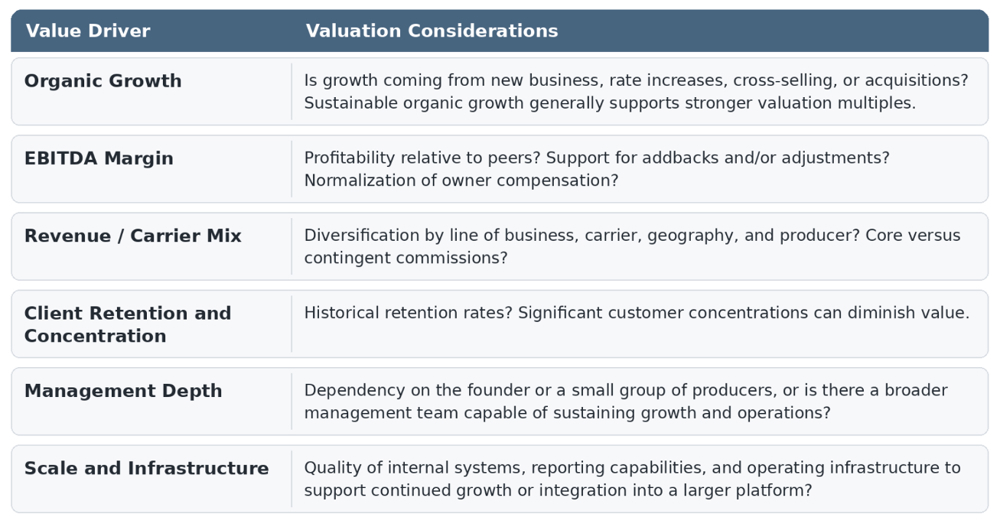
Specialty brokers, agencies in faster-growing markets, and firms with demonstrated acquisition capabilities may command higher valuation multiples. Conversely, client concentration, key person dependence, weak organic growth, or margin pressure may reduce value.
Deal Price Versus Fair Market Value
A recent transaction price can be highly relevant, but it is not automatically determinative of fair market value for gift and estate tax purposes.
This distinction is critical. Insurance brokerage transaction multiples may reflect buyer-specific synergies, scarcity value, unique sponsor investment theses, rollover expectations, or other economics that would not be applicable to the valuation of a minority interest.
For example, a private equity-backed platform may pay a premium price for a controlling interest in an agency because the buyer expects to integrate the agency into a larger platform, improve margins, expand carrier relationships, or use the acquired firm as a platform in a new geography. A hypothetical buyer of a small, non-controlling, non-marketable interest would not necessarily have access to those same benefits.
Private Equity-Sponsored Equity Structures
Rollover equity in a private equity-backed insurance platform can be especially complex. These interests may be held through multiple tiers of entities and may be subordinate to preferred equity or other sponsor-favorable structures. The primary sponsor may have preferential returns, governance control, exit control, or distribution rights that materially affect the economics available to minority holders.
In some cases, the equity being valued is not simple common equity. It may include profits interests, options, incentive units, or other securities whose value depends on future exit values and distribution waterfalls.
Depending on the structure, valuing these interests may require the use of option pricing models, scenario-based methods, or Monte Carlo simulation. The purpose of these methods is to allocate enterprise value across the capital structure in a manner consistent with the rights and priorities of each class of equity.
Discounts for Lack of Control and Marketability
Discounts for lack of control and lack of marketability are often significant issues in gift and estate tax valuations of private company interests.
A lack of control discount may be appropriate where the interest holder cannot direct operations, compel distributions, determine compensation, approve a sale, or control exit timing. A lack of marketability discount may be appropriate where the interest cannot be readily sold, is subject to transfer restrictions, or lacks an active secondary market.
The magnitude of these discounts depends on the facts and circumstances. Relevant considerations include the legal structure of the entity, rights attached to the interest, expected holding period, distribution policy, redemption provisions, transfer restrictions, information rights, and prospects for a future liquidity event.
In the insurance brokerage context, shareholder agreements and sponsor-imposed transfer restrictions are often particularly relevant. These restrictions may materially affect what a hypothetical buyer would pay for the interest.
Valuation of Earnouts and Other Contingent Rights
Earnouts should not be treated as an afterthought. For some sellers, contingent consideration may represent a meaningful portion of total transaction value.
Valuation typically requires an assessment of the probability and timing of future payments. This may involve reviewing historical financial performance, management forecasts, transaction documents, and contractual definitions of key metrics and terms. Depending on the facts, the valuation may use probability-weighted scenarios, simulation analysis, or other techniques designed to capture the range of potential outcomes.
A dollar of contingent consideration is generally not equivalent to a dollar of cash at closing.
Documentation and IRS Scrutiny
Transfer tax planning involving closely held business interests is a common area of IRS examination. In the insurance brokerage context, potential areas of focus include:
Transfers occurring near a known or anticipated liquidity event
Proper consideration of the rights, benefits, and attributes of the specific interest being valued
Appropriate comparability to guideline companies or transactions when using a market approach
Adequate support for cash flow and growth assumptions when using an income approach
Aggressive and/or unsupported application of discounts for lack of control and/or marketability
Understated values for contingent consideration
A contemporaneous, independent valuation report can provide a defensible basis for the reported value. The report should identify the subject interest, the standard of value, the valuation date, the relevant facts known or knowable at that date, the applicable valuation methods, and the reasoning supporting any discounts or adjustments.
A well-supported valuation report does not eliminate audit risk, but it may improve the taxpayer’s position. It also helps attorneys, accountants, and wealth advisors coordinate planning decisions around a shared factual and analytical record.
How Mercer Capital Advises Clients
Effective gift and estate tax planning for insurance brokerage owners requires coordination among legal, tax, wealth advisory, and valuation professionals. Mercer Capital assists business owners and their advisors by providing independent valuation analyses tailored to the specific planning context.
Before a transaction, Mercer Capital can value minority interests in closely held agencies, assess relevant market indications, and help advisors understand how timing, control, and marketability affect fair market value.
After a transaction, Mercer Capital can value rollover equity, minority interests in private equity-backed platforms, profits interests, options, and other incentive securities. These analyses often require careful review of operating agreements, shareholder agreements, distribution waterfalls, sponsor rights, and exit assumptions.
For contingent consideration, Mercer Capital can analyze earnouts, seller notes, and other deferred or performance-based payments. These assignments may involve probability-weighted scenarios, discounted cash flow analysis, or simulation-based methods.
For tax reporting and audit support, Mercer Capital provides valuation reports designed to support gift and estate tax filings and assist advisors in responding to potential IRS scrutiny.
Conclusion
Insurance brokerage owners and investors operate in an environment characterized by rapid value creation, complex transactions, and evolving ownership structures. Industry consolidation and private equity investment have created significant wealth, but that wealth is often held in assets that are illiquid, non-controlling, contingent, or embedded in complex capital structures. These factors create both opportunities and risks in the context of gift and estate tax planning.
At the center of these issues is valuation. The effectiveness of many planning strategies, and their defensibility under IRS scrutiny, depends on a rigorous, well-supported assessment of fair market value. Proactive planning, undertaken in coordination with experienced legal, tax, and valuation advisors, can help individuals manage transfer tax exposure while preserving flexibility in a dynamic industry landscape.