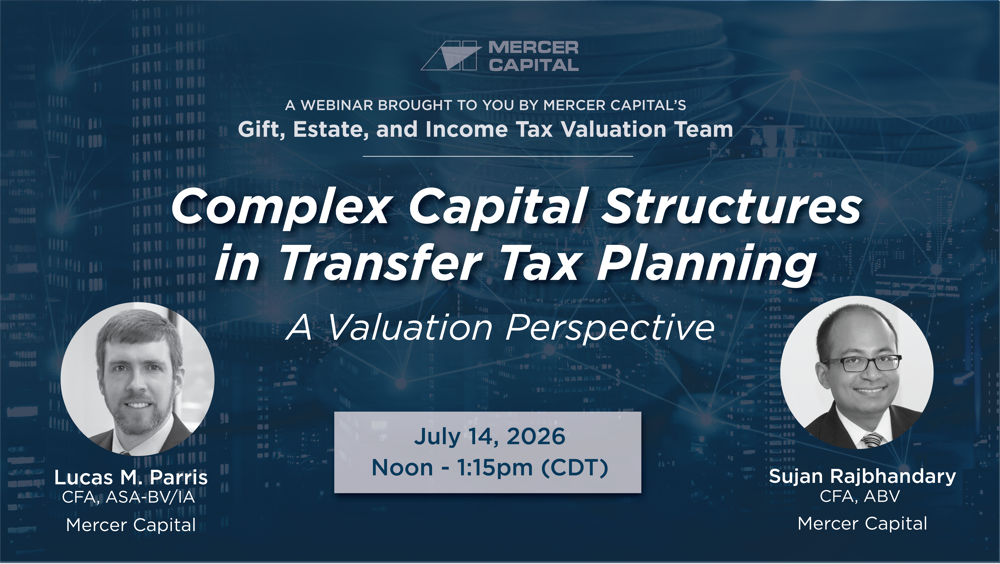
>> CLICK HERE TO VIEW WEBINAR <<
Broadcast Date: July 14, 2026
Presenters: Lucas M. Parris, CFA, ASA/IV-IA and Sujan Rajbhandary, CFA, ABV
Course Overview and Purpose
This program, for advanced estate planning attorneys and other estate planners, examines the increasing prevalence of complex capital structures in privately held businesses and the valuation challenges they present in gift, estate, and transfer tax planning.
How preferred equity, rollover equity, profits interests, earnouts, and other structured ownership interests create economically differentiated rights requiring specialized valuation analysis is discussed.
Learning Objectives
Upon completion of this program, participants will be able to:
Identify common forms of complex capital structures encountered in privately held businesses.
Explain how differing economic rights affect fair market value.
Recognize valuation methodologies used to allocate value among multiple ownership classes.
Evaluate transfer tax planning implications associated with economically differentiated ownership interests.
Content Outline
Introduction: The Rise of Complex Capital Structures
Evolution of private company capital structures
Growth of preferred equity and incentive arrangements
Influence of private equity and institutional investors
Transfer tax relevance
Increasing valuation complexity
Importance of economic rights analysis
Economic Fundamentals of Differentiated Ownership Interests
Senior and junior equity interests
Preferred equity
Common equity
Incentive equity
Allocation of risk and return
Downside protection
Future appreciation potential
Liquidity considerations
How Modern Transactions Create Multiple Economic Interests
Private equity-backed transactions
Cash consideration
Rollover equity
Earnouts
Management incentive equity
Transfer tax implications
Differing valuation characteristics
Distinct appreciation profiles
Non-pro rata economic rights
Structural Features That Drive Value
Liquidation preferences
Participation rights
Conversion features
Performance-based incentive arrangements
Valuation Considerations and Methodologies
Enterprise valuation foundation
Income approach
Market approach
Asset approach
Allocation methodologies
Scenario-Based Method (SBM)
Option Pricing Model (OPM)
Monte Carlo simulation
Key assumptions
Volatility
Holding period
Practical Planning Considerations and Conclusion
Importance of governing documents
Sensitivity of valuation conclusions to economic rights
Role of valuation professionals in transfer tax planning
Key takeaways
Q&A Opportunity