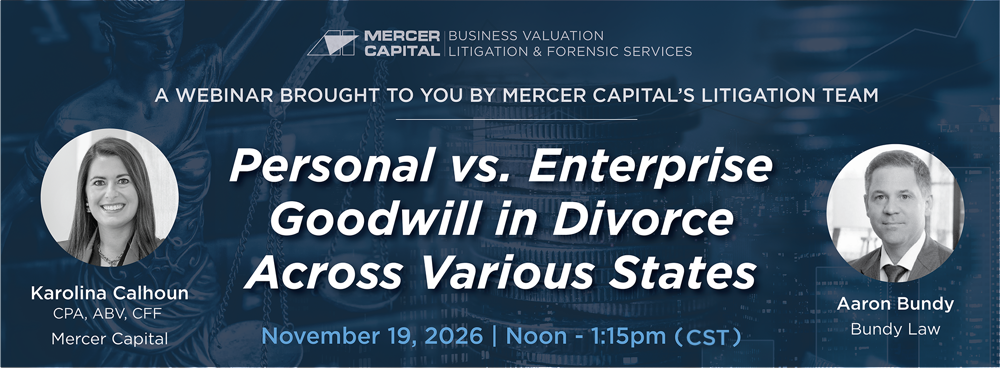
Title: Personal vs. Enterprise Goodwill in Divorce Across Various States
Date: November 19, 2026
Time: 10:00am - 11:15am (PST)
11:00am - 12:15pm (MST)
12:00pm - 1:15pm (CST)
1:00pm - 2:15pm (EST)
Cost: Complimentary
CLE/CPE Credit: This webinar has been approved for CLE and CPE credit. Click here for more information.
Presenters: Karolina Calhoun, CPA, ABV, CFF (Mercer Capital) and Aaron Bundy (Bundy)
Course Overview and Purpose
This webinar offers an in‑depth discussion of personal and enterprise goodwill from a valuation and legal perspective, with practical frameworks, valuation methodologies, case law, and examples.
This webinar will provide an in-depth examination of personal and enterprise goodwill from a national valuation expert’s perspective and that of a board-certified family lawyer and fellow of the American Academy of Matrimonial Lawyers (AAML) and International Academy of Family Lawyers (IAFL).
In divorce, personal goodwill can potentially be carved out of the marital estate as a separate asset, making this topic not only important, but also one that comes with complexities. As a result, this has become a bit of a “battleground” area in the valuations for divorce.
Personal goodwill differs from enterprise goodwill in that personal goodwill typically represents that value stemming from an individual and is an asset owned by the individual, not the business itself. This typically stems from an individual’s professional reputation, personal relationships with customers or suppliers, technical expertise, or other distinctly personal abilities, which provide economic benefit to a business. However, what if the relationships or other attributes of personal goodwill can be transferred? How does this impact the allocation to personal goodwill? There are many more nuances as well.
The webinar will cover valuation methodologies used to calculate personal and enterprise goodwill and will examine how and where personal goodwill is potentially also considered within a business valuation, noting tips for cautionary considerations of areas of potential double counting risk.
Attendees will review a handful of court rulings, and case studies will be used throughout the course to illustrate key principles and valuation approaches, from both valuation and legal perspectives.
Learning Objectives
Upon completion of this program, participants will be able to:
Identify the circumstances and reasons for determining goodwill between personal and enterprise
Recognize factors of personal vs. enterprise goodwill and differentiate goodwill from other intangibles
Apply the various methods used to calculate personal and enterprise goodwill
Analyze legal perspective and case law in a handful of states and examine how comparability must be considered among varying matters, fact and circumstances.
Course Outline
Introduction
What Is Value?
What Is Goodwill?
Three Potential Classifications of Goodwill
Why Does Personal vs. Enterprise Goodwill Matter?
Enterprise Goodwill vs. Personal Goodwill
Factors to Consider When Determining Personal Goodwill
Examples: Transferable Personal Goodwill vs. Non-Transferable "Pure" Goodwill
Factors to Consider When Determining Enterprise Goodwill
The Goodwill Transition: Personal to Business
Case Law
Considerations / Issues with Case Precedent
Lunt v. Lunt
Rosenberg v. Rosenberg
Conde Berrocal v. Conde
Cela v. Cela
Kim v. Kim
Travis v. Travis
Traczyk v. Traczyk
Mocnik v. Mocnik
Wilson v. Wilson
Williams v. Williams
Atherton v. Atherton
Jordan v. Jordan
Technical Discussion
Methodologies
Methods to Quantify Personal Goodwill
Question: Where Do You Apply %
Personal Goodwill Calculation Examples
Methods and Considerations for Calculating Personal Goodwill
The "MUM" Theory & Example
Simplified MUM
It's Not an Exact Science
Asset or Income?
The Double Dip ... ?
Areas to Consider Duplicative Instances for Same Consideration(s)
Tips & Takeaways
Question & Answer Section
This Webinar Has Been Approved for CLE and CPE Credit
CLICK HERE FOR CLE & CPE INFORMATION