Transaction Advisory, Investment Management

November 16, 2015

Are IPOs the New Down Round?

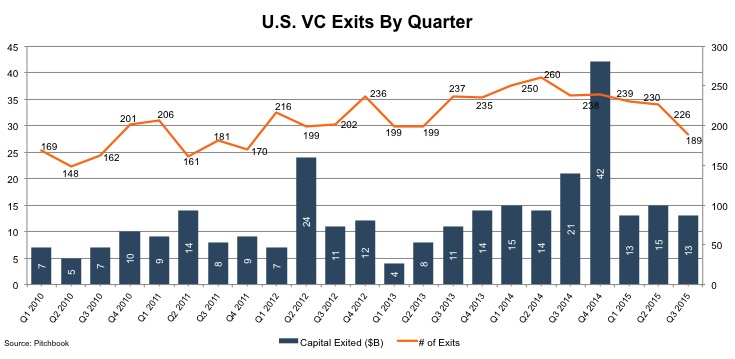
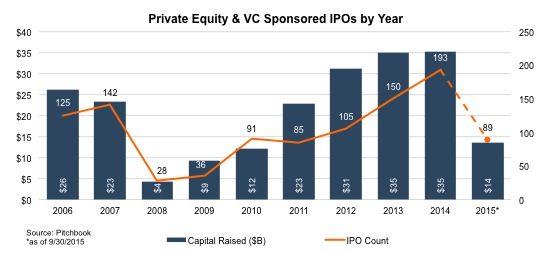
There's something about nature that abhors a vacuum. Right now that vacuum seems to be the imbalance between the public and private markets, with the latter attracting maybe too much interest since the credit crisis, at the expense of the former. Blame fair value accounting or Sarbanes-Oxley or the plaintiff's bar, but it has been some time since being public was actually considered a good thing. With interest running high in the "alternative asset space" and cheap debt for LBOs, the costs of being public have not been particularly worthwhile. This situation is not sustainable, and was never meant to be. Family businesses can stay private forever, but institutional investors eventually need the kind of liquidity that can only come from the breadth of ownership afforded by established public markets. Valuations are never really proven until exposed to bids and asks. So the circumstance in which private capital markets are considered more desirable than public markets is to express an illiquidity preference which is at odds with basic investment logic and the requirements of portfolio management. This cannot last, and the end – which appears to now be unfolding - will ripple throughout the asset management industry. Continuing a trend set into motion in the first half of 2015, third quarter IPO activity fell 34% year over year in 2015, while the median capital raised in private fundraising rounds hit a staggering $92 million. The tech industry in particular has suffered from a glut of capital in late-stage funding rounds, leading to a general hesitation to leave the safe (because it is comfortably theoretical) harbor of the private market. Only 11% of IPOs completed in 2015 so far involved tech companies, with a majority of them generating returns of less than 3% from their IPO prices, and producing a negative 15% from their debut closing prices. Within the tech industry, the sheer amount of capital inflow from the private market has distorted the usual hubbub around the IPO. Private valuations have quietly (and in some cases, publicly) reached levels unsustainable in the public market, and companies now face a reality in which going public may in fact devalue the company – at least from late financing rounds. US VC Exits by Quarter It seems only fitting that a company whose entire platform is built on the concept of impermanence should fall prey to the largest tech devaluation in the private market in 2015. Snapchat, a photo, text and video messaging app in which messages "self-destruct" in ten seconds or less, took a hit this past week when it was revealed that Fidelity Investments cut the value of its stake in the company by a whopping 25%. Earlier this year, BlackRock reduced its valuation of the cloud-storage software DropBox by 24%. However, as mutual funds, both Fidelity and BlackRock are obligated to mark their portfolios to market on a regular basis and disclose their valuations. In the third quarter, plummeting gas prices, unstable Asian markets, and whatever new catastrophe was going on with the Eurozone were in full effect. As a result, Twitter saw its stock price fall by 29%, while Facebook also had less than stellar returns. In all likelihood, Snapchat and DropBox were victims of market pressure rather than fundamental performance. It's a buyer's market in the IPO world, as 16% of IPOs downsized their debuts during the third quarter. Investors burned by lower than expected returns in the public market are putting pressure on startups to offer protections or lower their share price. Square, Inc., a mobile payment company founded in the heart of Silicon Valley, recently announced plans to sell 27 million shares in an IPO offering ranging from $11 to $13 per share, a significant discount from the company's October 2014 funding round that valued shares at $15.46. Granted, late stage Square investors are operating under a "ratchet" agreement (not the adjective kind). Square agreed to provide extra shares to certain investors if the company went public at a share price lower than the funding valuation the investor bought in at. If Square goes public at a share price below $15, the IPO will trigger the ratchet and diminish the outstanding shares. But terms don't fix price, as the "protection" afforded some Square investors will come from other Square investors. Ultimately, price is a zero sum game. Although startups do not often publicize whether investor protections are in place, it is an additional factor that has led several startups to postpone a planned IPO. LoanDepot is the latest company to get cold feet before their big day, as the company's prospective share price plummeted from a high of $18 per share to below $12. Instead of floating the lower valuation, LoanDepot walked, citing "market conditions" as the primary culprit behind the lower valuation. The IPO market has become a waiting game, as more and more startups have punted going public in favor of private capital. Whether the current market squeeze filters its way down to affect private valuations is only a matter of time. It's hard to imagine that a buildup of companies waiting to go public will somehow improve IPO pricing. PE VC Sponsored IPOs And it is hard to imagine this ending well. ZIRP and arguably over-regulated public markets have created a robust private market, but it is a market of "Level 3" assets without validation. If private markets seize, will they also become more regulated? If rates ever rise significantly, can financing get rolled over to sustain leveraged ownership? Can pension plans and endowments satisfy their funding liabilities without liquidity for alternative assets? At some point, liquidity preference is going to have to restore some reason for public ownership. Ultimately, though, the question is whether that comes from improvement in the public markets or deterioration in the private market.

Continue Reading

Eagle Ford – 2017/2018 Acquisition & Divestiture Commentary (1)
Eagle Ford – 2017/2018 Acquisition & Divestiture Commentary
Transaction activity in the Eagle Ford Shale has been fairly steady over the past 12 months, with the majority of transactions in the $100-300 million range.  The seller’s rationale has most often been about balance sheet management and re-allocation to other plays, usually the Permian Basin.  However, the Eagle Ford area has some quality economics of its own, which has been attractive to buyers.  Many argue it has the best shale production economics in the U.S. next to the Permian Basin.  These differing strategy based swaps have been at the heart of transaction flow.  This has also led to consideration that Devon may sell its Eagle Ford division in search of returns elsewhere.  The chart below, drawn from Mercer Capital’s newsletter, shows some details in regards to the transactions including some comparative valuation metrics.Magnolia – Blank Check Company forms a New South Texas ProducerThe largest transaction in the past year was the recent announcement of a special purpose acquisition entity (“SPAC”) coming to an agreement with certain Enervest controlled funds.  The result of the merger is the creation of a pure play Eagle Ford and Austin Chalk company with 360,000 net acres in South Texas.   The majority of that acreage is in what is known as the Giddings field which is an oil play in the Austin Chalk (mostly held by production).Break-evens are claimed to be in the low $30’s per barrel with one year (or less) paybacks in Karnes and Giddings field.  Magnolia1 is led by a former Occidental Petroleum executive, Steve Chazen, who has both short and long-term optimism for the opportunity.  Estimated EBITDA for 2018 is projected at $513 million including approximately $240 million of cash flow after capital expenditures.Highest and Best EconomicsDenver-based Sundance Energy Australia Ltd. struck a deal with Pioneer Natural Resource Co. to buy almost 22,000 acres and 1,800 boe/d of production in the Eagle Ford Shale, bolting on to an existing leasehold in South Texas.The pure-play Eagle Ford player agreed to pay $221.5 million for the leasehold, which runs through McMullen, Atascosa, LaSalle and Live Oak counties. The transaction would give Sundance 56,600 total acres in the play, with an inventory of 716 gross undrilled locations.Meanwhile, Pioneer was exiting to focus on the Permian Basin.  Pioneer announced in February it would put most of its resources going forward into the Permian and planned to sell nearly all “non-Permian” projects, including in the Eagle Ford, Raton Basin, and West Texas Panhandle.  The table below demonstrates why its desire to focus on the Permian was warranted.  However, one thing to note is that purchasing acreage in the Permian is much more expensive than the Eagle Ford, so drilling most likely needs to be based on existing acreage positions. Overall, the Eagle Ford’s economics are improving (Venado – a KKR backed Austin firm, made a $765 million purchase from Cabot that was based on this optimism). About 61,500 net acres of the Venado position, which is located primarily in Frio and Atascosa counties in South Texas, is operated and about 9,400 net acres are non-operated. Production from the properties during third-quarter 2017 was 15,656 barrels of oil equivalent per day. An interesting discussion on this acquisition can be found in this video: ?? Have a great week! Endnote1 In case one was wondering - Chip and Joanna Gaines are not involved.
Bankruptcy: An Overview Part 3 (1)
Bankruptcy: An Overview Part 3
From January through May of this year, 39 E&P companies and 31 oilfield services companies had to file for bankruptcy. This post is the last in a series of three aimed at helping those companies, and any others who may face bankruptcy in the future, to understand the valuation-related aspects of Chapter 11 restructuring. In the first post we highlighted two reorganization requirements tied to valuation. First, the plan should demonstrate that the economic outcomes for the consenting stakeholders are superior under the Chapter 11 proceeding compared to a Chapter 7 proceeding. Second, upon confirmation by the bankruptcy court, the plan must not be likely to result in liquidation or further reorganization. In the second post we explored in depth the consequences of the first requirement. Here we examine the importance of the second requirement.Cash-Flow TestFor a company that has followed the steps explained in the previous post, this second requirement represents the last valuation hurdle to successfully emerging from Chapter 11 restructuring. Even if a company shows that the restructuring plan will benefit stakeholders more than liquidation will, the court will still reject the plan if it is likely to lead to liquidation or further restructuring in the foreseeable future. To satisfy the court, a cash-flow test is used to analyze whether the restructured company would generate enough cash to consistently pay its debts. This cash-flow test can be broken into three parts.The first step in conducting the cash-flow test is to identify the cash-flows that the restructured company will generate. These cash-flows are available to service all the obligations of the emerging entity. Remember the discussion in the second post—a stream of cash-flows is developed using the DCF method in order to determine the reorganization value. Thus, in practice, establishing the appropriate stream of cash-flows for the cash-flow test is often a straightforward matter of using these projected cash-flows in the new model.Once the fundamental cash-flow projections are incorporated, analysts then model the negotiated or litigated terms attributable to the creditors of the emerging entity. This involves projecting interest and principal payments to the creditors, including any amounts due to providers of short term, working capital facilities. These are the payments for each period that the cash-flow generated up to that point must be able to cover in order for the company to avoid another bankruptcy.The cash-flows of the company will not be used only to pay debts, and so the third and final step in the cash-flow test is documenting the impact of the net cash-flows on the entire balance sheet of the emerging entity. This entails modeling changes in the company’s asset base as portions of the expected cash-flows are invested in working capital and capital equipment; and modeling changes in the debt obligations of and equity interests in the company as the remaining cash-flows are disbursed to the capital providers. A reorganization plan is generally considered viable if such a detailed cash-flow model indicates solvent operations for the foreseeable future.ConclusionAlthough the Chapter 11 process can seem like no more than a burden, a rigorous assessment of cash-flows and a company’s capital structure can help the company as it tries to develop a plan for years of future success. We hope that these past three posts explaining the key valuation-related steps of a Chapter 11 restructuring help managers realize this potential.However, we also understand that executives of oil and gas companies going through a Chapter 11 restructuring process need to juggle an extraordinary set of additional responsibilities—evaluating alternate strategies, implementing new and difficult business plans, and negotiating with various stakeholders. Given executives’ multitude of other responsibilities, they often decide that it is best to seek help from outside, third party specialists. Valuation specialists can relieve some of the burden from executives by developing the valuation and financial analysis necessary to satisfy the requirements for a reorganization plan to be confirmed by a bankruptcy court. Specialists can also provide useful advice and perspective during the negotiation of the reorganization plan to help the company emerge with the best chance of success. With years of experience in both oil and gas, and in bankruptcy, at Mercer Capital, we are well positioned to help in both of these roles. For a confidential conversation about bankruptcy proceedings and how we can help, please contact a Mercer Capital professional.
Does AI Spending Increase an RIA’s Value-or Just Reduce Its EBITDA?
Does AI Spending Increase an RIA’s Value - or Just Reduce Its EBITDA?
AI investment can create value for RIAs by improving capacity, growth, efficiency, and risk management, but the benefits must ultimately translate into stronger cash flow or reduced risk. Recurring AI costs generally remain operating expenses, making measurable adoption and returns critical to valuation.

Cart

Your cart is empty