Family Business Advisory Services

August 30, 2021

How Long Will It Take to Sell My Family Business?

That Depends on the Type of Transaction …

In this week’s Family Business Director, Tim Lee, ASA, Managing Director of Corporate Valuation and John T. (Tripp) Crews, III, Senior Financial Analyst, discuss expectations around the timeline for your business transition or sale and summarize key points to keep in mind when driving towards an internal or external sale.
Ownership transitions, whether internal among family and other shareholders or external with third parties, require effective planning and a team of qualified advisors to achieve the desired outcome. In this article, we examine some “typical” timelines involved in various types of transactions and expectations you can share with your family board members.

Internal Transitions

In this section, we discuss the importance of a buy-sell agreement in a sale to the next generation. Then we take a brief look at employee stock ownership plans as another potential avenue to an internal transition.

Sale to Next Generation

Internal transitions are often undertaken in accordance with provisions outlined in the Company’s existing or newly minted buy-sell agreement. A buy-sell agreement is an agreement by and between the family members and other shareholders of a closely owned business that defines the terms for the purchase when an owner requires liquidity. Buy-sell agreements typically specify how pricing is determined, including the timing, the standard of value used, the level of value, and the appraiser performing the valuation.

A buy-sell agreement is an agreement by and between the family members and other shareholders of a closely owned business that defines the terms for the purchase when an owner requires liquidity.

As a matter of practicality, the timing for transfers using an existing buy-sell agreement is often dependent on the readiness of financing and the service level of the assisting legal and valuation advisory professionals. Experience suggests this can take as little as four to eight weeks, but often involves processes that can require three to six months to carry out.

In circumstances where a newly crafted buy-sell agreement is being developed, you should expect a lengthier process of at least several months so that the attending financial, valuation, and legal frameworks are satisfactorily achieved.

Mercer Capital has published numerous books on the topic of buy-sell agreements, which readers of this article should avail themselves of, or better yet, contact a Mercer Capital valuation professional to make sure you get directed to the most useful content to assist in your circumstance.

Family-owned companies with an existing buy-sell agreement and those that obtain regular appraisal work, stand the best chance of achieving a timely process. Those Companies that are embarking on their first real valuation process, and that have stakeholders who require a thorough education on valuation and other topics, should allow for a deliberate and paced process.

In the event of an unexpected need for ownership transfer (death and divorce to name a few), it is sound advice to retain a primary facilitator to administer to the potentially complex sets of needs that often accompany the unexpected.

Employee Stock Ownership Plans

The establishment of an Employee Stock Ownership Plans (ESOP) is a necessarily involved process that requires a variety of analyses, one of which is an appraisal of the Company’s shares that will be held by the plan.

For a family business with well-established internal processes and systems, the initial ESOP transaction typically requires four to six months. In a typical ESOP transaction, the Company will engage a number of advisors who work together to assist the family and its shareholders in the transaction process. The typical “deal team” includes a firm that specializes in ESOP implementation, as well legal counsel, an accounting firm, a banker, and an independent trustee (and that trustee’s team of advisors as well).

Most modern-day ESOPs involve complex financing arrangements

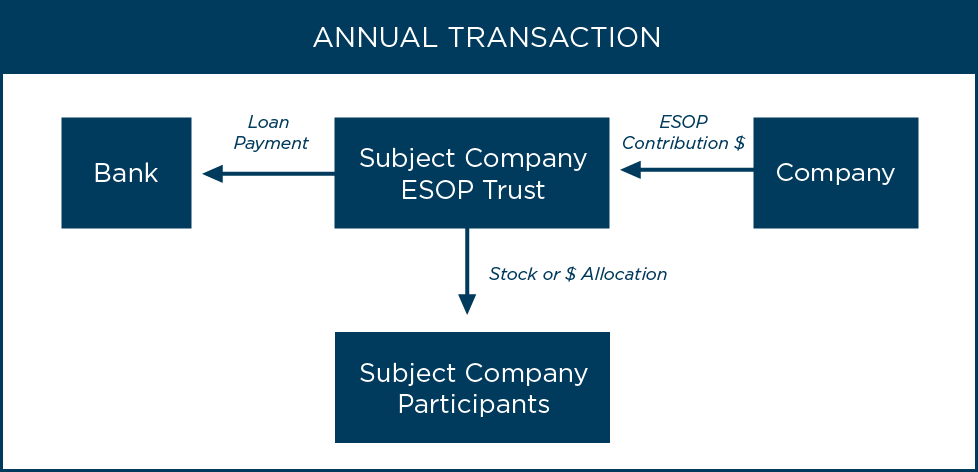
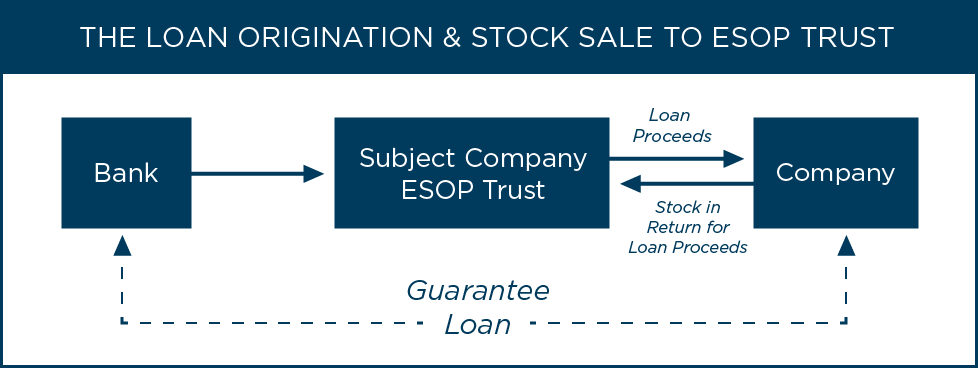
Most modern-day ESOPs involve complex financing arrangements including senior bankers and differing types and combinations of subordinated lenders (mezzanine lenders and seller notes). There are numerous designs to achieve an ESOP installation. In general, the Company establishes and then funds the ESOP’s purchase financing via annual contributions.

ESOPs are qualified retirement plans that are subject to the Employee Retirement Income Security Act and regulated by the Department of Labor. Accordingly, ESOP design and installation are in the least, a time consuming process (plan for six months) and in some cases an arduous one that requires fortitude and an appreciation by all parties for the consequences of not getting it right up front. The intricacies and processes for a successful ESOP transaction are many.

A more detailed assessment of ESOPs is provided here on Mercer Capital’s website.

The following graphics depict the prototypical ESOP structure and the flow of funds.
External Sales

Many families cannot fathom why success in business may not equally apply to getting a deal done. In most external transactions, there is a significant imbalance of deal experience: today’s buyers have often completed many transactions, while sellers may have never sold a business. Accordingly, family businesses need to assemble a team of experienced and trusted advisors to help them navigate unfamiliar terrain.

Without exception, we recommend retaining a transaction team composed of at least three deal-savvy players: a transaction attorney, a tax accountant, and a sell-side financial advisor. If you do not already have some of these capable advisors, assembling a strong team can require time to accomplish. Since many transactions with external buyers originate as unsolicited approaches from the growing myriad of private equity and family office investors, it is advisable to maintain a posture of readiness.

Up-to-date financial reporting, good general housekeeping with respect to accounts, inventory, real property maintenance, information technology, and the like are all part of a time-efficient transaction process. These aspects of readiness are the things that family business directors and managers can control in order to improve timing efficiency. As is often said in the transaction environment - time wounds all deals.

In most external transactions, there is a significant imbalance of deal experience ... accordingly, family businesses need to assemble a team of experienced and trusted advisors to help them navigate unfamiliar terrain.

Sellers doing their part on the readiness front are given license to expect an efficient process from their sell-side advisors and from buyers. We do caution that selling in today’s mid-market environment ($10-$500 million deal size) often involves facilitating potentially exhaustive buyer due diligence in the form of financial, legal, tax, regulatory and other matters not to mention potentially open-ended Quality of Earnings processes used by today’s sophisticated investors and strategic consolidators. A seasoned sell-side advisor can help economize on and facilitate these processes if not in the least comfort sellers as to the inherent complexity of the transaction process.

The sell-side advisor assists the family (or the seller’s board as the case may be) in setting reasonable value expectations, preparing the confidential information memorandum, identifying a target list of potential motivated buyers, soliciting and assessing initial indications of interest and formal bids, evaluating offers, facilitating due diligence, and negotiating key economic terms of the various contractual agreements.

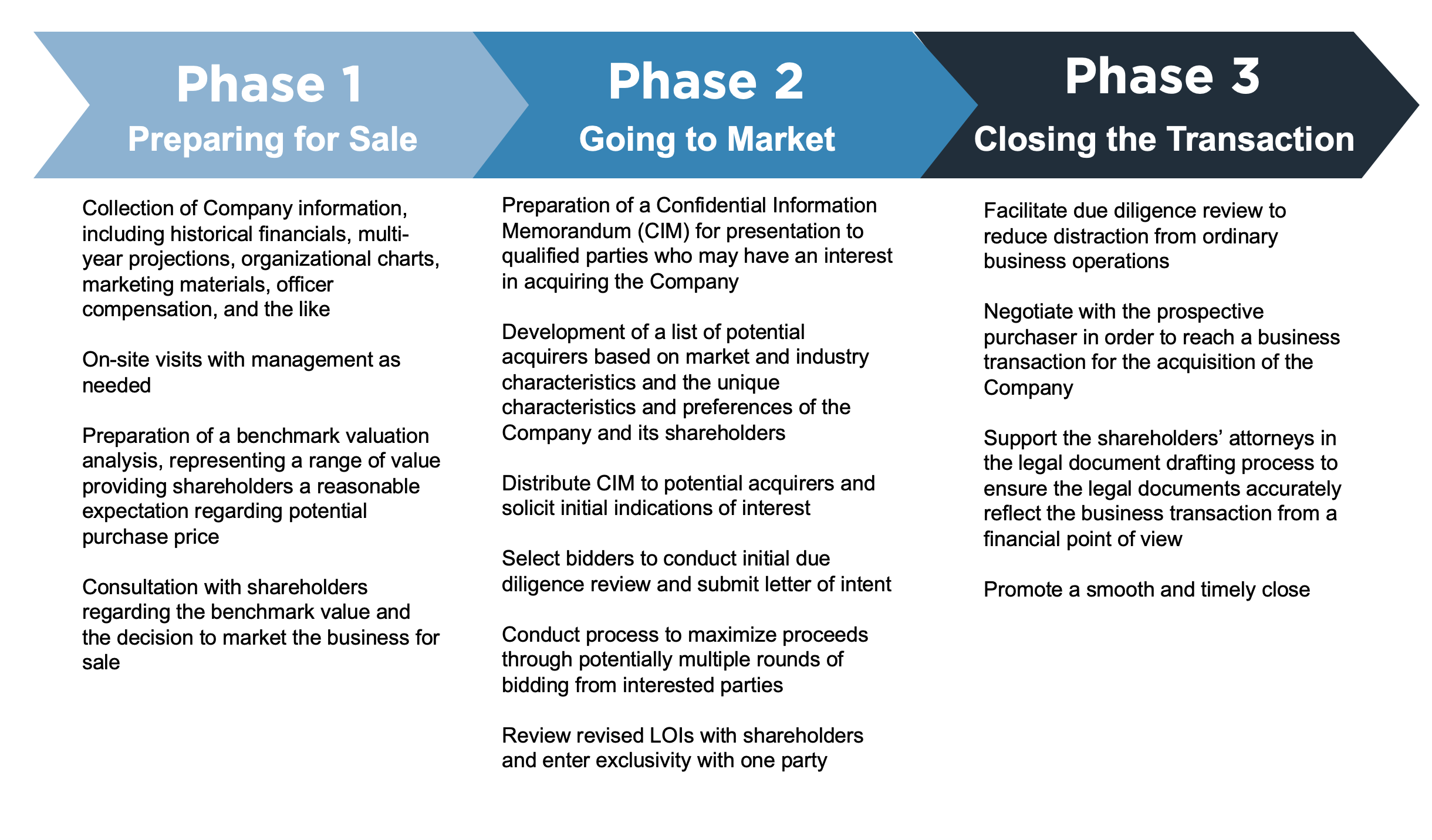
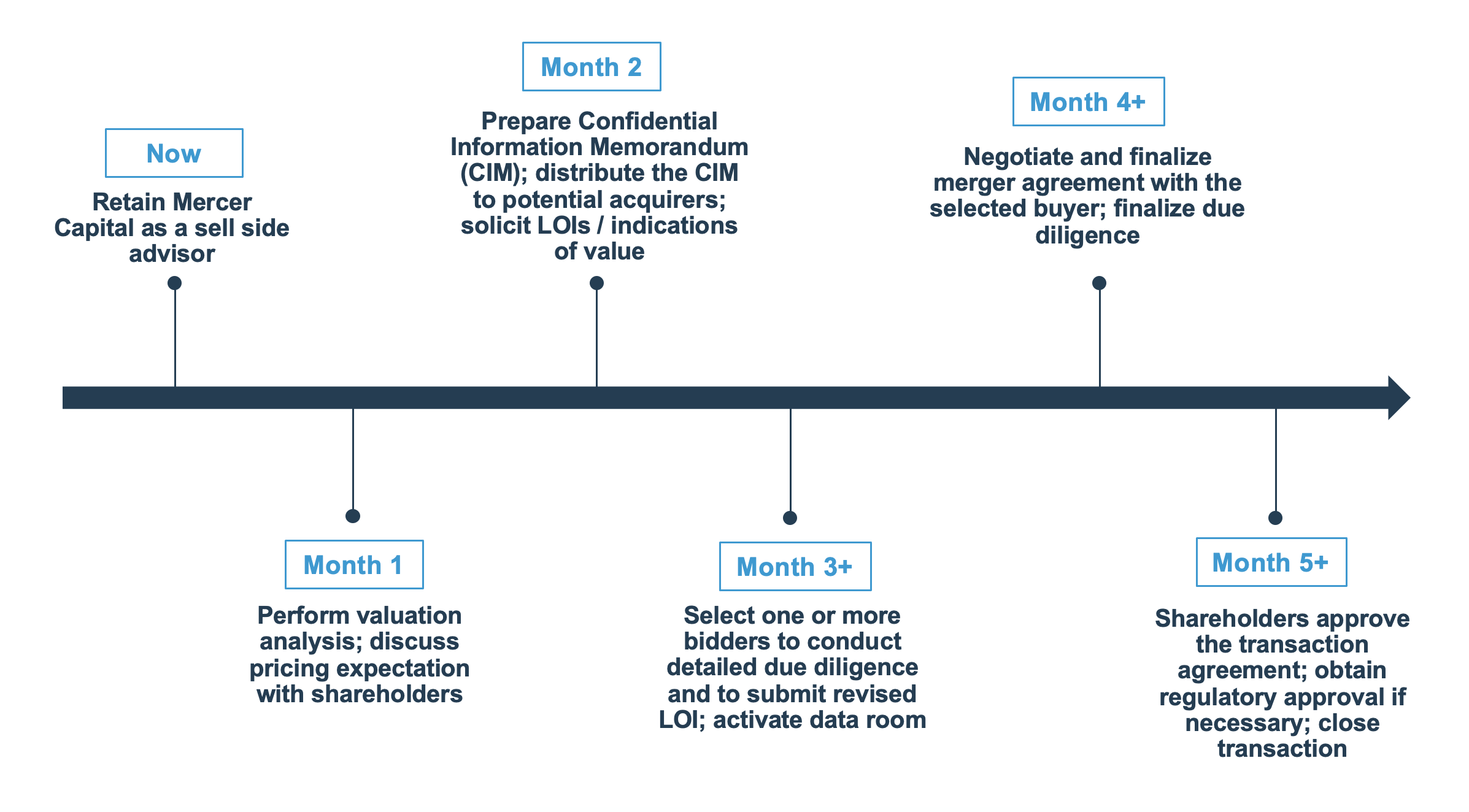
The typical external transaction process takes four to seven months and is done in three often overlapping and recycling phases. While every deal process involves different twists and turns on the path to consummation, the typical external transaction process takes five to seven months and is completed in the three phases depicted in the following graphics.
CLICK HERE TO ENLARGE THE IMAGE ABOVE
CLICK HERE TO ENLARGE THE IMAGE ABOVE

Conclusion

As seasoned advisors participating on both front-end and post-transaction processes, we understand that every deal is unique. We have experienced the rush of rapid deal execution and the trying of patience in deals that required multiple rounds of market exposure. A proper initial Phase I process is often required to fully vet the practical timing required for an external transaction process.

Mercer Capital provides transaction advisory services to a broad range of public and private companies and financial institutions. We have worked on hundreds of consummated and potential transactions since Mercer Capital was founded in 1982. We have significant experience advising shareholders, boards of directors, management, and other fiduciaries of middle-market public and private companies in a wide range of industries. Rather than pushing solely for the execution of any transaction, Mercer Capital positions itself as an advisor, encouraging the right decision to be made by its clients.

Our independent advice withstands scrutiny from shareholders, bondholders, the SEC, IRS, and other interested parties to a transaction. Our dedicated and responsive team stands ready to help manage your transaction.


Continue Reading

Mercer Capital Sponsoring and Speaking at the 5th Annual It’s All Relative Family Business Symposium
Mercer Capital is pleased to sponsor the 5th annual It’s All Relative Family Business Symposium, hosted by the Ole Miss Center for Innovation and Entrepreneurship. The 2026 program will focus on governance and boards, with sessions designed to help family business leaders think more strategically about structure, stewardship, and long-term continuity.The Symposium takes place September 15-16, 2026, in Flowood, Mississippi. Travis Harms, Tripp Crews, and Zac Lange will represent the firm at the Symposium.In addition, Travis Harms and Tripp Crews are also leading the Tuesday afternoon session on “Dividend and Redemption Policies,” which explores how family businesses can balance shareholder liquidity needs with the capital required to support the long-term health of the business.Travis Harms, CFA, CPA, ABV, is President of Mercer Capital and leads the firm’s Family Business Advisory Services Group. He focuses on financial education, valuation, and strategic financial consulting for multigenerational family businesses.Tripp Crews, ABV, is a Vice President with Mercer Capital and serves on the firm’s Transaction Advisory Services team, the Agribusiness Industry team, and the Family Business Advisory Services Group. He works on valuation and transaction-related matters for closely held businesses and family enterprises, with particular experience in agribusiness and ownership transition issues.Zac Lange, CPA, ABV, is a Vice President with Mercer Capital and serves on the firm’s Family Business Advisory Services Group. He focuses on supporting family businesses and litigants with valuation, financial analysis, and dispute-related matters, including corporate planning and reorganizations, financial reporting, and fairness opinions.Mercer Capital regularly works with family business owners and advisors on valuation and strategic financial matters involving ownership, governance, succession, and long-term planning. The firm is proud to support programs that bring family business leaders together for practical discussion and shared learning.Mercer Capital looks forward to connecting with attendees in Flowood and participating in this year’s Symposium. To learn more about the symposium, visit the event's website: https://olemisscie.com/family-business-26/
Eagle Ford – 2017/2018 Acquisition & Divestiture Commentary (1)
Eagle Ford – 2017/2018 Acquisition & Divestiture Commentary
Transaction activity in the Eagle Ford Shale has been fairly steady over the past 12 months, with the majority of transactions in the $100-300 million range.  The seller’s rationale has most often been about balance sheet management and re-allocation to other plays, usually the Permian Basin.  However, the Eagle Ford area has some quality economics of its own, which has been attractive to buyers.  Many argue it has the best shale production economics in the U.S. next to the Permian Basin.  These differing strategy based swaps have been at the heart of transaction flow.  This has also led to consideration that Devon may sell its Eagle Ford division in search of returns elsewhere.  The chart below, drawn from Mercer Capital’s newsletter, shows some details in regards to the transactions including some comparative valuation metrics.Magnolia – Blank Check Company forms a New South Texas ProducerThe largest transaction in the past year was the recent announcement of a special purpose acquisition entity (“SPAC”) coming to an agreement with certain Enervest controlled funds.  The result of the merger is the creation of a pure play Eagle Ford and Austin Chalk company with 360,000 net acres in South Texas.   The majority of that acreage is in what is known as the Giddings field which is an oil play in the Austin Chalk (mostly held by production).Break-evens are claimed to be in the low $30’s per barrel with one year (or less) paybacks in Karnes and Giddings field.  Magnolia1 is led by a former Occidental Petroleum executive, Steve Chazen, who has both short and long-term optimism for the opportunity.  Estimated EBITDA for 2018 is projected at $513 million including approximately $240 million of cash flow after capital expenditures.Highest and Best EconomicsDenver-based Sundance Energy Australia Ltd. struck a deal with Pioneer Natural Resource Co. to buy almost 22,000 acres and 1,800 boe/d of production in the Eagle Ford Shale, bolting on to an existing leasehold in South Texas.The pure-play Eagle Ford player agreed to pay $221.5 million for the leasehold, which runs through McMullen, Atascosa, LaSalle and Live Oak counties. The transaction would give Sundance 56,600 total acres in the play, with an inventory of 716 gross undrilled locations.Meanwhile, Pioneer was exiting to focus on the Permian Basin.  Pioneer announced in February it would put most of its resources going forward into the Permian and planned to sell nearly all “non-Permian” projects, including in the Eagle Ford, Raton Basin, and West Texas Panhandle.  The table below demonstrates why its desire to focus on the Permian was warranted.  However, one thing to note is that purchasing acreage in the Permian is much more expensive than the Eagle Ford, so drilling most likely needs to be based on existing acreage positions. Overall, the Eagle Ford’s economics are improving (Venado – a KKR backed Austin firm, made a $765 million purchase from Cabot that was based on this optimism). About 61,500 net acres of the Venado position, which is located primarily in Frio and Atascosa counties in South Texas, is operated and about 9,400 net acres are non-operated. Production from the properties during third-quarter 2017 was 15,656 barrels of oil equivalent per day. An interesting discussion on this acquisition can be found in this video: ?? Have a great week! Endnote1 In case one was wondering - Chip and Joanna Gaines are not involved.
Bankruptcy: An Overview Part 3 (1)
Bankruptcy: An Overview Part 3
From January through May of this year, 39 E&P companies and 31 oilfield services companies had to file for bankruptcy. This post is the last in a series of three aimed at helping those companies, and any others who may face bankruptcy in the future, to understand the valuation-related aspects of Chapter 11 restructuring. In the first post we highlighted two reorganization requirements tied to valuation. First, the plan should demonstrate that the economic outcomes for the consenting stakeholders are superior under the Chapter 11 proceeding compared to a Chapter 7 proceeding. Second, upon confirmation by the bankruptcy court, the plan must not be likely to result in liquidation or further reorganization. In the second post we explored in depth the consequences of the first requirement. Here we examine the importance of the second requirement.Cash-Flow TestFor a company that has followed the steps explained in the previous post, this second requirement represents the last valuation hurdle to successfully emerging from Chapter 11 restructuring. Even if a company shows that the restructuring plan will benefit stakeholders more than liquidation will, the court will still reject the plan if it is likely to lead to liquidation or further restructuring in the foreseeable future. To satisfy the court, a cash-flow test is used to analyze whether the restructured company would generate enough cash to consistently pay its debts. This cash-flow test can be broken into three parts.The first step in conducting the cash-flow test is to identify the cash-flows that the restructured company will generate. These cash-flows are available to service all the obligations of the emerging entity. Remember the discussion in the second post—a stream of cash-flows is developed using the DCF method in order to determine the reorganization value. Thus, in practice, establishing the appropriate stream of cash-flows for the cash-flow test is often a straightforward matter of using these projected cash-flows in the new model.Once the fundamental cash-flow projections are incorporated, analysts then model the negotiated or litigated terms attributable to the creditors of the emerging entity. This involves projecting interest and principal payments to the creditors, including any amounts due to providers of short term, working capital facilities. These are the payments for each period that the cash-flow generated up to that point must be able to cover in order for the company to avoid another bankruptcy.The cash-flows of the company will not be used only to pay debts, and so the third and final step in the cash-flow test is documenting the impact of the net cash-flows on the entire balance sheet of the emerging entity. This entails modeling changes in the company’s asset base as portions of the expected cash-flows are invested in working capital and capital equipment; and modeling changes in the debt obligations of and equity interests in the company as the remaining cash-flows are disbursed to the capital providers. A reorganization plan is generally considered viable if such a detailed cash-flow model indicates solvent operations for the foreseeable future.ConclusionAlthough the Chapter 11 process can seem like no more than a burden, a rigorous assessment of cash-flows and a company’s capital structure can help the company as it tries to develop a plan for years of future success. We hope that these past three posts explaining the key valuation-related steps of a Chapter 11 restructuring help managers realize this potential.However, we also understand that executives of oil and gas companies going through a Chapter 11 restructuring process need to juggle an extraordinary set of additional responsibilities—evaluating alternate strategies, implementing new and difficult business plans, and negotiating with various stakeholders. Given executives’ multitude of other responsibilities, they often decide that it is best to seek help from outside, third party specialists. Valuation specialists can relieve some of the burden from executives by developing the valuation and financial analysis necessary to satisfy the requirements for a reorganization plan to be confirmed by a bankruptcy court. Specialists can also provide useful advice and perspective during the negotiation of the reorganization plan to help the company emerge with the best chance of success. With years of experience in both oil and gas, and in bankruptcy, at Mercer Capital, we are well positioned to help in both of these roles. For a confidential conversation about bankruptcy proceedings and how we can help, please contact a Mercer Capital professional.

Cart

Your cart is empty